Showing posts with label safety. Show all posts

Friday, November 8, 2019

Using CRISPR to Fight Cancer

CAR-T therapy is a new form of cancer treatment that has been developed over the last few years. It works by modifying the T-cells of a patient to attack the cancerous cells in their body. While results have been promising in some leukemia and lymphoma patients, scientists hope to increase the effectiveness of the treatment. In order to do so, an additional three genes have been removed from the T-cells using CRISPR. Without these genes, the T-cells are able to attack the cancer cells more aggressively.

These initial trials were not testing effectiveness, but safety. The patients who received these modified T-cells showed no significant adverse signs after six months.

I think these results are exciting advancements for cancer treatments. We've known for a long time that each case of cancer is highly specific and it is impossible to create a single treatment that would cure the disease. CRISPR is allowing us to create specific solutions to these specific cases.

Links:
Article
CAR-T Information

Sunday, November 4, 2018

Concerns Arise about CRISPR Safety and Genome Vandalism

Media has a way of portraying science fiction and scientific technologies in an outrageous way, like changing humans into creatures through the use of CRISPR (clustered regularly interspaced short palindromic repeats) technology. CRISPR was seen in bacterial defense and was used to destroy DNA that entered the bacteria, but is now used to edit and alter specific DNA sequences. In humans, though, CRISPR can ultimately be used to treat improve health, improve food, treat cancers and diseases and potentially suppress the effect of environmental pollution.

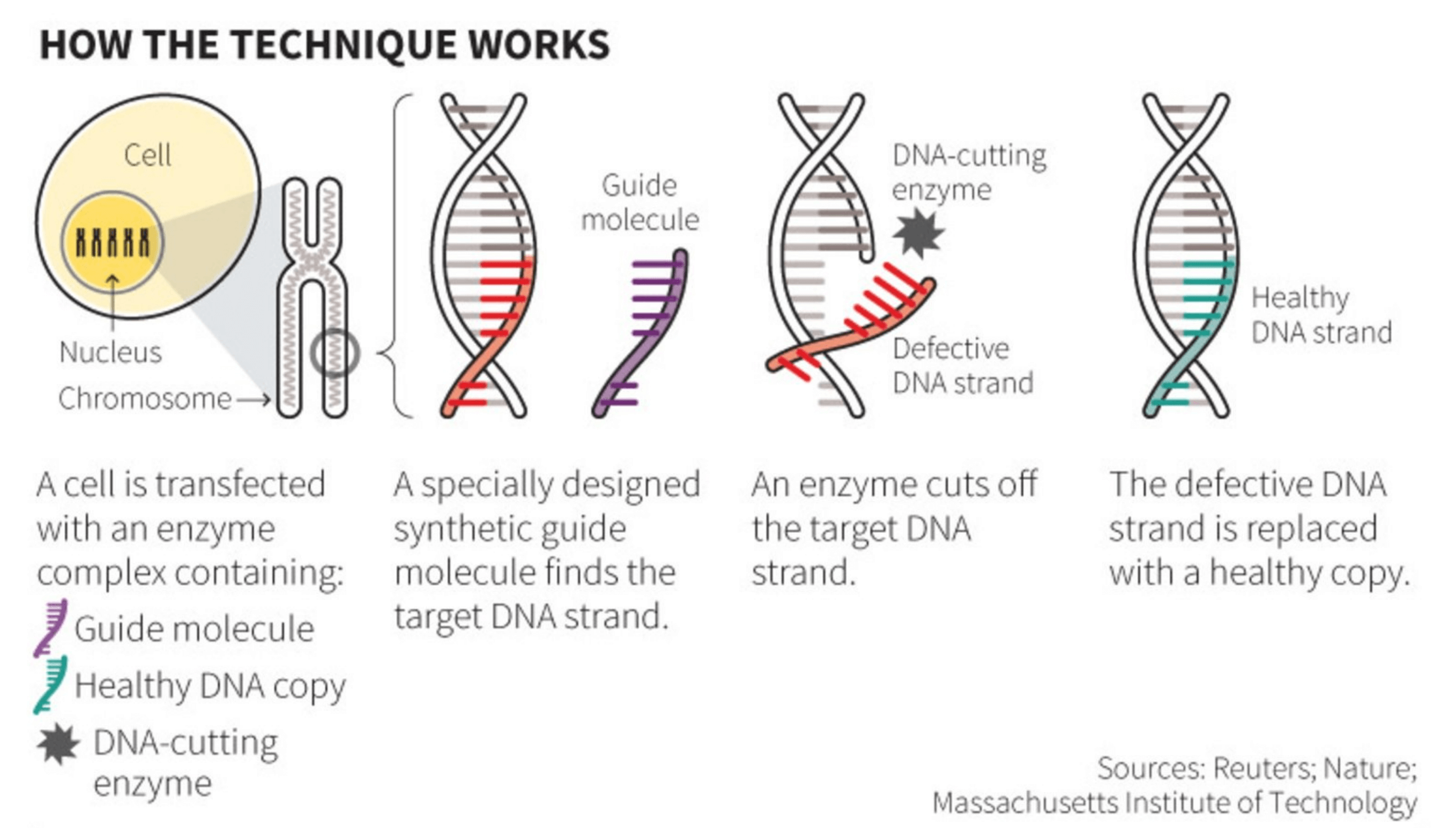
How CRISPR works.

However, concerns are arising on the problems with CRISPR. Some research suggests that the use of CRISPR at a specific sequence can damage DNA further along the chromosome, and this makes some caution to be needed when using CRISPR in clinical settings.

In humans, some trials have been planned to help treat human diseases. Two main trials have been planned in order to treat blood diseases (beta-thalassemia and sickle cell anemia). The trials use gene editing outside of the patient’s body (ex vivo). The thought is that researchers will take hematopoietic blood cells and edit them and “correct” them. Once the genes are corrected and the cells are normal, they will be reintroduced into the patient’s body to cure the disease. This theory has been used in China to test treatments on human cancers. Using immune T cells, researchers use CRISPR to stop the cells from producing a PD-1 protein, and allows T cells to now attack cancer cells.

Although in theory these treatments seem flawless, there are some concerns. Some studies suggest that using CRISPR may not be as effective as thought and have some side effects. One study says that when Cas9 cuts the DNA, it can potentially cause it to not be able to edit the DNA anymore. A bigger concern is about human exposure to CRISPR. Since CRISPR is a protein found in bacteria, many individuals may have already been exposed to it from bacterial infections, which causes the body to develop an immune response to the protein and therefore are unable to benefit from the CRISPR therapies. The last concern is that CRISPR is not totally accurate and may have the potential to cut the wrong DNA sites and cause disease.

I think that CRISPR is a discovery that changed genetics and clinical methods of treatment for diseases. Although it may have its impurities and potential dangers, I think that the CRISPR methods are one of the best out there as of now. There is inadequate research on the negative impacts of CRISPR after a long period of time. What if there are more implications for CRISPR after years? In addition, the use of CRISPR has ethical implications of potentially causing cancers and other diseases. Is it ethical to use CRISPR in humans when there is the potential of causing cancers and other diseases? Using the ex vivo method can help to identify the negatives before placing the cells back into the patient’s body, but there is still the possibility of cancers arising. Overall, I still think CRISPR is the best genetic engineering technique right now and the effects will not be truly known until it is used to treat human diseases more commonly. 

Monday, March 23, 2015

FDA says Genetically Modified Apples and Potatoes are Safe to Consume


                  Okanagan Specialty Fruits developed the Article apple, and J.R. Simplot Company developed the Innate Potato. Both crops were designed to defy browning when sliced or bruised, and the potato was reduced of its potential cancer-causing chemical when fried. Although the F.D.A. approves of the genetically engineered apples and potatoes to be safe and nutritious in comparison to the non-engineered plant, there are still many consumers and environmental groups that oppose. These groups have warned restaurants and food companies against using engineered crops while other groups think that accepting engineered foods will taint the image of the organically made crops. Mostly all biotech crops go through the F.D.A.’s safety food review even though it is optional. The opposing biotech parties argue that the F.D.A. reviews are not adequate, but the F.D.A. assures that their evaluations are in-depth. The F.D.A. even advises that the biotech companies disclose information to their consumers by labeling. In the meantime, the discussion of what should appear on the labels, and when the labels would be used is in process. Currently, it is suggested that the label should include an appealing description of the trait without the inclusion of the crop being “genetically engineered”. The primary developers believe that when they sell the seed of the biotech potatoes and apples to growers, they are then not responsible for ensuring how the crops or products using the crops would be labeled. 
                  I believe that both the favoring and opposing groups have some valid points. Currently, there are many GMO and GMO containing products in the market. For example high fructose corn syrup and soy beans are typical GMO's where the majority of its crop type is genetically modified. I think that biotech foods are not bad for humans just because they were not naturally formed by nature. The only question I have is that if a fruit does not brown, how does a person know if its still good to eat? Other than that, I believe that non-browning crops have the potential to be a positive thing for society. 

Original link: http://www.nytimes.com/2015/03/21/business/gene-altered-apples-and-potatoes-are-safe-fda-says.html?ref=science

Additional link: http://www.dailyfinance.com/2013/11/21/foods-give-up-avoid-eating-gmo/#!fullscreen&slide=1585612

Additional link 2: http://www.nongmoproject.org/learn-more/what-is-gmo/