Showing posts with label nucleus. Show all posts
Friday, November 20, 2015
Cells compact their DNA when starved of oxygen, nutrients
Many diseases like a heart attack, stroke, and cancer can cause long-term effects to the body. Because there is lack of blood supply to the heart and brain, it causes the cells to be deprived of oxygen and nutrients. This condition is also known as Ischemia and oxygen starvation as hypoxia.
In a new study, researchers reveal that when cells undergo starvation of oxygen, the DNA in the nucleus becomes compacted. The DNA compresses into tight clumps, which prevents gene-reading molecules from accessing the genetic code. This is a factor to why disease like a heart attack or stroke can occur because the cell eventually stops functioning.
Scientists are now using new technology to figure out ways to prevent DNA from compressing. The new technology is a development of super-resolution light microscopy. Since the genetic code is tightly packed inside of the chromatin, scientists do not yet have the technology to look at the nanostructures of chromatin. Instead they use a dye that binds to the DNA and the dye allows them to look inside and around the chromatin and define the location of molecules in the DNA.
"What is interesting to me is the cause of the cell to stop functioning. Because the DNA becomes compressed into tight clumps, it is hard for the gene-reading molecules to access the genetic code. If the genetic code is not accessed, then there is no protein built, which could possibly code for a specific function. If there is no cell function, then the cell will die. This makes me think what causes a cell to undergo starvation? If there is treatment to keep the cells from starvation, then the DNA will not compress."
Click HERE for the article!
Labels:
cancer,
cells,
DNA,
genetic code,
Heart attack,
nucleus,
oxygen,
protein,
stroke
Thursday, November 12, 2015
Cells Compact DNA When Oxygen Starved
In a recent study, researchers and scientists from the Institute of Molecular Biology at Johannes Gutenberg University Mainz in Germany have discovered that when a cell suffers from hypoxia or lack of nutrients, the DNA in the nucleus packs tightly together and forms clumps instead of being loose when the cell is not being starved of these. If this happens and blood flow is restricted like in cases such as a heart attack or stroke, the gene-reading molecules will not be able to access the genetic code which will then cause the cell to stop working.
These scientists used a new technique, called single-molecule localization microscopy, in order to look inside mammal cells to see their chromatin complexes in order to find locations of each DNA molecule in the cell. This is done by using blinking dyes that bind to DNA. The chromatin complexes are looked at since chromatin tightly packs together DNA and proteins. When the chromatin becomes restricted and compacted when there is low oxygen and nutrient levels, transcription is reduced. Along with transcription being reduced, the mobility of linker histone H1 is also reduced. By looking at the results of this technique, different ways in which to stop the DNA from compacting can be more easily found.
The two articles that deal with this study that I found were very interesting, seeing as though a heart attack or stroke victim can still deal with more things detrimental to their health even though they survived the event. Knowing that the DNA compacts when oxygen and nutrient deprived, scientists and researchers can now work to prevent it from happening. These events happen every day to people around the world and to know something now that we did not know years or even months before the study was completed is a huge step forward in the right direction in making the long-term damage as short as possible.
Click here for the original article
These scientists used a new technique, called single-molecule localization microscopy, in order to look inside mammal cells to see their chromatin complexes in order to find locations of each DNA molecule in the cell. This is done by using blinking dyes that bind to DNA. The chromatin complexes are looked at since chromatin tightly packs together DNA and proteins. When the chromatin becomes restricted and compacted when there is low oxygen and nutrient levels, transcription is reduced. Along with transcription being reduced, the mobility of linker histone H1 is also reduced. By looking at the results of this technique, different ways in which to stop the DNA from compacting can be more easily found.
The two articles that deal with this study that I found were very interesting, seeing as though a heart attack or stroke victim can still deal with more things detrimental to their health even though they survived the event. Knowing that the DNA compacts when oxygen and nutrient deprived, scientists and researchers can now work to prevent it from happening. These events happen every day to people around the world and to know something now that we did not know years or even months before the study was completed is a huge step forward in the right direction in making the long-term damage as short as possible.
Labels:
chromatin,
DNA,
genetic code,
Heart attack,
hypoxia,
nucleus,
stroke,
transcription
Wednesday, November 26, 2014
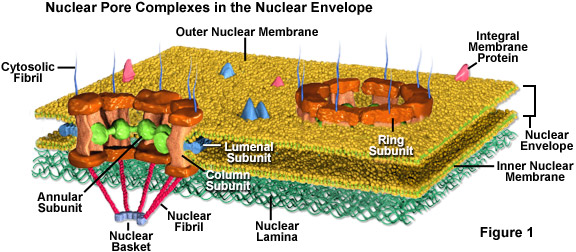
Nuclear Pores Concept Understood to Protect Cell From Viruses
Scientists at University College London have uncovered the secrets behind how the structure and function of nuclear pores work. More specifically, they discovered how the nucleus selectively block particular molecules to protect genetic material from being manipulated. This major discovery can now enable scientists to try to manipulate and create new drugs to stop viruses from entering (to infect genetic code).
For years scientists have been trying to figure out how the nuclear pores function, but now, they have the answer. They found out that the proteins that are in the envelope of the membrane are like thick "spaghetti" that in a way move themselves by chemical reaction to react to certain incoming molecules. Big molecules like mRNA enter the nucleus by nucleus transport receptors which act like "chaperones". Nuclear proteins will then tighten and unwind to regulate the stiffness of the nuclear membrane. These nucleus transport receptors basically lubricate the site of entrance to let the mRNA and other big molecules to get into the nucleus at a very fast rate.
The way they found this out was through atomic force microsopy (or AFM for short) to study these pores. It basically scans the surface as the articles says like "braille" to project an image on a screen.
Viruses get their way into the nucleus by tricking these pores, and by learning the genetic code viruses use to get in there, scientists can create special drugs to counter the virus coding from entering.
I found this article interesting because I love revolutionary discoveries that will enhance the survival of the human race and its generic understanding about how the human body functions. I'm guessing that it will not be long until scientists figure out a way for humans to survive ANY nuclear virus that eventually destroys the body.
Original: http://www.sciencedaily.com/releases/2014/11/141124111819.htm
Supporting Article: http://www.sciencedaily.com/releases/2014/02/140225143939.htm
Monday, November 24, 2014
How Our Bodies Keep Unwanted Visitors Out of Cell Nuclei
Through the use of atomic force microscopy, in which a small needle is run over substance in order to measure
its shape and hardness, the nuclear pores of frog eggs were examined. This
method allows for an extremely accurate map of a subject that is too small for
optical microscopy to be used. Using this method, it was determined that the
proteins that exist in the center of the pores tangle over each other to form a
barrier. Due to this, smaller molecules are able to easily fit through these
pores through passive diffusion and reach the inside of the nucleus. However,
larger molecules such as messenger RNA require a chaperone molecule in order to
pass through the barrier. The chaperone molecules are able to lubricate the
barrier inside of the pores and allow these larger molecules to fit through.
I find this article to be interesting
because it shows that there is still much to learn about the cell even though
it has been extensively studied already. However, as technology becomes more
advanced, these minute yet important details about the cell will continue to be
discovered and studied. Research like this is crucial because it can also lead
to the development of new antiviral drugs or better delivery mechanisms for
gene therapy.
Thursday, April 11, 2013
what effect does protein have on the nucleus?
This article discusses the use of protein to keep order in the nucleus of the cell. Dr Patrick Heun used fruit flies to test this theory. One protein plays a major role which is NLP protein. It helps bind the chromosomes near the nucleus. If that protein is missing DNA damage in the cell increases and cell division is impaired. This protein also plays an important role in centromere positioning. Where the protein binds to the chromosome depends on DNA packaging. There is a process called gene knock down, which scientist use to eliminate the protein NLP. By doing so, the centromeres fall apart and distribute themselves through the nucleus. There is an article attached of the geen knockdown in mice by using lentiviral vectors expressing small interfering RNA.

article: http://www.sciencedaily.com/releases/2013/04/130404121930.htm
other article: http://www.ncbi.nlm.nih.gov/pmc/articles/PMC149921/
article: http://www.sciencedaily.com/releases/2013/04/130404121930.htm
other article: http://www.ncbi.nlm.nih.gov/pmc/articles/PMC149921/
Subscribe to:
Posts (Atom)