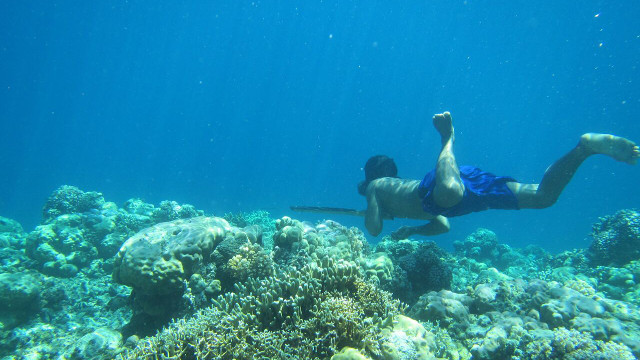
The article Free Divers From Southeast Asia Evolved Bigger Spleens is about the Bajau people, also known as sea nomads, that have adapted larger spleens overtime which increases the number of oxygenated red blood cells when diving. The genetic variant increases their endurance when free diving in open ocean. This natural selection in humans is believed to have occurred over hundreds possibly thousands of years. The Bajau people spend the majority of their day in the ocean, diving for fish and shellfish. This has been their method of hunting for over a thousand years now. The body has a number of tricks that allows them to increase their time they can spend under water. One is the increase in red blood cell production which expands lung capacity and more efficiently delivers oxygen to the tissues and organs in the body. The adaptation that is rare and distinct to these groups of people is the increased size of the spleen. The larger spleen stores oxygenated red blood cells and contracts while diving to release the blood cells into the blood circulation throughout the body.
A graduate student from the University of Copenhagen, Melissa Ilardo, sought out to understand whether the Bajau had their own technique to deal with hypoxia while diving. She used an ultrasound machine to measure the spleen of 43 Bajau and 33 Saluan participants (unrelated to Bajau population). She was interested in spleen size, because she knew the spleen could get quite large in diving marine mammals. Melissa Ilardo also took saliva samples for genomic sequencing. Even while taken into account age, gender, and weight, Melissa Ilardo and her team found that the spleens of the Bajau people were on average 50% larger than the Saluan. The team then compared the genomic sequences of the Bajau and Saluan people to genomic sequences to those of Han Chinese (control - unrelated group). While scanning the variants, they were able to identify 25 polymorphisms unique to the Bajau genomes. This shows the natural selection is definitely at play here. A phylogenetic tree was created which calculated that the Bajau and Saluan people diverged about 15,000 years prior.
One of the top variants of interest was one adjacent to the gene for PDE10A which is involved in regulating smooth muscle contraction, including the muscles that surround the spleen. The teams top hit was a variant adjacent to the gene BDKRB2 which is the only gene that was previously associated with diving response of humans, but not spleen size. They do not yet know how it affects the diving reflux and more studies would need to be done in the future. I found this study and analyses to be extremely interesting. It gives evidence of natural selection among the human species and a timeframe for how long it takes for these adaptions to make way. I am excited to see where they take this study in the future and what more is to come from it.

