Showing posts with label messenger RNA. Show all posts

Sunday, December 7, 2025

Hidden alarm system in the cell discovered through the ZAK Molecule

     Scientists at Ludwig-Maximilians-Universität München have discovered that ribosomes, best known for their part in creating proteins, also act as a built-in alarm system that monitors cellular health. When normal protein production is interrupted by stressors like damaged messenger RNA, nutrient shortages, or viral infection, ribosomes can stall and collide with one another. These collisions are not a coincidence. Instead, they serve as a danger signal that activates a protective pathway inside the cell known as the ribotoxic stress response.

    Researchers were able to find that a key protein called ZAK senses these ribosome collisions. When ZAK binds to the stalled ribosomes, it becomes activated and triggers a chain of molecular signals that helps the cell respond to the stress. Depending on how severe the damage is, the cell might attempt to repair itself, slow down protein production, or initiate programmed cell death to prevent further harm. Using advanced imaging techniques like cryo-electron microscopy, the team was able to analyze how ZAK interacts with collided ribosomes at the molecular level.

                                  Ribosome collisions act as an early danger sign within cells an trigger a response.

       This discovery alters the way scientists understand ribosomes, revealing that they are not just protein factories but also significant sensors of cellular stress. Through showing how cells detect internal damage so quickly, the study provides new insight into how stress responses, inflammation, and disease development may be regulated. These findings could eventually contribute to new therapeutic strategies for conditions linked to chronic cellular stress or abnormal protein production.

https://www.cell.com/molecular-cell/fulltext/S1097-2765(20)30189-1 

Saturday, October 31, 2015

"AAAAA Is for Arrested Translation"


In a post by Ruth Williams focusing on recent research results, a study conducted on the halt of protein translation found that multiple adenosine nucleotides in messenger RNA was the reason behind the interruption. The finding contradicted the idea that protein sequences were responsible. The importance behind the failure of the ribosome protein to translate the codon sequences of mRNA into amino acids lies on the fact that the mRNA and developing protein are degraded during the process.
Due to Rachel Green and her research team at Johns Hopkins University School of Medicine, it was found that there is a significance in the difference between mRNA sequences and associated amino acids. Bacterial ribosomes were found to halt on lysines in the presence of AAA codons as opposed to AAG codons. The research team, utilizing human cells, went on to find that reporter gene constructs with lysines encoded by AAA sequences had far less protein production then lysines encoded by AAG, as well as arginines encoded by AGG and CGA codons.
Two outcomes from this research were particularly important- bioinformatic analyses of vertebrate genomes proposed that the AAA codons are not favored evolutionary, and previously thought silent mutations may actually alter protein expression. The AAA sequence was thought to not be favored, being that the chance of lysines encoded by such a sequence was much lower than the chance of being encoded by AAG codons. The rejection of the silent mutation inference to instead be of greater importance, stemmed from mutating AAG codons to AAA codons and finding a decrease in protein expression. The opposite result was found from mutating AAA codons to AAG codons.
It is particularly interesting how failing to discover one tiny aspect of the translation process could later result in finding reasons behind translation failure. This may suggest that silent mutations are even more rare than previously thought, and that perhaps these mutations are simply misunderstood rather than inactive in many processes.

Monday, November 24, 2014

How Our Bodies Keep Unwanted Visitors Out of Cell Nuclei

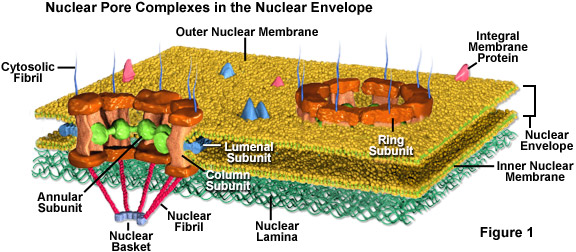
     Inside of each cell in the human body is a singular nucleus that contains the DNA of that person. In order to keep this DNA protected, the nuclear membrane surrounds the nucleus and keeps unwanted material on the outside. However, molecules that are vital for the nucleus to function are able to pass through the membrane, whereas others are unable to. This is because of the selective permeability of the nuclear membrane, due to the nuclear pores that line its surface. These pores are able to filter substances based on either physical properties such as size or chemical properties like polarity.
     Through the use of atomic force microscopy, in which a small needle is run over substance in order to measure its shape and hardness, the nuclear pores of frog eggs were examined. This method allows for an extremely accurate map of a subject that is too small for optical microscopy to be used. Using this method, it was determined that the proteins that exist in the center of the pores tangle over each other to form a barrier. Due to this, smaller molecules are able to easily fit through these pores through passive diffusion and reach the inside of the nucleus. However, larger molecules such as messenger RNA require a chaperone molecule in order to pass through the barrier. The chaperone molecules are able to lubricate the barrier inside of the pores and allow these larger molecules to fit through.

     I find this article to be interesting because it shows that there is still much to learn about the cell even though it has been extensively studied already. However, as technology becomes more advanced, these minute yet important details about the cell will continue to be discovered and studied. Research like this is crucial because it can also lead to the development of new antiviral drugs or better delivery mechanisms for gene therapy.