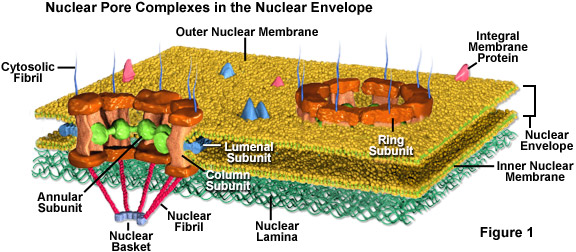
 Scientist have recently begun putting a new technology to use to study the micro-physiology of our cells. With the aide of an atomic force microscope (AFM), researchers from Basel University have been able to observe the nuclear pores that control traffic through the nucleus of a cell. The most notable discovery from this research was the ability of these pores to prevent unwanted chemicals from entering the cell. This was observed via microscopic tentacles that monitor movement in and out of the nucleus. The AFM does not work like any regular microscope. This machine uses a fine-tipped feeler to sense the environment in which it has been emmersed. This method and information could prove incredibly useful for the study of carcinogens and how they enter the nucleus.
Showing posts with label atomic force microscopy. Show all posts
Showing posts with label atomic force microscopy. Show all posts
Friday, May 6, 2016
New Technology Applied to Studdying Nuclear Pores
Scientist have recently begun putting a new technology to use to study the micro-physiology of our cells. With the aide of an atomic force microscope (AFM), researchers from Basel University have been able to observe the nuclear pores that control traffic through the nucleus of a cell. The most notable discovery from this research was the ability of these pores to prevent unwanted chemicals from entering the cell. This was observed via microscopic tentacles that monitor movement in and out of the nucleus. The AFM does not work like any regular microscope. This machine uses a fine-tipped feeler to sense the environment in which it has been emmersed. This method and information could prove incredibly useful for the study of carcinogens and how they enter the nucleus.

Monday, November 24, 2014
How Our Bodies Keep Unwanted Visitors Out of Cell Nuclei

Through the use of atomic force microscopy, in which a small needle is run over substance in order to measure
its shape and hardness, the nuclear pores of frog eggs were examined. This
method allows for an extremely accurate map of a subject that is too small for
optical microscopy to be used. Using this method, it was determined that the
proteins that exist in the center of the pores tangle over each other to form a
barrier. Due to this, smaller molecules are able to easily fit through these
pores through passive diffusion and reach the inside of the nucleus. However,
larger molecules such as messenger RNA require a chaperone molecule in order to
pass through the barrier. The chaperone molecules are able to lubricate the
barrier inside of the pores and allow these larger molecules to fit through.
I find this article to be interesting
because it shows that there is still much to learn about the cell even though
it has been extensively studied already. However, as technology becomes more
advanced, these minute yet important details about the cell will continue to be
discovered and studied. Research like this is crucial because it can also lead
to the development of new antiviral drugs or better delivery mechanisms for
gene therapy.
Subscribe to:
Posts (Atom)