Showing posts with label neurotransmitter. Show all posts

Monday, October 24, 2022

Are Mental Illnesses Inheritable?


The question of whether mental illness is genetic tends to be a complicated discussion. It is most likely caused by a combination of genetic and environmental factors. Conditions like depression and schizophrenia tend to be more closely related to genetics than some other disorders. There is still much to be explored between the relationship of mental illness and genetics. However, it is usually caused by a combination of four main factors: genetics, environmental, psychological, and biological factors. While there is no current genetic test to determine if you carry a specific gene that is likely to lead to a specific mental illness, one's best bet is to review their familial line to determine their genetic risks for developing a mental illness. With this being said, if you do have a close family member with a particular illness that does not mean you will develop it, there is just an increased risk.  

Focusing specifically on depression, it is one of the most common mental illnesses that affects nearly 350 million people around the world. The genetic components of this condition are still being explored, however it is heavily involved with genes that regulate neurotransmitters (like serotonin transporter genes). Overall chemical imbalances, childhood trauma, life stressors and drug and alcohol abuse can also contribute to the development of mental illnesses. While we still have a lot we don’t know, there are links between genetics and mental illnesses. By studying more about these contributing factors, we can learn how to manage our mental illnesses and live a balanced life.  

Sunday, December 2, 2018

Schizophrenia symptoms alleviated in model mice


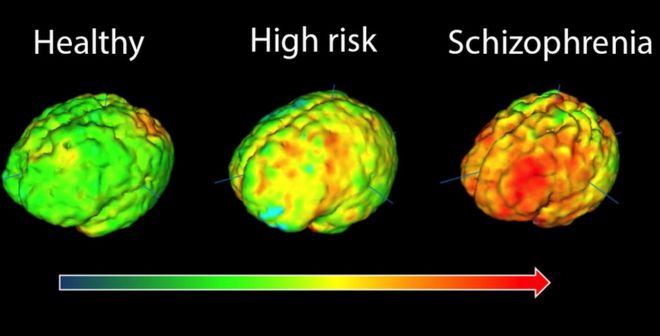
Researchers from Case Western Reserve University, studied a brain cell receptor called ErbB4. This specific receptor is altered in adults who have schizophrenia. The purpose of this brain receptor is to maintain a neurotransmitter, GABA, which prevents brain cells from overreacting as well as keeping fear and anxiety at normal levels. In this specific study the researchers engineered two new mice models of schizophrenia, the first mouse model  was treated with a chemical that switches the "off" gene encoding ErbB4 while in the second mouse model the receptor was missing from the beginning which in turn hampered brain cell development. The researchers found that in restoring the brain receptor in the first mouse model the mice had reduced hyperactivity and normalized fear responses. This information was super useful in the treatment of patients because researchers believe by adding or restoring ErbB4, it could reduce symptoms of schizophrenia in patients.

Image result for schizophrenia


References:
https://www.webmd.com/schizophrenia/schizophrenia-symptoms
https://www.sciencedaily.com/releases/2018/11/181130120442.htm

Sunday, March 12, 2017

I Can See Clearly Now the GABA is Almost Gone! - How Zebrafish Recover From Blindness


A recent study funded by the National Eye Institute found a link between the neurotransmitter GABA, or gamma-aminobutyric acid, and recovery from blindness in zebrafish.  For some time now, scientists were aware of the zebrafish's ability to recover from loss of vision that would normally blind humans permanently.  This is due to the zebrafish having a miraculous ability to regenerate cells in the retina.  Prior studies showed that dying retinal cells produced signals to trigger Muller glia, which revert back to an undifferentiated state and divide.into new cells.  Studies in mice on the brain and pancreas indicated that GABA could play a role in the regeneration process, where low levels signaled stem cells to  divide.  The researchers of the current study, therefore, hypothesized that GABA in zebrafish could be a factor in the regeneration of retinal cells.  To test their theory they injected zebrafish with GABA inhibitors.  They found that these fish responded with retinal cell regeneration.  Fish with retinal damage that were given high levels of GABA, on the other hand, displayed little to no regeneration.  These findings clearly support the hypothesis that GABA plays a very important roll in the regeneration of new cells.

I found this article interesting because I often joke about how I'm going blind because my vision is so poor.  But on a serious note I think the findings in this study could be very significant for finding cures to diseases in humans that affect vision, and it could lead to new treatments to cure blindness.  It is also the first study to report these kind of results, so with more experiments in the future it would be fascinating to see what else researchers find out about the subject.

Thursday, February 2, 2017

Another Excuse to Skip the Gym Today?


Are you one of those people who will find any excuse to avoid getting in a workout?  Well, this behavior might actually be in your genes.  According to researchers, anywhere from 20% to 60% of physical activity tendencies can be passed down to the next generation.  They found that the genes that control dopamine levels may effect a person's attitude toward exercise, whether they love it or hate it.  Dopamine is a neurotransmitter that effects a person's drive, pleasure, and reward centers of the brain.  So in conjunction with other behavioral traits and social influences there can be an indirect effect on levels of physical activity.

As someone who absolutely loves exercise it made me wonder if there were any genetic links to why that is.  After reading about the study it makes a lot of sense that it would be related to neurotransmitters that effect mood and motivation.  I've grown to love it so much because it's an escape, or an outlet, to clear things from my mind that are bothering me and to release negative feelings..

Tuesday, April 14, 2015

The placebome: Where genetics and the placebo effect meet

Genetic sequencing is revealing that the placebo response is actually a complex phenotype. The study of genomic effects on the placebo response, referred to as “the placebome”, has yielded ample evidence that genetic variations in the brain’s neurotransmitter pathways modify placebo effect. The placebo effect occurs when patients show improvement from treatments that contain no active ingredients. Scientists initially used behavioral instruments such as personality measures to predict which patients would respond to placebos. Over the past decade, the development of neuroimaging technologies illuminated the activation of the brain's neurotransmitter pathways in response to placebos. Because they are the chemical messengers that either excite or inhibit nerve function in the brain, many neurotransmitters play key roles in reward and pain. Researchers from Beth Israel Deaconess Medical Center have hypothesized that genetic variation in the genes that encode the proteins in these neurotransmitter pathways might also modify placebo responses. In 2012 the first placebo biomarker, catechol-O-methyltransferase (COMT), was identified by Kathryn T. Hall. Genetic variations in the COMT gene influences the brain’s levels of the neurotransmitter dopamine which also determined the extent of an individual’s placebo response. Researchers reviewed scientific literature over the last 10 years and were provided with confirmation that, beyond the COMT gene, there is evidence for genetic variation in other neurotransmitter pathways that modify placebo response.
This research suggests that the assumptions of placebo controls in randomized clinical trials need to be reconsidered. The next step in describing the placebome would be to include a no-treatment control in placebo-controlled randomized clinical trials. I found this article to be interesting as it sheds new light on what is known about the placebo effect. I’m curious to see how further research on this topic effects clinical trials and the use of placebos.

http://www.sciencedaily.com/releases/2015/04/150413140906.htm


http://www.webmd.com/pain-management/what-is-the-placebo-effect

Tuesday, October 29, 2013

Some people maybe programmed to focus on the negative

A study conducted by a researcher from University of British Columbia has connected a gene variant to how some people may see the world around them in a negative manner. It is aid that this is the first study of its kind that has realized a connection between a genetic variation and how that can effect how people perceive the people and the world around them. In a previous study it showed how a previously known gene can cause people to experience negative moments and situations in a more vivid manner when compared to happy moments and occasions. The article and the researcher compared it to people seeing life through a pair of genetic colored glasses accompanied by biological variation at a genetic variation level which causes differences in how people interpret life and perception.

The gene in question was ADA2b deletion variant which influences hormones and neurotransmitter norepinephrine. This gene allows people to perceive emotions in real time and through emotional memories. The study used 200 participants and showed them positive, negative, and neutral words in a rapid succession. The participants that had the ADA2b gene saw more negative words compared to the happy and neural words. Where as both groups, those that had the ADA2b gene and one that don't have the gene, saw more positive words then neural words. It is said that those who have the ADA2b gene are more likely to see and pick out angry faces in a crowd of people and are able to see or notice hazardous situation such as, a spot where someone could fall, or a lose rock or object that could potentially harm someone. The researcher conducted this study to show how the combination of genetics with other factors can have an affect on how individuals differ in emotional perception and human subjectivity.

I found this article to be interesting because I didn't realize that people could be born to focus on the negative parts of life in a more intense manner. I know people have differences in opinions, but I didn't realize that the opinion could be different because the person was born to see it that way. 

Sunday, April 7, 2013

Gene Linked to PTSD

When referring to Post-traumatic Stress Disorder, it is often said that not all wounds are visible.  PTSD is a debilitating disorder that quite literally destroys lives.  Trauma that initiates PTSD becomes so embedded in the mind of the person suffering from the disorder that it can lead to major depression, anxiety, insomnia, difficulty forming relationships, and even suicide.  But now, it has been discovered that there is indeed a genetic component to this disorder, which may eventually lead scientists to a cure.

According to Medical News Today, Ya-Ping Tang, MD, PhD, of New Orleans has found that a specific gene is critical to the adult-onset PTSD.  In particular, the action of this specific gene occurs during adolescent exposure to trauma.  This specific transgene has been identified as CCKR-2.

Not only is the original trauma significant to PTSD, but in most cases, a second stressor or "re-victimization" is essential to the development of this disorder.  In studies done with mice, original trauma and a second stressor were not enough on their own to cause PTSD.  However, with the introduction of CCKR-2, PTSD-like behavior was finally observed.

This identification of CCKR-2 and its significance in the development of Post-traumatic Stress Disorder have finally provided fresh hope for treatment of those who suffer from this life-altering condition.  Now that CCKR-2 is a known cofactor in the brain that coincides with adolescent trauma, it is possible for scientists to prevent and even cure PTSD by developing a way to block the reception of the neurotransmitter CCKR-2.  By doing so, generations could be spared the intense agony that is known as PTSD.