Showing posts with label honey bees. Show all posts

Monday, October 23, 2023

Honey bees may inherit altruistic behavior from their mothers

 Honey bees may inherit altruistic behavior from their mothers

Penn State researchers have discovered that honey bees exhibit true altruistic behavior, which is influenced by an evolutionary battle of genetics. The study, published in Molecular Ecology, focused on "retinue" behavior, where worker bees, after exposure to the queen bee's pheromone, disable their own reproductive abilities to support the queen's reproduction. This altruistic behavior benefits the queen's ability to produce offspring, with the worker bees remaining sterile. The genes causing this behavior can be inherited from both parent bees; however, altruism only manifests when passed from the mother. The findings not only offer insights into bee behavior but also highlight the significant influence of parental gene inheritance on gene expression, supporting the Kinship Theory of Intragenomic Conflict.

The Penn State study on honey bees and their altruistic behavior is a fascinating exploration of how genetics and behavior can go hand in hand in nature. It's remarkable to see how the complex interplay of genes, inherited specifically from the mother, can shape such selfless behavior in the offspring. By highlighting the significance of the maternal lineage in altruistic behaviors, the study offers a fresh perspective on the Kinship Theory of Intragenomic Conflict. The second research article supports this conclusion as well. It states that sexual reproduction merges genes from two parents, leading to potential conflict due to differing familial presence. However, according to this article, worker reproduction traits in worker honey bees are more influenced by paternal genes rather than maternal ones. Despite this point of conflict, both articles suggest gene conflicts might be common in social insects.


Links: 

https://www.sciencedaily.com/releases/2023/10/231012161659.htm

https://www.pnas.org/doi/10.1073/pnas.1516636113


Tuesday, August 1, 2017

Yet Another Reason Honey Bees Are Important for Human Life


A very interesting study has been done that connects humans on the autism spectrum scale and honeybees. At the University of Illinois, Hagai Shpigler, is doing his post doctorate on a project that involved videoing honeybee’s social interactions during two different scenarios. One type of interaction recorded was putting a bee that was unfamiliar with a colony into that group and the second was introducing an immature queen larva into the unfamiliar group. In all, there were 245 groups of bees that had been brought in from seven different colonies and used to collect data on how the bees would react to the situations and then were ranked on it. The data resulted in 14% of the bees not reacting to either situation they were in while most of the bees were found to show a social reaction to atleast one of the situations. The team conducting this project analyzed the bees who reacted to neither situation and took into account their sets of genes and looked at possible similarities to genes in found in the disorders of autism, depression, and schizophrenia. Genes found in autism spectrum disorder were the only ones to have high similarity to genes found inthe bees of the 14% non social reactors. The researchers found this information to be interesting and plan to possibly find ways to better understand autism spectrum disorder on a molecular level in humans from looking at honey bees.

Thursday, November 10, 2016

South African Cape Bees are Reproducing Without Mates

The Cape Bee, a honey bee that is native to South Africa, is just like any ordinary honey bee.  Except for the fact that the female worker bees are renegades.  The Cape Bee is a small subspecies of honey bee found only in South Africa, which have the ability to self fertilize.  This would be considered a normal thing, as many insects, reptiles, and other organisms can reproduce asexually, but so far, honey bees have not been seen on this list.  This subspecies of bees is observed taking over other colonies, in a stealthy and gene induced way.


The Cape Bee females have this quality to them, that allows them to go against the rule of their own queens, and take over other hives.  This renegade action would normally be a problem, as the workers in one hive would recognize this intruder and exterminate them, but for some reason the Cape Bee is able to make it's way into the position of queen.  How it does this, is in it's genes.

The Cape Bee, while it has a very similar genome to normal honey bees, it has a few specific differences.  One of which allows for the Cape Bee to reproduce asexually.  This is done by the queen laying a pre-fertilized egg, which is created by the fusing of 2 of her eggs.  This eliminates the purpose of having a mate, which allows the new queen to parasite her way into a new hive without notice.  This is called social parasitism, and is only used by this bee because its genes let it disguise itself as a member of the same colony, while also giving it the ability to reproduce asexually.

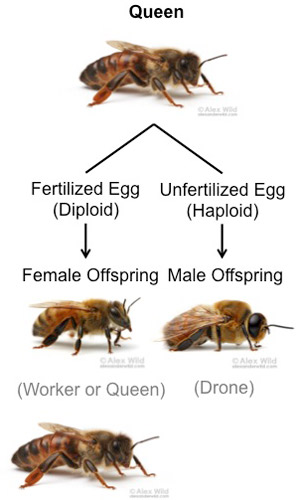
Diagram of haplodiploid sex determination in the honey bee. Unfertilized eggs develop into drones, and fertilized eggs develop into females.

The fact that a very small change in the genome of this bee is the only thing that allows it to completely reproduce asexually is fascinating to me.  Also that this bee's female colony members can just become the queens of other colonies just through a parasitic process is incredible.  Bees are normally very territorial and defensive against intruders, but this is the case where the impostor goes unnoticed, allowing them to take complete control of their new hive, which is pretty unique.  Knowing this though, I feel like this subspecies would be much more abundant in nature, but there must be a specific stressor that is causing these bees to spread to other hives.

http://www.nytimes.com/2016/06/10/science/bees-asexual-south-africa.html?rref=collection%2Fcolumn%2Ftrilobites&action=click&contentCollection=science&region=stream&module=stream_unit&version=search&contentPlacement=1&pgtype=collection&_r=0 

http://entnemdept.ufl.edu/creatures/misc/bees/cape_honey_bee.htm 

Sunday, March 29, 2015

Honey Bees use multiple genetic patheways to fight infections.

Honey bees are essential to pollination, which means that it is extremely important for them to survive. Over the years we have had difficulty trying to keep honey bee colonies alive due to viruses, bacteria as well as parasites. Scientists have been working hard to determine a solution to the downfall of honey bee populations. Studies have shown that about 30 percent of honey bee colonies are lost over the winter, another 25 percent over the summer. The problem here is that there is not currently any type of treatments available for these bee keepers to fight these infections in their colonies. This has been up for discussion for a period of time due to the importance of these bees. A solution has to be found in order to protect these bees from further destruction of their populations.

     Scientists are working to find out which genes increase or decrease activity levels of these bees in the presence of viruses by measuring the expression of all genes in the honey bee genome, whether the virus is present or not. Their findings showed that the RNAi pathway in these bees had increased activity, which could mean that it has anti-viral properties in the immune pathway in bees.The researchers also looked for extra methylation marks which in virus infected bees could be present or not. Their finding showed that not only does the viral infections change the pattern of DNA methylation in honey bees, but its also in completely different genes then the ones in the RNAi pathway. These researchers have discovered that some of these genes are also anti-viral in humans, this has not yet before been linked in insects. These finding may not save the honey bees but it will only help further the information we have on the bees genetic background.. This information will help lead to how we can protect the populations of bees that we still have. Honey bees are important to understand and we should be doing everything we can to protect them.

Article: Honey Bees
Info: Honey Bee Pollination

Saturday, December 6, 2014

A Mouse, a Fish, and a Bee Walk into a Territory


Researchers at the University of Illinois have discovered that some organisms have much in common, genetically, despite the fact that they do not have much in common species-wise. The team at the University of Illinois did experiment with a house mouse, a stickleback fish, and a honey bee to see the relationship of brain patterns when stimulated with a threat coming into their territory. “We knew that a variety of animals share genes for some common physical traits. Now it appears that different organisms share a ‘genetic toolkit’ for behavioral traits, as well,” says Lisa Stubb, who is the lead of the research team. When the brain activity of each of the organisms was observed when each with threatened with an intruder was alarmingly similar. It is so alarming due to the fact that a house mouse, a stickleback fish, and a honey bee all have very different brain anatomy. The research showed that all three organisms had the same change in gene expression that regulate hormones and brainwaves that influence behavior. Other organisms shared similar responses linked to brain development.
Researchers say that the links between these organisms gives hope to the research for comparative genetics among organisms. If scientists are able to find similarities among organisms that evolved their behaviors hundreds of millions of years apart, it won’t be long before they can make connections between other organisms including humans.

http://www.sciencedaily.com/releases/2014/12/141201163243.htm

Sunday, November 9, 2014

How Diet and Pesticides Change Bees Gene Expression

Feeding a bee an artificial pollen diet is not beneficial. A bee that has a natural diet of pollen is more resistant to pesticides than a bee with an artificial diet. Pesticides also cause a change in expression of genes in bees that deal with detoxification, immunity, and nutrition.
Help me I'm a poor little cute bee.

The first part of the study, done by Christina Grozinger at Penn State, showed that even when bees are exposed to nonlethal doses of pesticides, larges changes in gene expression are made. There is a link between nutrition, diet, and pesticide exposure when dealing with the health of a bee. The diet impacts how long bees live after given lethal doses of pesticides. Danial Schmehl at the University of Florida states that a bee's natural diet makes them "significantly more resistant to lethal doses of a pesticide than feeding them a more simple, artificial diet."
The impact of pesticide exposure on gene expression was done by feeding bees pesticides that have been detected in hives for a period of seven days. On the last day the RNA of the bees was extracted, attached to a fluorescent marker, and then the differences in gene expression patters were examined. The patterns of fluorescence between the treated bees and controlled bees showed the changes. Over 1100 pieces of RNA showed change in genes involved in detoxification, nutrition, and immunity. The researches then did the tests giving bees a natural and artificial diet, and the natural diet showed less changes.
This study is very useful because it could help the future of honey bees. Many honey bees have been dying off due to pesticides and it is negatively impacting the environment since honey bees are a major contributor to spreading pollen. This study could help scientists make sure bees are getting a proper diet that can help them survive harmful pesticides. The amount of pesticides used needs to be greatly reduced first, but this study could also help honey bees survive. This study also shows how gene expression could be affected and this may be helpful for humans and what could affect their gene expression diet, nutrition, and detoxification wise.

Article: http://news.psu.edu/story/332959/2014/11/03/research/diet-affects-pesticide-resistance-honey-bees