Embarking on a scholarly exploration into avian genetics, this report, curated exclusively for the University of Kentucky, unravels the intricate tapestry of sex-linked crosses in poultry. In mirroring the structure of the University of Kentucky report, we delve into the genetic determinants of avian sex and the profound implications of selective breeding. In the avian kingdom, sex determination follows the ZW system, where males are ZZ and females are ZW. Echoing the genetic foundations outlined in the University of Kentucky report, we acknowledge the role of genes while emphasizing that they aren't the sole arbiters of outcomes in sex-linked crosses. Parallel to the University of Kentucky's focus on mating selection, we delve into the strategic pairing of specific breeds for sex-linked crosses. Much like the emphasis on environmental factors in the original report, we underscore the importance of this genetic dance in achieving desired traits in the offspring. Mating Selection: A Genetic Ballet: In tune with the format, we explore the nuanced art of mating selection, highlighting that certain genetic combinations influence the expression of traits. Drawing a parallel with the University of Kentucky's discussion on the interaction between genes and the environment, we emphasize the role of the breeding environment in shaping outcomes. As discussed in the University of Kentucky report, resulting offspring from sex-linked crosses are hybrids. Emphasizing the significance of genetic diversity, we stress the notion that, akin to the breeding of hybrids, understanding the nuances of genetics is paramount in achieving specific traits in poultry. Practical Example - Black Sex-Link (Rock Reds): As a real-world illustration, we present the creation of the Black Sex-Link, a product of specific crossbreeding. Emphasizing genetic traits manifested in the offspring, we highlight the significance of understanding genetic contributions in achieving the desired outcome, mirroring the practical example presented in the original report. In line with the University of Kentucky's approach, we conclude by underscoring the significance of both genetic understanding and environmental considerations in the world of poultry breeding. "Genes may co-determine the outcome, but our breeding practices and environmental choices collectively shape the success of sex-linked crosses." This encapsulates the essence that successful avian genetics requires a comprehensive approach, incorporating both genetic insights and strategic environmental considerations.
Sunday, February 4, 2024
Thursday, December 7, 2023
Chickens as a Model Organism
The chicken fits the usual criteria of a model organism with it being cost effective, easily manipulated genetics, and a fast reproductive cycle. However chickens have an extra trait due to it being a member of the avian species, the ability to lay eggs. The egg allows scientists to conduct experiments during the embryo phase of the unborn chick without harming the mother. The egg shell can also be removed without damaging the chick embryo inside. The chicken embryo can be utilized to further understand the embryo stages of other animals with fewer ethical concerns. The chicken egg has been mainly used to create vaccines by growing and inactivating bacteria within the fertilized embryos while some of the chicken eggs have been used to research caner. Recently, after obtaining a genomic sequence of a chicken, it was observed that there are some functional proteins that are similar between chickens and humans. Researchers now believe that chickens could be used to study the non-coding regions in mammals.
Sources:
Wednesday, December 6, 2023
Sequencing the Genome of Chickens
Thursday, November 9, 2023
Chicken DNA Increase in Jungle Fowl Population
![]() |
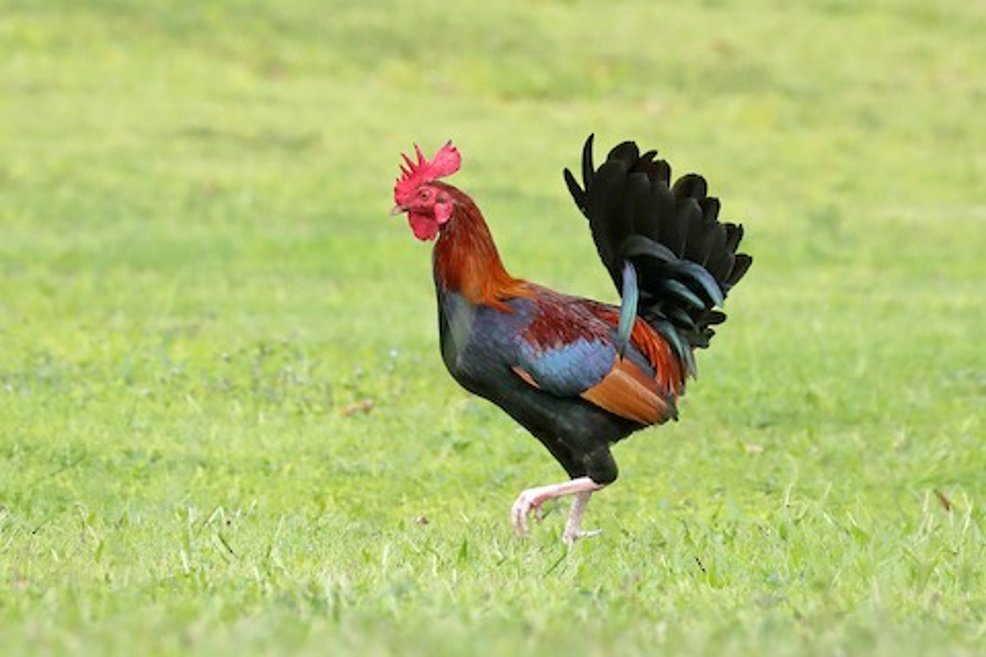
| A male red jungle fowl and chicken hybrid. Has the plumage of a red jungle fowl but in a rooster shape. |
The red jungle fowl and domesticated chicken share a common ancestor, but recently there has been a trend in the red jungle fowl's DNA. The fowl and chickens have been interbreeding with the jungle fowl in Southeast Asia. The domesticated chickens and jungle fowl were researched to determine if the cross was harmful to the populations. This interbreeding has resulted the modern fowls having 20-50% of the genomes that originated from domesticated chickens. Over the last century, many domesticated species have been interbreeding with the wild populations. It was expected that the two populations would have a higher genetic diversity, but the jungle fowl have lost their genetic diversity. The measure of a population's genetic diversity, heterozygosity, is only 10% of what it was a century ago which could be a result of the domestic chickens having such low genetic diversity.
Most of the traits that chickens have been bred for are for human uses, which would decrease the survival of the red jungle fowls. The genetic change of the fowl is negative for both domestic chickens and fowls. Fowls have a lower chance of survival as their survival traits are replaced for the traits that were selected for in chickens. As the red jungle fowl becomes more like chickens, humans cannot use the genetics of the fowl to help make domestic chickens more resilient to disease.
Although the red jungle fowl and domesticated chickens appear similar, it is important to reduce the interbreeding between the two. In my opinion, the managing of the jungle fowl populations is a great initiative. Humans need the domestic chickens as a source of food, and the wild red jungle fowl are vital in improving the chickens resistance. The separation will also be beneficial to the red jungle fowl by keeping the wild-type traits as the traits with the highest survivability in the wild.
Sources:
Wednesday, November 8, 2023
Gene Editing In Chickens Provide First Steps in Creating Influenza A Virus Resistant Chickens
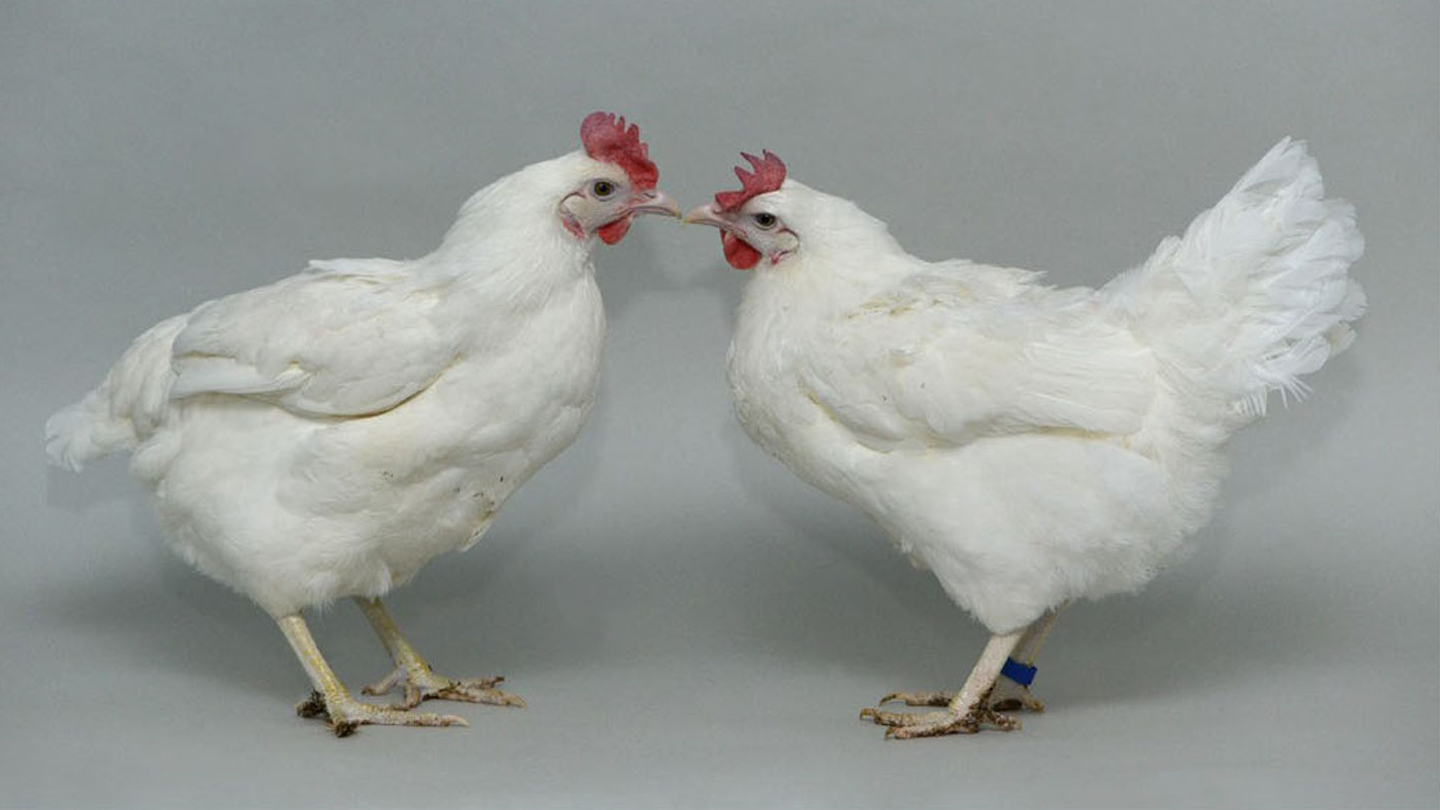
Picture: Genetically edited chicken that is resistant to an avian influenza infection (right) and unedited bird (left).
A group of researchers recently created influenza A virus (IAV) resistant chickens using CRISPR/Cas9 to generate homozygous gene edited chickens containing two ANP32A amino acid substitutions that prevent viral polymerase interaction. The study saw 90% effectiveness in chickens with low exposure; however, higher doses resulted in breakthrough infections where the IAV was able to adapt and work around the one genetically modified gene. Additional genome editing to eliminate other ANP32 protein family members eliminated all viral growth in chicken cells. This data illustrates a proof of concept in the generation of IAV-resistant chickens and shows that multiple genetic modifications will be required in order to stop viral mutations from bypassing the genetic modifications. An issue that other scientists are worried about is that IAV is a quickly mutating virus and the battle of genetic engineering will be constant (I refer to this as "job security"). There is likely not going to be one solution, but numerous that have to be implemented all at once and changed depending on viral variations. This method would also need to be used to modify other genes for other avian flus in order to prevent other dangerous strains. Creating healthier livestock is just one goal of this kind of research, the other is to prevent avian influenza viruses from mutating into a disease that can affect humans. In protecting livestock, human exposure to the virus should decrease. In a similar manner to the low doses in chickens not being able to adapt to create breakthrough infections, if human exposure is low there should be little chance of breakthrough cases. Since the virus is in wild bird populations, the spread of the disease is inevitable; however, by minimizing exposure, and maximizing resistance in chickens, people can ensure a safer future with fewer pandemics and more chicken nuggets.
I personally have no problem with eating genetically modified organisms. They do testing to make sure that the food won't hurt people, and to me genetic modifications are like selective breeding, but with less possibilities of making accidental monstrosities (like the pug) and reducing the time it takes to get the desired result. If GMOs are going to be necessary to ensure the health of livestock and people I welcome this kind of scientific development, though other people may not be as enthusiastic about it. In my personal opinion, I am more concerned with chlorine washes applied to chicken after butchering the bird than a gene changed to protect the organism from a virus.
https://www.nytimes.com/2023/10/10/science/bird-flu-chickens-crispr.html?auth=login-google1tap&login=google1tap
https://www.nature.com/articles/s41467-023-41476-3
https://www.sciencenews.org/article/gene-editing-chicken-resistant-bird-flu
Monday, November 23, 2020
Effects in the DNA of Chickens Exposed to Long-Term Stress
In this article a study was conducted to observe what effects stress had on the genetics of chickens. The study involved one control group in which the chicken were given: plenty of space to roam; other chickens to socialize with; and easy access to food and water, and a stress group in which the chickens were confined to a small area; isolated at times; and given limited access to food and water. The genes within the red blood cells of both chickens were analyzed. It was found in the chickens that were put under stressful conditions that their methyl groups were attached to their DNA in a completely different way than that of the control groups. Methylation changes the activity of a DNA segment without changing the DNA sequence. I found this article posted by Science Daily to be very informative. I agree with the data found from this study, as there is no denying that even just the quality of chicken is found to be better in free range than in factory raised, so it comes to no surprise that there are other harmful factors that occur when chickens are put under stressful conditions. I hope this study brings more awareness to how harmful the techniques used in factories impact the health and well being of the animals. In my opinion the treatment of commercially produced meat and dairy products is inhumane and cruel, and I believe guidelines and laws should be put into place to ensure that all animals are treated in an ethical manner.
Thursday, May 3, 2018
A Link Bewteen Genetics and Social Behavior in Chickens
The study placed a group of birds in a new habitat and observed their tendency to either explore the new area or seek out other chickens. Gene expression in the hypothalamus was also measured. Five genes were identified to influence the sociality and gene expression observed. The genes had already been associated with influencing behavior or the nervous system. Social behaviors are very complex, and although we can assume that they are influenced by genetics to be able to pinpoint what specific genes have influence is fascinating.
Sunday, November 20, 2016
G.M.O.s, 8-Legged Chickens, and China
I believe that the fear felt by the people of China is not justified by any factual, scientific evidence. It is all based on propaganda. China's authorities on the matter use fear mongering as a means of keeping GMO's, an American method of farming, out of their practices and out of their country. GMO's must be better understood before these kinds of accusations are made.
Tuesday, November 17, 2015
Dino-Chicken--Not of the Nugget Variety
With the recent Jurassic World movie, even this generation's young people know about the disastrous outcome of when scientists "play god" and create a park full of dinosaurs. Despite this, dinosaur breeding may be closer than one may think. The Indominous rex was one of the unlikely stars of the recent Jurrasic World movie, for a good reason. While fossilized dinosaur DNA that is still viable has yet to be found, remnants of the prehistoric code that existed in dinosaurs still exists in chickens today. Quoted in an article on livescience, James Horner, the inspiration for the original Jurassic Park's Alan Grant, says, "Chickens and all birds are carrying much bigger chunks of dinosaur DNA than we are ever likely to find in the fossil record." He believes that, because DNA tends to come apart after a cell dies, there wouldn't be anything left after millions of years.
However, in a bird, there may be enough groundwork and prehistoric DNA that they could be essentially reverted to resemble a dinosaur. It's already been proven that birds can be transgenically created to have teeth and a team from Yale and Harvard recently retro-engineered a bird's beak to look like a dinosaur-looking mouth. Horner believes that all that is left is to recreate the tails and transform the wings back into an arm and hand. He admits a miniature dinosaur may be about ten years off.
While this is scary, much like Grant I would love my own miniature pet dinosaur, but I do believe this whole exercise would anger people who are traditionally against GMOs. This involved completely modifying an organism to create something completely different which leaves a weird taste in my mouth.