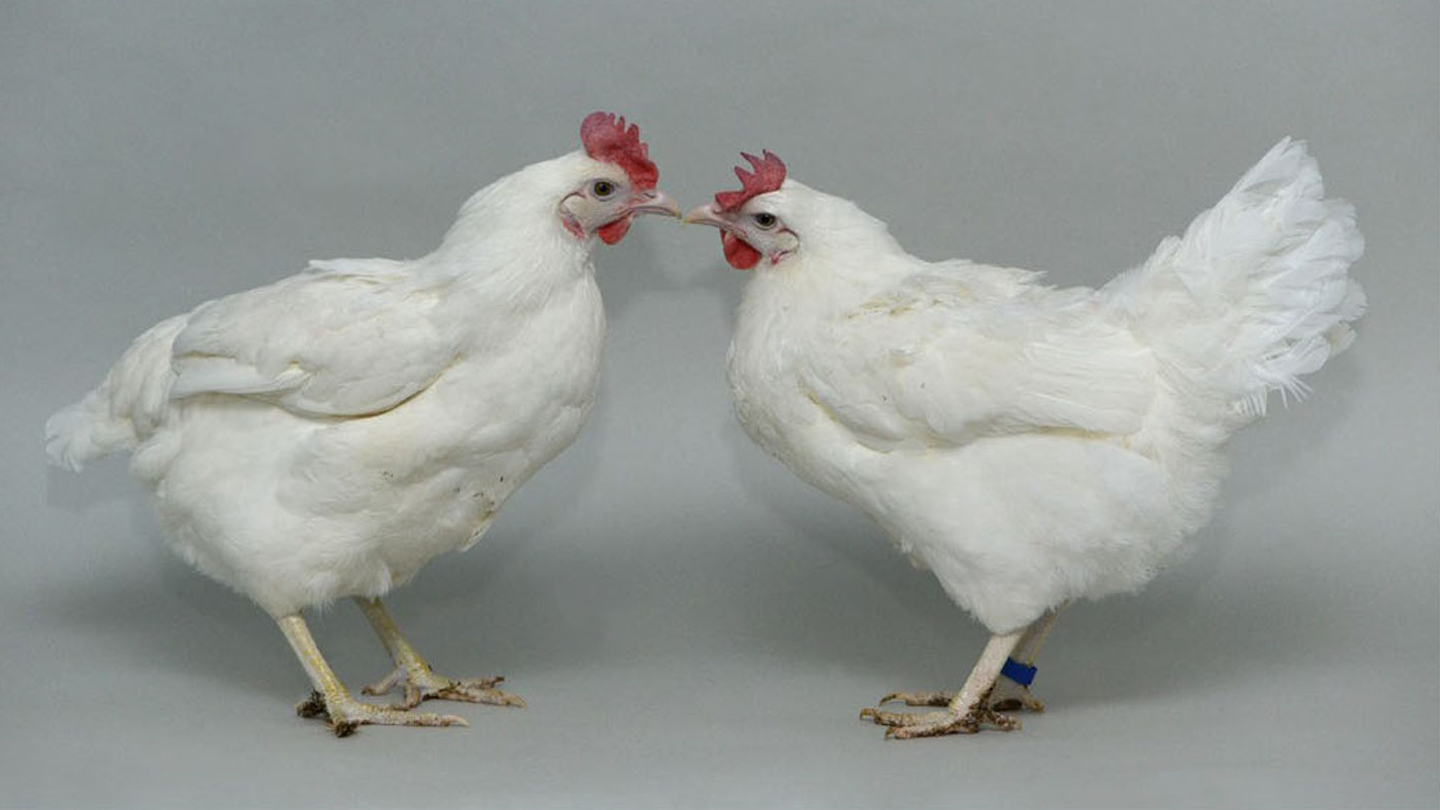
Picture: Genetically edited chicken that is resistant to an avian influenza infection (right) and unedited bird (left).
A group of researchers recently created influenza A virus (IAV) resistant chickens using CRISPR/Cas9 to generate homozygous gene edited chickens containing two ANP32A amino acid substitutions that prevent viral polymerase interaction. The study saw 90% effectiveness in chickens with low exposure; however, higher doses resulted in breakthrough infections where the IAV was able to adapt and work around the one genetically modified gene. Additional genome editing to eliminate other ANP32 protein family members eliminated all viral growth in chicken cells. This data illustrates a proof of concept in the generation of IAV-resistant chickens and shows that multiple genetic modifications will be required in order to stop viral mutations from bypassing the genetic modifications. An issue that other scientists are worried about is that IAV is a quickly mutating virus and the battle of genetic engineering will be constant (I refer to this as "job security"). There is likely not going to be one solution, but numerous that have to be implemented all at once and changed depending on viral variations. This method would also need to be used to modify other genes for other avian flus in order to prevent other dangerous strains. Creating healthier livestock is just one goal of this kind of research, the other is to prevent avian influenza viruses from mutating into a disease that can affect humans. In protecting livestock, human exposure to the virus should decrease. In a similar manner to the low doses in chickens not being able to adapt to create breakthrough infections, if human exposure is low there should be little chance of breakthrough cases. Since the virus is in wild bird populations, the spread of the disease is inevitable; however, by minimizing exposure, and maximizing resistance in chickens, people can ensure a safer future with fewer pandemics and more chicken nuggets.
I personally have no problem with eating genetically modified organisms. They do testing to make sure that the food won't hurt people, and to me genetic modifications are like selective breeding, but with less possibilities of making accidental monstrosities (like the pug) and reducing the time it takes to get the desired result. If GMOs are going to be necessary to ensure the health of livestock and people I welcome this kind of scientific development, though other people may not be as enthusiastic about it. In my personal opinion, I am more concerned with chlorine washes applied to chicken after butchering the bird than a gene changed to protect the organism from a virus.
https://www.nytimes.com/2023/10/10/science/bird-flu-chickens-crispr.html?auth=login-google1tap&login=google1tap
https://www.nature.com/articles/s41467-023-41476-3
https://www.sciencenews.org/article/gene-editing-chicken-resistant-bird-flu