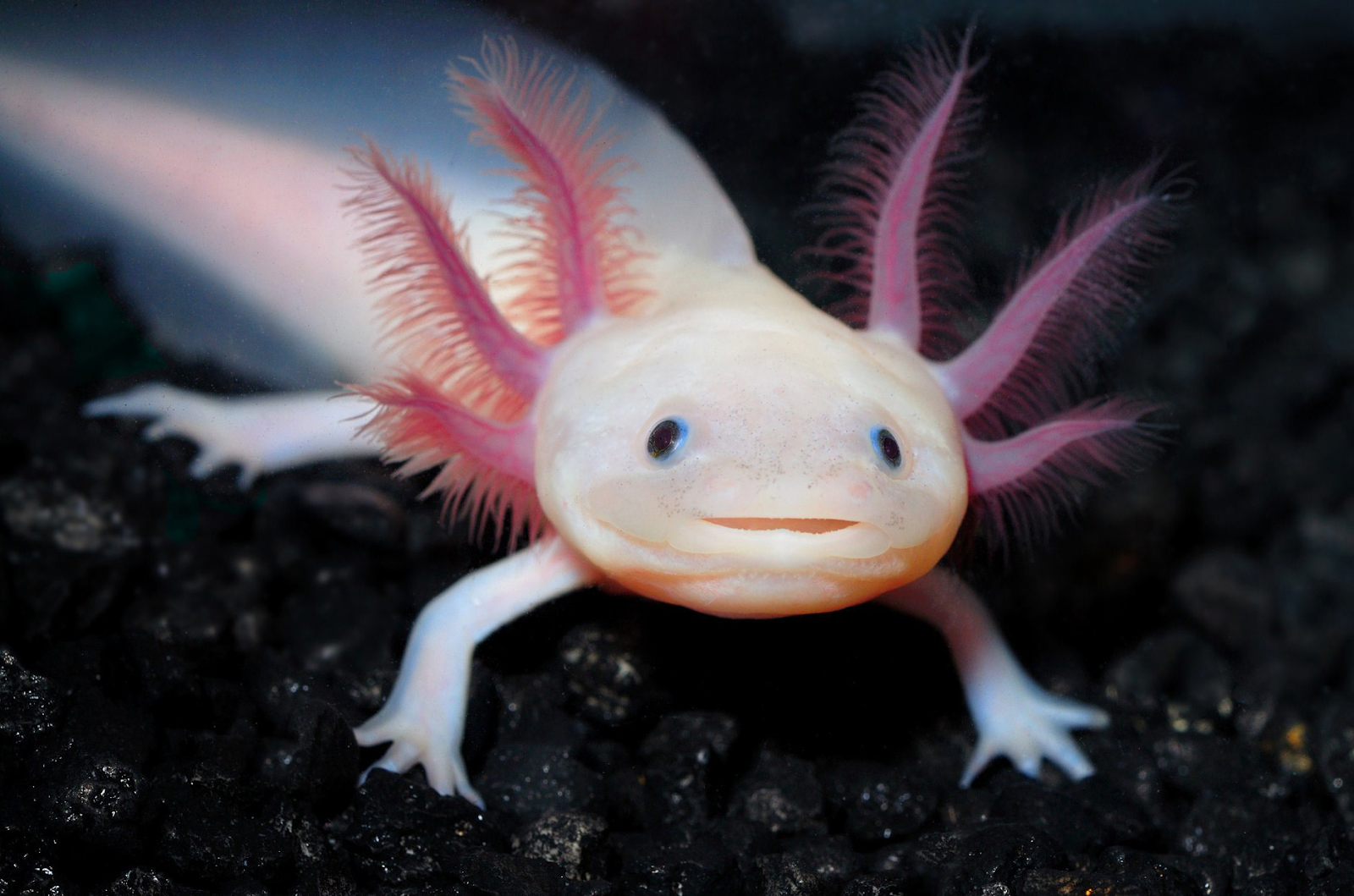
Showing posts with label axolotl. Show all posts

Sunday, March 3, 2024

The Axolotl's Superpower: Tissue Regeneration!

    This article discusses the sequencing of the axolotl genome, and how it may be significant in regards to human health/medical treatments. Axolotls are neotenic- in other words, they never reach "full maturity". This is how they keep their gills and continue to live underwater. They also hold the title for the largest genome ever fully sequenced. Scientists are particularly interested in researching axolotls for their incredible ability to regenerate lost tissues- even having the capability to regrow their spinal cords, and parts of their brains! Scientists may be able to learn from this ability and translate it into the medical field. Since axolotls have been used as model organisms, health-related events observed in them, such as heart problems, can be studied, and then used in respect to human health-related problems.

    I find this article to be incredibly interesting. The concept of utilizing the information axolotls provide regarding regeneration in a medical sense for humans is groundbreaking. I can only imagine the different manners in which it could be used to better our medical treatments- such as use on burn victims or use in combating degenerative diseases. It makes me wonder just how far we can push the bounds of this regenerative ability- I know we as humans will not be able to regrow entire limbs, but to what extent will we be able to practice this ability in the medical field? 


Thursday, January 31, 2019

Axolotl Regeneration and Mapping Their DNA

Axolotl are small amphibians from Mexico who have extraordinary regenerative abilities. These creatures are able to regrow just about any body part, even up to half of the brain. Aside from cutting off the head, an exact replica of anything else will be regrown. Scientists around the world are attempting to completely map the DNA of this organism in hopes to provide advances in human regenerative medicine. Dr. Melissa Keinath describes that the axolotl genome is ten times larger than that of the human genome. The New York Times reports that "Dr. Keinath and her colleagues mapped more than 100,000 pieces of DNA onto chromosomes". Because DNA sequences that are physically close together on chromosomes are commonly inherited together, the researchers could use linkage mapping to organize the axolotl DNA. Additionally, the scientists were able to identify DNA exclusive to axolotl by crossing them with tiger salamanders. Knowing how DNA is positioned "allows you to start thinking about functions and how genes are related," scientist Dr. Voss explains. After understanding the relationships between the DNA position and gene function in the axolotl, scientists can observe whether the same relationships are seen in humans. 


The research on axolotl is interesting because if we can understand the genes and their functions behind axolotl regeneration, maybe a similar technique can be applied to human medicine. Studying the axolotl DNA may also reveal more about epigenetics and if deactivating certain genes results in excellent regenerative abilities. Furthermore, the physical location of where DNA is located and how it affects the genes can be analogous to humans. 

Wednesday, April 25, 2018

10 Times the Human With a Smile


           The axolotl, a smiling Mexican amphibian, is the largest genome ever sequenced. It has 32 billion base pairs, ten times the size of human genome. The axolotl has been bred and studied in laboratories for over 150 years and is endangered in the wild. The axolotl is an extremely interesting organism: it regenerates damaged organs, regrows amputated limbs with all bones, muscles, and nerves, and even heals wounds without scar tissue. The amazing thing about its ability to heal and regrow is that it will do so with the new organs or limbs functioning just like they did before. For example, a crushed spinal cord can function again normally like it was never crushed. This animal was the first salamander genome to ever be sequenced. It took so long to be done because it has many repetitive parts in its genome. This genome sequencing is just the beginning of their studies, but a huge advance in science because it has the potential to answer many questions. The genes involved in regeneration are being identified and studied. 

summarized article:
https://www.nytimes.com/2018/02/01/science/axolotl-genes-limbs.html

original scientific study:
https://www.nature.com/articles/nature25458


Friday, February 2, 2018

The Smiling Axolotl Hides a Secret: A Giant Genome


With 32 billion base pairs, the axolotl, also known as the Mexican salamander, is the largest genome ever sequenced! To put into perspective, that is ten times the size of the human genome, in which the human genome is already very complex. This creature is on the endangered list, however they are breeded in the laboratories because of their body’s unique structures and functions. Axolotl are able to repair broken parts of their bodies and regrow lost limbs, just as good of quality as before. For an example, “this salamander can heal a crushed spinal cord and have it function just like it before it was damaged.” These qualities are what make this specific animal incredibly interesting and worth researching. With this research, scientist can manipulate the genes of an axolotl and better understand how the genome effects cell behavior.

I think this discovery is fascinating because it opens a door of opportunity for researchers just like it did for those who studied Drosophila melanogaster and won a nobel prize. Also, it is amazing that with today’s advanced technology, genome sequence is becoming more easy and accessible. As a science major, I am excited and curious to see the next coming results after they further research the genes.

Sunday, January 28, 2018

Decoding the Axolotl genome: Insights into tissue regeneration


In biology salamanders have become a model for evolutionary and developmental studies. In this study it focuses on one salamander, which is the Mexican axolotl (Ambystoma mexicanum). They choose this salamander in particular because they are known for their ability to regenerate body parts. If this salamander looses a body part, within weeks the limb will grow back with, muscles, bones, and tissue. To understand regenerate and why it is very limited in most species, scientists need to have access to genome data. In the Axolotl due to their size, there are 32 billion base pairs, which is 10x larger than the human genome.


International team of researchers have now assembled, annotated, and sequenced the complete axolotl genome, which is the largest genome to ever be decoded. They did this using the PacBio-platform, which a sequencing technology that produces long reads to span large repetitive regions. Those who analyzed the assembled genome discovered many features that seem to point uniqueness of the axolotl. It was also discovered that an essential development gene named PAX3 is completely missing from the genome and it function has been taken over by another genome named PAX7. Both of these genes play a key role in muscle and neural development.