Showing posts with label #regeneration. Show all posts

Sunday, March 3, 2024

The Axolotl's Superpower: Tissue Regeneration!

    This article discusses the sequencing of the axolotl genome, and how it may be significant in regards to human health/medical treatments. Axolotls are neotenic- in other words, they never reach "full maturity". This is how they keep their gills and continue to live underwater. They also hold the title for the largest genome ever fully sequenced. Scientists are particularly interested in researching axolotls for their incredible ability to regenerate lost tissues- even having the capability to regrow their spinal cords, and parts of their brains! Scientists may be able to learn from this ability and translate it into the medical field. Since axolotls have been used as model organisms, health-related events observed in them, such as heart problems, can be studied, and then used in respect to human health-related problems.

    I find this article to be incredibly interesting. The concept of utilizing the information axolotls provide regarding regeneration in a medical sense for humans is groundbreaking. I can only imagine the different manners in which it could be used to better our medical treatments- such as use on burn victims or use in combating degenerative diseases. It makes me wonder just how far we can push the bounds of this regenerative ability- I know we as humans will not be able to regrow entire limbs, but to what extent will we be able to practice this ability in the medical field? 


Friday, November 24, 2023

Neuroimmune Crosstalk Role in Heart Tissue Repair

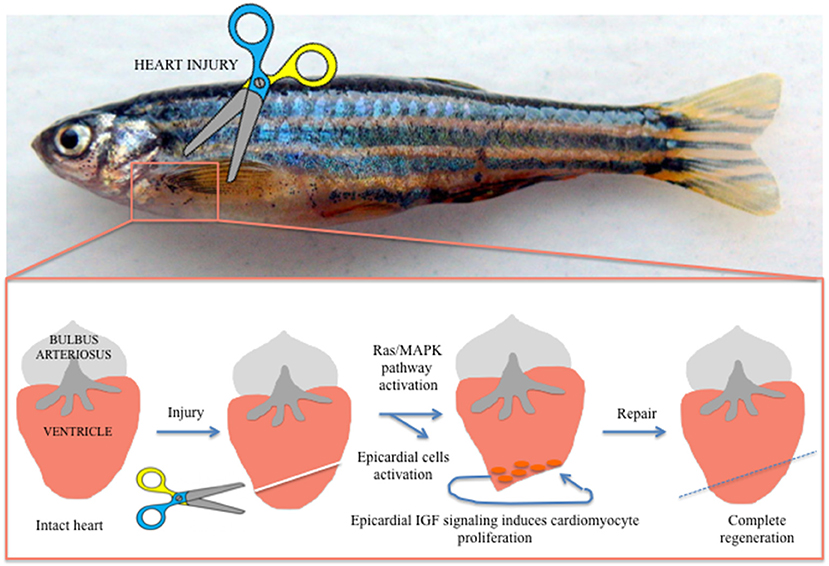
Researchers at the Max Delbrück Center have discovered that zebrafish regenerate heart tissue using communication signals between their nervous and immune systems. In general, myocardial infarctions happen when blood vessels supply blood and nutrients to the heart, resulting in portions of the afflicted heart tissue dying. Since humans are unable to grow new heart cells to reduce the damage, they instead form scar tissue that weakens the pumping power of the heart overtime. Unfortunately, even stem cell research has been proven to be unsuccessful here.

Interestingly enough, signals between the autonomic nervous system (ANS) and immune system were found to play pivotal roles in scarring cand tissue regeneration. To observe this communication, researchers induced an injury into the hearts and several macrophage receptors of zebrafish larvae. After noticing that ANS adrenergic signals resulted in macrophages multiply and regenerating heart muscle, the research team genetically engineered the fish larvae so that the signal couldn’t enter the macrophage cell. The research study found that interrupting the adrenergic ANS signal deactivated the macrophages and induced heart scarring. In difference, when macrophages are activated by these signals, they communicate with fibroblasts and promote regeneration at the damaged site, creating an environment conducive for the growth development and growth of blood, lymph, and heart vessels.


A rather interesting study, this research’s findings provide an insight into how the regeneration of human heart muscle tissue can be made foreseeable. By better understanding the differences in signaling between zebrafish and humans, biologists can better understand why cardiac tissue does not regenerate, find methods to navigate a path to initiating the regeneration process, and even how to better treat heart attack patients’ conditions.

For more information, the news article has been linked here and the published journal article has been linked here.

Saturday, November 17, 2018

Break a leg... and repair it?

   Don't tell PETA, but researchers are amputating frog legs in the name of science! While this may seem disturbing just know that the street value for frog legs is pretty decent; someone has to pay for the funding of research! On the bright side, there is no reason to worry as these frogs can grow back their limbs. Known as the African clawed frog, these little guys have the ability to regenerate limbs, though not as good as the original. Luckily for the frogs, researchers have come up with a device that can assist the healing process to help grow back their limbs. Using a 3D printer, scientists created a bioreactor device made out of silicon and inserted a hydrogel. The gel itself has "hydrating silk proteins that promote healing and regeneration" but scientists also added progesterone, a hormone that can "promote nerve, blood vessel, and bone tissue repair" (1).

   In order for the bioreactor device to work, the researchers sutured the device where the limb was amputated for a total of 24 hours before removing it. At this point, the goal was that the device would release progesterone where the limb was amputated and increase the frog's regenerative abilities. With different test groups to ensure that the bioreactor device was the cause of any positive outcomes, the experimental group did grow a stronger and better limb. Typically, the frog grows a limb that is subpar, something the article describes as a spike-like structure. However, with the bioreactor in place, the frog regenerated a limb that was noticeably different from the other groups, essentially resembling an almost fully healed limb. This can be attributed to the change in gene expression from the bioreactor causing an upregulation in healing factors and a downregulation in scarring factors.

   Ultimately, due to the change in gene expression from the bioreactor device, the frogs were able to swim again as if they had never lost their leg. While this is only a laboratory setting for a device that is working on frogs, imagine the implications this could have on humans. Obviously we do not regenerate limbs, but regeneration has been something of wonder in the realm of science for a while. I think that once scientists become more familiar with how regeneration works, that maybe one day there could be procedures to help those who had lost limbs. However, there may be a parallel to my last post in which I talked about the ethics of CRISPR for humans. Would regeneration yield a  stronger and better limb? I would hope so, but then comes the argument of genetic modification and enhancement. What if other body parts or organs could be regenerated? Stay posted, just might see my name in a paper one day...

Monday, April 3, 2017

Myelin formation, limb function restored in MS mouse models

In this study researchers have found that they can restore myelin formation and limb function in mice with MS with the microRNA miR-219.  Multiple sclerosis is a disease that attacks the central nervous system.  This disease destroys the myelin sheath and also oligodendrocytes.  Patients with MS lack miR-219.  Researchers deleted miR-219 in mouse models and found that several proteins that prevent myelin formation were present with the absence of the microRNA.  Then they administered a synthetic version of miR-219 to the MS mice and found that myelin-producing cells were reactivated.  This led to reformation of mylelin and improved limb function.

This could lead to a huge breakthrough in the treatment of MS for humans.  MS is a horrible illness and millions of people in the world are affected by it.  This disease could potentially be eliminated from the gene pool with more advances in medicine.

http://www.medicalnewstoday.com/articles/316599.php
http://www.cell.com/developmental-cell/fulltext/S1534-5807(17)30122-3

Friday, March 31, 2017

'Skin-and-bones' mechanism underlying zebrafish fin regeneration discovered by researchers


Zebrafish have the ability to regenerate their complex skeleton fin in just two weeks after being amputated.  This is possible due to clusters of specialized cells called rays.  Rays migrate over reforming bones and escort bones into the right position to form a branched skeleton.  Sonic hedgehog is a protein that interacts with osteoblasts to promote bone pattering during bone regeneration.  In this experiment genetically modified zebrafish were used.  These zebrafish produce a fluorescent protein to help identify skin and bone cells that respond to hedgehog signals.

The research team said that the findings won't lead to regeneration of limbs in humans but could lead to better therapeutic treatments for broken bones.  This article is very interesting because understanding this mechanism could eventually lead to regrowing limbs in humans.  I'm sure that's 
something everybody is excited about.  


Monday, April 11, 2016

Genetic elements that drive regeneration uncovered Limb or organ regrowth may be hidden in our genes


Junsu Kang from Duke University a study was conducted to find the gene sequence in zebra fish that triggers regeneration potential. Tracing back the evolutionary tree there was a common ancestor we shared with other animals that had this ability but along the way we lost it through the millions of years of evolution. The important factor is not only the gene itself but the sequence that can regulate and activate the regrowth gene. The model research is called "tissue regeneration enhancer elements" or TREE for short. Over the past decade, researchers have identified dozens of regeneration genes in organisms like zebrafish, flies and mice. The work Kang and his collaborator Brian L. Black, PhD, of the University of California, are just at the beginning of their work to find the genes that turn on the grown factor and stop it. They are trying to understand these types of genes to hopefully have the potential to pinpoint the gene and enable to change the poor regenerative tissue to have near-surgical precision.

Science and the knowledge of our past is increasing drastically. With the potential of regeneration of lost body parts can change the world drastically. It not only can repair lost limbs or body parts, but nerves can be regenerated and stop many life long crippling diseases. This is just a start of what can potentially be a break through for modern medicine and with technology advancing on a daily basis, so much can be accomplished. The information for all we know is within our DNA, we just need to find a way to tap into it and figure out how everything works.

Saturday, April 9, 2016

The Ability to Regenerate Organs and Limbs Hidden in DNA Sequences?

      It is known today that descendants of regenerative organisms such as today's salamanders and zebrafish still possess the very impressive ability but humans unfortunately lost their regenerative ability long ago. With this thought in mind, a study lead by Dr. Kenneth D. Poss at Duke University has discovered a DNA sequence found in zebrafish called "tissue regeneration enhancer elements" or TREEs. These sequences can turn on genes at an injury site and when turned on can even change organisms with the inability to regenerate organs and limbs to become able to regenerate.
    Dr. Poss states that the main goal behind the study is to understand more about how regeneration works and to inform the human race of their full potential. He says that in their studies they have learned that there is potential of activating the genes responsible for regeneration that we all have in our bodies. In result of much research done on zebrafish, research has found molecules such as neuregulin 1 which regenerates heart muscle and fibroblast growth factors which make regeneration of zebrafish fins possible. 
   What was learned by Dr. Poss and his team is that TREEs are present during the embryonic stages of development. Dr. Junsu Kang who is the lead researcher on Dr. Poss's team found that a gene called leptin b was turned on in fish when they are injured and after sorting through 150,000 base pairs in the sequence, he found an enhancer element. He split the enhancer element into two separate parts and fused one with the fibroblast growth factor and one with the neurogulin 1. In result transgenic zebrafish whose fins and hearts had extremely superior regeneration after injury to both their fins and heart. Furthermore, a collaborator Dr. Brian L. Black at the University of California attached one TREE to a gene called lacZ and found that by borrowing the elements from the genome of the zebrafish, it activated gene expression in injured paws and hearts of mice.
   From this large advancement in technology, Dr. Poss and his team plan to further study these types of elements so that they can understand what controls regeneration. The ultimate goal of regeneration research is to one day enhance surgical processes and ultimately biologically and natural 3D print (create) organs and limbs. 


    I find it so intriguing how far we have come in even the past 5 years with medical technology and advances in understanding the complexity of the human body. Before I was ignorant to relation between organism such as zebrafish for example and us as humans. I did not realize that by learning more about other organism and the specifics to how they function can be directly linked to understanding more about the human body. I think that since they have recently been able to regenerate the paws and hearts of mice, that next they will try to regenerate the limbs of a large mammal and then eventually perform a trial with a human amputee. I look forward to seeing what happens as the work of Dr. Poss and others continues.