Showing posts with label autonomic nervous system. Show all posts

Friday, November 24, 2023

Neuroimmune Crosstalk Role in Heart Tissue Repair

Researchers at the Max Delbrück Center have discovered that zebrafish regenerate heart tissue using communication signals between their nervous and immune systems. In general, myocardial infarctions happen when blood vessels supply blood and nutrients to the heart, resulting in portions of the afflicted heart tissue dying. Since humans are unable to grow new heart cells to reduce the damage, they instead form scar tissue that weakens the pumping power of the heart overtime. Unfortunately, even stem cell research has been proven to be unsuccessful here.

Interestingly enough, signals between the autonomic nervous system (ANS) and immune system were found to play pivotal roles in scarring cand tissue regeneration. To observe this communication, researchers induced an injury into the hearts and several macrophage receptors of zebrafish larvae. After noticing that ANS adrenergic signals resulted in macrophages multiply and regenerating heart muscle, the research team genetically engineered the fish larvae so that the signal couldn’t enter the macrophage cell. The research study found that interrupting the adrenergic ANS signal deactivated the macrophages and induced heart scarring. In difference, when macrophages are activated by these signals, they communicate with fibroblasts and promote regeneration at the damaged site, creating an environment conducive for the growth development and growth of blood, lymph, and heart vessels.
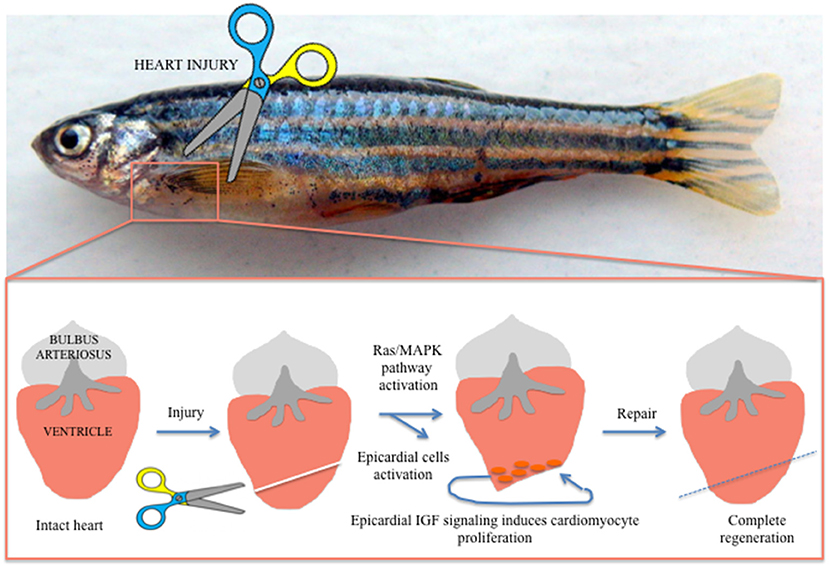

A rather interesting study, this research’s findings provide an insight into how the regeneration of human heart muscle tissue can be made foreseeable. By better understanding the differences in signaling between zebrafish and humans, biologists can better understand why cardiac tissue does not regenerate, find methods to navigate a path to initiating the regeneration process, and even how to better treat heart attack patients’ conditions.


For more information, the news article has been linked here and the published journal article has been linked here.

Tuesday, November 23, 2021

Handstanding Rabbits From the RORB Gene


The mutation in a gene was found to have made rabbits jump instead of hop because of the gene that helps coordinate their limbs. In general, rabbits walk on their front paws which is controlled by the RORB gene. This gene is tied to limb movement and allows rabits to hop. However, when this gene is defective, the hops transform into handstands and does not allow for the bunnies to naturally hop. Comparatively, there was a study that was found that mice also performed handstands when the gene was altered. This was found in rabbits as well as mice. This mechanism is called the duck gait and allows for the development of the spinal cord and allows researchers to actually learn more about how the spinal cord works in other animals and humans. The RORB gene allows for the hormonal response in which elements of several genes were to be expressed and to code for organogenesis and differentation which helps regulate the circadian rhythm and hindlimb motor control. The gene is also a huge part in numberous physiololgical processes which uses different types of internal receptors to form various pathways and neurons. This rabbits with the defective gene can usually walk normally. However, with the RORB gene, the rabbits have the mutation to use their front paws to move quickly and swiftly to do instantaneous handstands. The gene which affects the spinal cord may affect the rabbit as a whole because of the syncopated movements of the four limbs which may lead to diseases upon further research.