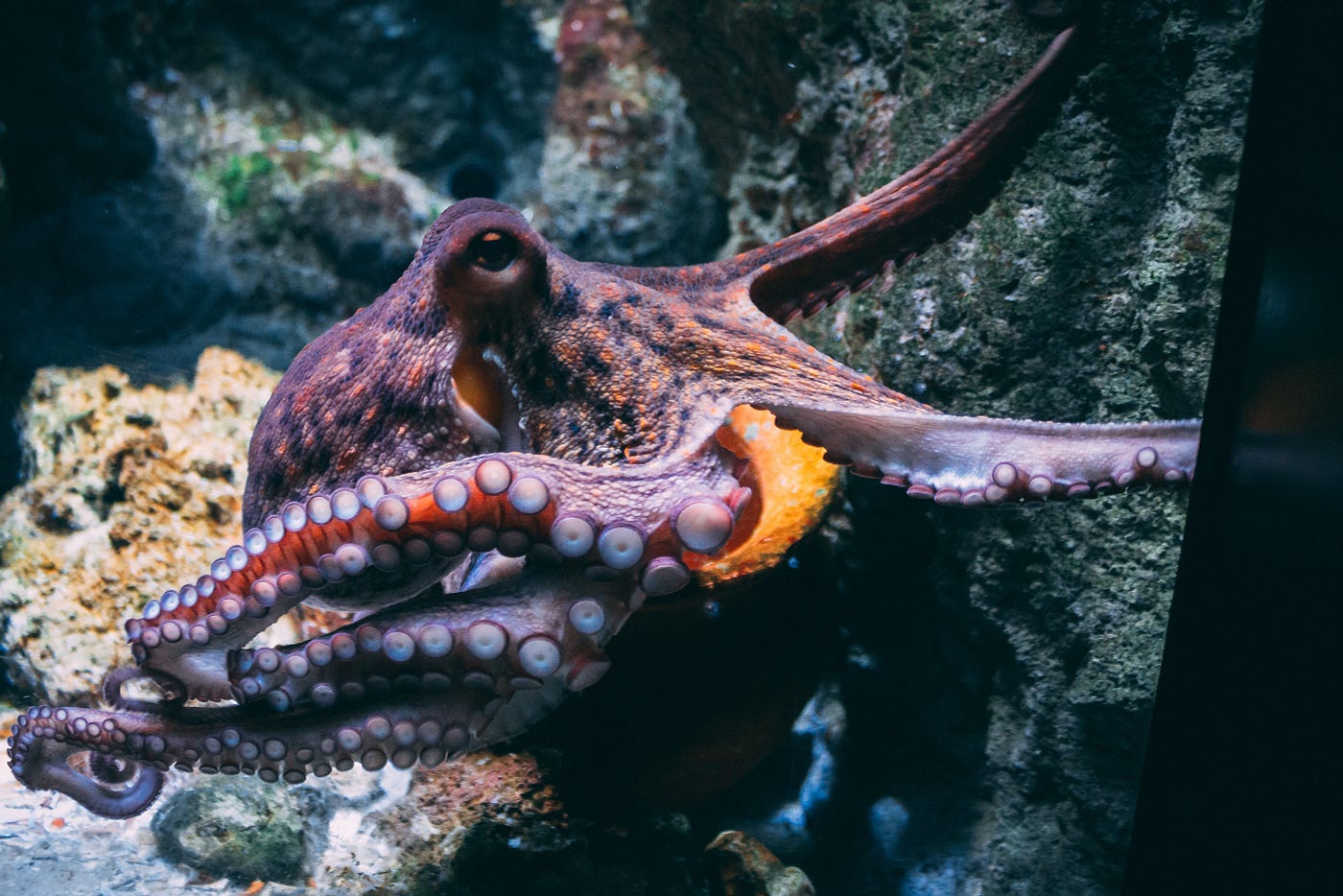
The difficulty in adjusting to the significant seasonal temperature fluctuations in the Pacific Ocean around the southern Californian coast is faced by Octopus bimaculoides. A research by Birk et al. published in Cell examined the effects of temperature on RNA recoding across the neural transcriptome of adult octopuses in order to comprehend the processes behind this acclimatization process. For two to three weeks, the scientists kept octopuses in temperature-controlled aquariums at 13 °C and 22 °C. They discovered that this acclimatization process was greatly aided by RNA editing via adenosine deamination. At 13 °C compared to 22 °C (cold-induced), almost 33% of the recoding locations in the stellate ganglia had greater editing levels. When the temperature changed, these alterations happened quickly within hours and stabilized after four days. Kinesin-1 and synaptotagmin, two brain proteins involved in axonal transport and synaptic transmission, respectively, underwent structural and functional reconfiguration as a result of the cold's induction of RNA editing. The kinetics of Ca2+-binding and these proteins' motility were changed. The study discovered comparable results in populations of wild octopuses collected in the winter and late summer, indicating that closely related species like O. bimaculoides and O. bimaculatus also exhibit cold-induced RNA editing.
Thursday, August 3, 2023
Temperature-induced RNA recoding in octopus
Tuesday, December 6, 2022
Sites in the Brain Where RNA Is Edited Could Help to Better Understand Neurodevelopment and Disease
Researchers at Mount Sinai have determined new avenues for understanding molecular and cellular mechanisms of brain development and how they affect both disease and health by cataloging sites in the brain where RNA is modified. As an individual ages, the RNA editing rate in the brain increases. This modification happens throughout one's lifetime through a process known as adenosine-to-inosine (A-to-I) editing. With this they could explore the implications across a range of aging and neurodevelopmental disorders. Because there are so many already identified A-to-I sites, it can be difficult to determine which sites are physiologically important. The researchers were able to narrow it down to about 10,000 sites that have potential functional roles from early fetal development through advanced aging. These sites will help get a better understanding of brain neurodevelopment through a lens of A-to-I RNA modifications.
While DNA is widely known as the genetic blueprint of all human and other living things, RNA is responsible for carrying out the instructions to create functioning proteins. When modifications accumulate on RNA, it can alter the way a protein functions. These A-to-I changes are introduced by a group of ADAR enzymes whose edits have been known to have an important physiological role in early fetal development by regulating neuronal signaling and synaptic transmission. All of this shows that in the course of a lifetime, thousands of individual edits will accumulate in the RNA in the brain and will likely produce functional ramifications as a person ages.
The data collected by the Mount Sinai study was from more than 800 individuals covering all stages of pre and postnatal development. The broad data can create a timeline to depict how A-to-I editing changes over time. The work uncovered by the researchers can now provide many avenues for future studies and offer insight into the role of RNA editing in the promotion of health and disease.
Friday, March 15, 2019
A Genetic Oddity May Give Octopuses and Squids Their Smarts
According to a study from NY times, Coleoid cephalopods are the most intelligent invertebrates for their behavioral complexity through RNA editing. Coleoid cephalopods is a group compassing octopus, squids, and cuttlefish. Research has revealed that natural selection favored the RNA editing of the coleoids and slowed the DNA-based evolution that helped the organisms to have beneficial adaptations over time. The enzymes of these cephalopods swap out some of the letters (ACGU) of RNA encoding and produced modified RNA which creates proteins that weren't originally encoded in the DNA sequences. The coleoid genes share tens of thousands of these RNA editing sites which markably contained DNA mutations that leads to the source of new traits for adaptation of the organisms. Additionally, the RNA editing allows the invertebrates to swiftly manipulate their nervous system and to have dynamic control over proteins based on different environmental conditions or tasks. In octopus, RNA editing aids to quickly adapt to the changes in temperature.
I find it very interesting how the swapping of the RNA encoding letters in the coleoid genes creates DNA mutations which leads to advantageous traits for the organisms for adaptation. It is amazing how mutations in these invertebrates can be beneficial while in humans it can cause major defects.
Tuesday, April 18, 2017
Mutations Account for the smarts of Octopuses and Squids
Sunday, April 16, 2017
A Genetic Oddity May Give Octopuses and Squids Their Smarts

Wednesday, April 12, 2017
A Genetic Oddity May Give Octopuses and Squids Their Smarts
Octopuses, squids, and cuttlefish, scientifically known as coleoid cephalopods, are the only species aside from humans known to have achieved behavioral sophistication. Dr. Rosenthal a marine biologist, Eli Eisenberg a biophysicist, and Noa Liscovitch-Brauser a postdoctoral scholar at Tel Aviv University uncovered in their research that these coleoids use extensive RNA editing to flexibly diversity proteins within their nervous system. In order to determine this change in coleoid's genetic coding, they looked at the differences in the DNA and RNA sequences of two octopuses, a squid, and a cuttlefish. In the study, they found that these species tens if thousands of re-coding sites in which the RNA edits proteins that were initially encoded by the DNA. When they compared the re-coding sites of each of the studied species, they uncovered that they each shared tens of thousands of similar re-coding sites, which is a major evolutionary discovery. They also uncovered that DNA mutations are marked depleted within these sites. These depletions hinders these aquatic animals from undergoing evolutionary change because DNA mutations are what usually causes a species to develop new adaptive traits. The researchers also found that RNA editing is abundant within the nervous tissue, which they hypothesized is the cause of their behavioral sophistication.
I found this article interesting because we could learn a lot about gene editing from these cephalopods. I also found it fascinating to learn how these animals develop sophisticated behavioral attitudes/functions. This article also sheds new light on RNA editing's function within different species, because it was once thought to be insignificant. It is also important to note that the article states that RNA editing seems to be favored by natural selection in cephalopods.
New York Times article
molecular phylogeny of coleoid cephalopods
A Genetic Oddity May Give Octopuses and Squids Their Smarts
https://www.nytimes.com/2017/04/06/science/octopus-squid-intelligence-rna-editing.html
https://futurism.com/these-species-recode-their-own-genetics/
http://www.cell.com/cell/fulltext/S0092-8674(17)30344-6
Monday, April 10, 2017
Can you edit your brain like a Cephalopod?
https://www.sciencenews.org/article/cephalopods-may-have-traded-evolution-gains-extra-smarts

Cuttlefish, octopus, and squid (cephalopods) can alter the DNA of their brains to code for new amino acids and, further, proteins that are not scripted in their DNA blueprints. They edit 11-13 percent of their brains protein making codes. The RNA editing changes adenine to inosine allowing new codes for amino acids.
New research is suggesting that this excessive amount of RNA editing is causing the slowing of cephalopod evolution. This seems contradictory as they can edit as many sites as they please causing diversity. When RNA is edited, it must fold into complex shapes and stretch so that it can turn from a single to double stranded molecule. However, this causes the inability for DNA mutations to occur at these sites. By limiting DNA mutations, genetic diversity for evolutionary purposes is not occurring at a fast rate. The trade off of having a smart brain versus evolution seems like a fair trade off to me. I would like to further know what is the fate for these cephalopods? These animals are some of the smartest and fierce predators of the sea. I think evolution should hopefully not pull so much weight in the survival of these animals due to their RNA editing and maintaining their intelligence to be one of the top species of the sea.
This figure shows the uniformity to RNA editing of a certain gene and how it creates the same phenotype among all three species.Link to how RNA editing works!
Wednesday, April 11, 2012
octopus from the Arctic tweaks its RNA to make nervous system proteins that work better in the cold.
Molecular neurophysiologist Joshua Rosenthal of the University of Puerto Rico Medical Sciences Campus in San Juan and his graduate student Sandra Garrett figured they knew how that adjustment would occur. "We thought we were going to see changes at the level of the gene," Rosenthal says. But instead they use RNA editing, to change a protein. During RNA editing, cells change the nucleotide sequence of the RNA which changes the sequence of amino acids in the resulting protein and change the protein's function. The Antarctic octopus edits its RNA at nine sites that change the amino acid sequence of the potassium channel.
Other researchers praise the study for revealing a new way for organisms to adapt. "There's this whole different molecular mechanism for increasing protein diversity," says molecular neurobiologist Ronald Emeson of the Vanderbilt University Medical Center in Nashville.


