Showing posts with label cephalopods. Show all posts

Monday, December 15, 2025

Understanding the Vampire Squid

Zaneyah Hughes
Genetics
Dr. Barbato
15 Dec, 2025

Understanding the Vampire Squid

This article says the genome of the vampire was finally sequenced, and how that explains the evolution of cephalods. The vampire squid shows us a common ancestor between squids and octopus and has less recombinations than octopuses. In other words, this allows us to see earlier cephalopod evolution. This research, led by the University of Vienna, Austria also stresses how deep sea species have the ability to preserve ancestral traits.


 I think that this article is really cool beause them sequencing the vampire squid changed our understanding of the cephalod’s evolution. Being able to see that it has a lot less recombinations that the octopus allows scientists to draw a much more distinct line between squids and octopuses for modern day reasons and evolutionary purposes. Additionally, the fact that we wouldn’t have known any of this information since vampire squids are very hard to study makes this even more fascinating, and it makes me wonder how much more information there is that we don’t know simply because we can’t use “ideal model organisms” or is inaccessible for research purposes.

Source: https://www.livescience.com/animals/mollusks/scientists-finally-sequence-the-vampire-squids-huge-genome-revealing-secrets-of-the-living-fossil

Extra sources: https://www.sci.news/genetics/vampire-squid-genome-14383.html

Tuesday, August 1, 2023

How Cephalopods Modify Their RNA

Soft-bodied cephalopod's main source of RNA editing is known as adenosine to inosine (A-to-I) editing. A-to-I editing happens when the enzyme ADAR2 takes one nitrogen and two hydrogen atoms from adenosine which turns it into inosine. Inosine is read as guanine by ribosomes which can change the amino acid into something other than what it used to be if there was still an adenine. This type of RNA editing is known as RNA recoding. Mollusks, humans, and other mammals do not seem to do it to the same extent. For example, Rosenthal, Eisenberg, and colleagues reported that longfin squid have 57,108 recoding sites. Multiple species of octopus, squid, and cuttlefish had been examined and each had tens of thousands of recoding sites. Coleoids have these many opportunities to recode because of their ADAR2 enzyme can be found in the cytoplasm. 


Wednesday, May 4, 2022

Chromosomal Gene Analysis of Cephalopods Give Scientists a Sneak Peek Into the Their Evolution


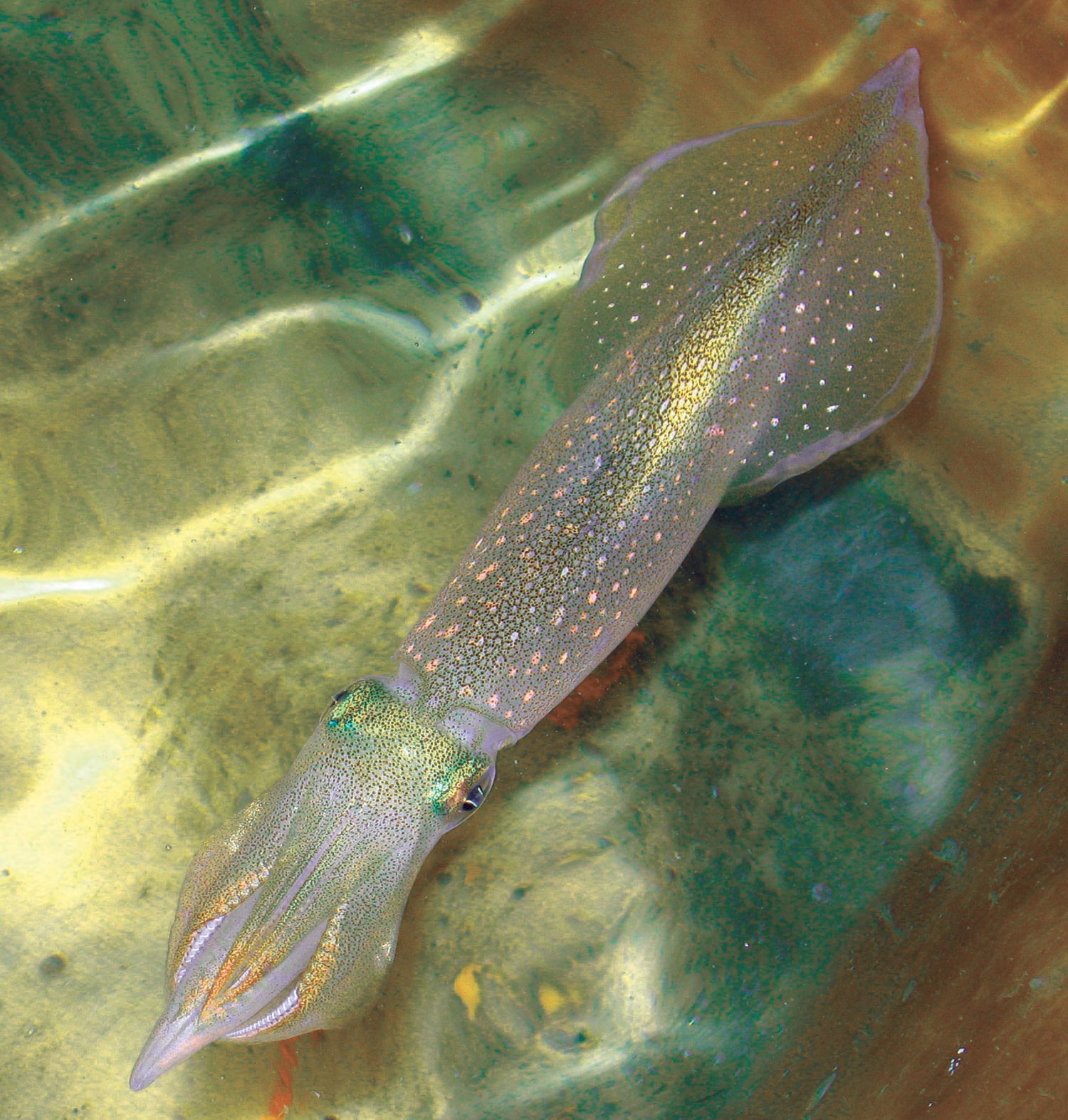
A Cephalopods nervous system is about as weird as the creatures’ external features. The evolutionary pathway that led to this infinitely complex nervous system has long been cloudy and less understood than other aquatic species. Recently, chromosomal assemblies of three cephalopod species – two squids  know as Doryteuthis pealeii and Euprymna scolopes along with an octopus species known as Octopus bimaculoides – have allowed scientists to better recognize which specific genes are present and in what order. This newfound knowledge can allow geneticists to further study components within the genome that are driving the expression of these genes (Nature).

Cephalopod genomes are notably different than those found in humans. Genomes within the two species of squid were found to be about 1.5 times larger than that of humans. While the Octopus’ genes more closely resemble a humans at about 90% size. Furthermore, it is found that while humans evolved through meiosis, a process in which two rounds of genome duplication occurs, a cephalopods evolution does not involve whole genome duplication, but instead undergoes “immense genome rearrangements” according to a Science Daily article. Which makes sense given that cephalopods started evolving 300 million years before humans existed. Discovery of this difference in duplication is a foot forward in finding out how these complex and highly intelligent creatures have evolved and thrived.

Friday, March 15, 2019

A Genetic Oddity May Give Octopuses and Squids Their Smarts


According to a study from NY times, Coleoid cephalopods are the most intelligent invertebrates for their behavioral complexity through RNA editing. Coleoid cephalopods is a group compassing octopus, squids, and cuttlefish. Research has revealed that natural selection favored the RNA editing of the coleoids and slowed the DNA-based evolution that helped the organisms to have beneficial adaptations over time. The enzymes of these cephalopods swap out some of the letters (ACGU) of RNA encoding and produced modified RNA which creates proteins that weren't originally encoded in the DNA sequences. The coleoid genes share tens of thousands of these RNA editing sites which markably contained DNA mutations that leads to the source of new traits for adaptation of the organisms. Additionally, the RNA editing allows the invertebrates to swiftly manipulate their nervous system and to have dynamic control over proteins based on different environmental conditions or tasks. In octopus, RNA editing aids to quickly adapt to the changes in temperature.

I find it very interesting how the swapping of the RNA encoding letters in the coleoid genes creates DNA mutations which leads to advantageous traits for the organisms for adaptation. It is amazing how mutations in these invertebrates can be beneficial while in humans it can cause major defects.

Friday, July 28, 2017

Giant Squid, Giant Eyes, but Rather Small Brain Lobes


Many researchers have questioned the deep sea squid's large eye size compared to other creatures who have a much smaller eye size, such as the cephalopods. Research has shown that even though squids have the largest eye orbit in the animal kingdom, they also have a very small optic lobe. This explains that squids do not rely on visual cues for communication like the cephalopods do because the optic lobe, which integrates visual information with motor tasks, is reduced. This new research is of current fascination because it goes against common anatomical sense and raises the question for future on whether there is some other underlying biological reason for this difference in sea animals.

Article

Monday, April 10, 2017

Can you edit your brain like a Cephalopod?

Can you edit your brain like a Cephalopod?

https://www.sciencenews.org/article/cephalopods-may-have-traded-evolution-gains-extra-smarts
cuttlefish

Cuttlefish, octopus, and squid (cephalopods) can alter the DNA of their brains to code for new amino acids and, further, proteins that are not scripted in their DNA blueprints. They edit 11-13 percent of their brains protein making codes. The RNA editing changes adenine to inosine allowing new codes for amino acids.

New research is suggesting that this excessive amount of RNA editing is causing the slowing of cephalopod evolution. This seems contradictory as they can edit as many sites as they please causing diversity. When RNA is edited, it must fold into complex shapes and stretch so that it can turn from a single to double stranded molecule. However, this causes the inability for DNA mutations to occur at these sites. By limiting DNA mutations, genetic diversity for evolutionary purposes is not occurring at a fast rate. The trade off of having a smart brain versus evolution seems like a fair trade off to me. I  would like to further know what is the fate for these cephalopods? These animals are some of the smartest and fierce predators of the sea.  I think evolution should hopefully not pull so much weight in the survival of these animals due to their RNA editing and maintaining their intelligence to be one of the top species of the sea.
 This figure shows the uniformity to RNA editing of a certain gene and how it creates the same phenotype among all three species.

Link to how RNA editing works!

Tuesday, April 7, 2015

Squids Can Change Their Genes - And Maybe Ours One Day, Too


A recent study done by Dr. Eli Eisenberg at Tel Aviv University has come to the conclusion that the longfin inshore squid is capable of modifying its own genome sequence. While RNA is known to, typically, transcribe the gene sequence of an organisms DNA without purposeful deviation, some animals have been observed changing the individual nucleotides on the transcribed RNA. More frequently, members of the cephalopod group, including the octopus and squid, have been using this technique of altering their RNA in response to temperature changes and environmental needs. The study discussed in the popular science article focused on the longfin inshore squid, and found that 60% of the transcribed RNA sequences were purposefully edited. Because squids – and other cephalopods – have such complex nervous systems, researchers are theorizing that these changes are a way for the squids to adapt more easily to environmental changes. In fact, in light of the damages inflicted by humans on the climate and especially in the ocean, squids appear to be doing well  , especially compared to the declining numbers of other marine species. Its possible, even likely, that the ability to alter its RNA is what’s allowing the squid to adapt to and survive in the increasing strain of the environment. Beyond just the impressive skills of the squid, this finding bears implications in the human world. Because some pretty serious human diseases are results of issues in RNA transcription, the ability to selectively edit RNA sequences could come in handy. Research is starting on how this discovery can be used to make humans just as hardy as our aquatic friends.