Showing posts with label IQ. Show all posts

Wednesday, January 27, 2021

Reaction Range Theory


    The Reaction Range Theory states that genetics determine the range of possible heights, weights, IQs, etc. a person can exhibit (known as the reaction range), while environmental factors such as nutrition and disease determine the height, weight, IQ, etc. within the range. The scope of environmental factors that impact certain traits are dependent on the traits themselves; there is very little environmental influence on eye color, but there is a vast number of environmental factors that influence abstract reasoning.

    The Nature v. Nurture argument is unproductive in this case. One does not dominate the other. Both serve important roles in determining a person's phenotype.

    Person A's genetic IQ limits are 90 and 120. If person A grew up in a high quality, nurturing environment, he will reach closer to the top of his genetic potential (120). Person B's genetic IQ limits are 120 and 150. If person B grew up in a low quality environment, he will reach closer to the bottom of his genetic potential (120).

    The obvious counterexample to this theory is obesity. We are not genetically predisposed to weigh over 400 pounds. This theory supports most, but not all traits.


Links:

https://www.ncbi.nlm.nih.gov/pmc/articles/PMC3341646/

https://cdn.auckland.ac.nz/assets/education/about/research/docs/FOED%20Papers/Issue%206/ACE_Paper_9_Issue_6.doc


Monday, December 7, 2020

Are you Intelligent because of your Genetics?


    In short, yes! Scientists have done studies that have compared twins and adopted children with their families IQ. They tested to see if there was any correlation. There was some relationship between families IQ and their children's, however it was not strong enough evidence to point at one gene or another. Scientists concluded that many genes probably code for intelligence with also strong environmental factors. I think that intelligence is more environmental than genetic. I think that if anybody works hard enough at something that they can succeed as much as anybody else. Maybe it would be more difficult if they lack a natural ability, but I do not think that bad genetics make you unintelligent.

https://medlineplus.gov/genetics/understanding/traits/intelligence/ 

https://www.human-intelligence.org/intelligence-is-genetic/ 

Wednesday, December 5, 2018

IQ and Disease Testing in IVF Embryos'

A new genetic test is on its way to the Unite States that screen IVF embryo's for a low IQ and high risk diseases such as breast cancer, heart disease, and diabetes. People in society have always had the want to create the "perfect baby". New methods that have arose may make this possible. IVF embryonic genes are able to be tested for high risk diseases and low IQ created by the firm Genetic Prediction. These test have not been used yet but the firm is working closely with many IVF clinics so it can be made available to their customers. The firm reports that when it comes to intelligence can only determine "mental disability" in the embryonic state. These forms of testing is not available in the United States just yet.

The Genetic Prediction firm has become the first company to make polygenic risk scores in embryo's available. Their purpose of these tests is to screen out any of the embryo's testing for the risk of specific medical conditions. The test that they have created for "mental disability" is considered controversial where they do not have enough accuracy to determine the IQ for each embryo. On the other hand, they can determine certain outliers that give people the change to not pick the embryos that have a potential IQ below 25. It cannot be understood how many other genes are involved in low risk of heart disease and high intelligence. Any kind of genetic testing has been impossible to detect certain genes that play a role in diseases and development. Now with may of the technological advances, we are able to evolve testing strategies to ensure a healthy individual. I wonder if people in the Unite States would be interested in this kind of testing of IVF embryos. If these genetics test are available in the United States, I believe it would not get a warm welcome from everyone. I see it as picking and choosing a certain child, whereas we're all the same and each deserve an equal amount of love and attention.


Article: https://www.newscientist.com/article/mg24032041-900-exclusive-a-new-test-can-predict-ivf-embryos-risk-of-having-a-low-iq/
Related Article: http://americanpregnancy.org/infertility/in-vitro-fertilization/


Thursday, May 3, 2018

DNA tests linked to IQ

New gene studies have allowed genetic researchers to discover more than 500 genes they believe can be tied to IQ test results. These studies involve over 200,000 test takers and there are impending results coming out soon in another experiment involving one million people's DNA tied to their academic success. A concept called precision education involves a DNA IQ test that will allow parents to purchases tests themselves through retail that they can than use to test their children and forecast their academic success. At the current moment the variations among these tests have explained less than 10% of the difference in intelligence between the people of European ancestry who have been studied. There are at least 3 online testing services that are already offering to quantify a person's genetic IQ.


I think this is interesting, however I am cautious to give it a ton of merit until more studies follow with similar or stronger results. If this is a plausible concept it would certainly be beneficial to the  parents who are the type of people that want to know every little thing about their child so that they can plan accordingly. As a future educator I do not believe that there is much here that should be used in deciding what type of classroom or learning environment a student belongs in. I think it is very dangerous to forecast what type of student or how smart a child will be. Genetics may offer an early advantage to some people, but that is only a small head start, the vast majority of what makes up a person's personality and intelligence has a lot to do with the environment they are in while in their early developmental stages. So cool concept, may turn out to be plausible and a tool parents can use if they want, but I don't think there is any place for this in schools.

P.S.- Hoping some fool does not try to turn this science into race like we discussed earlier in the semester.

Article:https://www.technologyreview.com/s/610339/dna-tests-for-iq-are-coming-but-it-might-not-be-smart-to-take-one/

2nd Article: https://www.newscientist.com/article/2163484-found-more-than-500-genes-that-are-linked-to-intelligence/

Tuesday, December 5, 2017

Genes don't just influence your IQ—they determine how well you do in school


A research was done with more than 6000 pairs of twins found that academic achievement is influenced by genes affecting motivation, personality, confidence, and dozens of other traits. The researchers have also shown that a person's IQ is highly influenced by genetic factors. They identified about 20 genetic variants associated with intelligence, each accounts for just 1% of the variation in IQ scores. The genetic variants associated with head size and the volume of the hippocampus is important for learning and memorizing. However, it is been unclear whether the same genes that influence IQ also influence grades and test scores. Thus, by doing researches with twins, whom share the identical genome with each other concluded that there is a genetic basis for the differences in how easy or enjoyable children find learning, rather than their actual IQ. In my opinion, this research is fascinating, due to the result of it is so different from what the society expectation and from what I known. I thought intelligence is always correlated with how much neurons one have or their ability to learned and memorized fast. However, this study proved otherwise, it is due to their genetic variants regarding about the personality which corresponding to the feeling of enjoy the subjects that one are learning.
Reference:
Link 1
Link 2

Tuesday, August 8, 2017

Alzheimer's Genes Influence on Childhood IQ

An article published claims there is a genetic link between childhood IQ and the development of Alzheimer's disease later in life. Specifically, mutations of the amyloid precursor gene which has been known to give someone a greater chance of developing Alzheimer's, is now hypothesized to affect cognitive abilities in children. This could possibly affect childhood cognitive abilities because the gene causes the buildup of senile plaques in the brain, which eventually accumulate in late adulthood and cause Alzheimer's. Therefore, these plaques, though they have not accumulated to the extent that they do in the elderly with Alzheimer's could pose some hinderance in cognitive efficiency in childhood. More research needs to be done but any conclusions from this research will help provide a better understanding of Alzheimer's disease, childhood intelligence, and the link between the two.

related link! 

Wednesday, December 14, 2016

Why Left Handedness?

Why is left handedness so puzzling? It only accounts for 12% of the world's population. Yet, so many famous people have been left handed as well as five out of our last seven presidents to Einstein to the first man on the moon. What is it, genetically speaking, about left handedness, that explains this phenomenon?

To begin, the left handed origins have been observed in Neanderthals. Scientists studied the grooves in their teeth from them scratches they made while carving their food up and found that one in every ten Neanderthal scratched their teeth towards the left side. This can give us some insight as to how long the genes have influenced left handedness. However, scientists still do not understand what genes and how many are in play to cause left handedness.

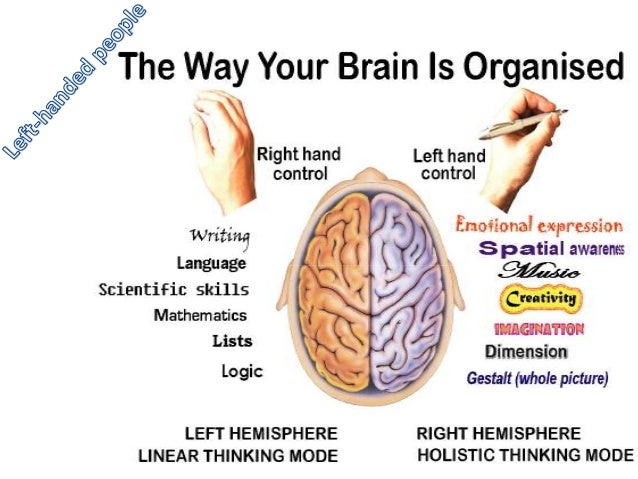
We do have a clue as to how it affects left handed people, however. Left handedness and intelligence seem to go hand in hand. Left handers disproportionately make up the small amount of people with a genius iq. For example, twenty percent of Mensa members (society where one must have a high iq) are left handed. For only about ten percent of left handed people making up the population, this is an interesting fact. There are some drawbacks to being left handed, however. 40% of schizophrenic people are left handed. Scientists believe this happens to left handed people who have equal access to both sides of the brain. This can cause complex messages to the brain that can result in misconnections in neural networks and thus causing the symptoms of schizophrenia. The science is not in on this yet, however.


Image result for left handedness


One thing is for sure. Left handedness should be studied more and understood. Many household names are left handed people that changed the world with their way of thinking. Science could have a breakthrough if they can understand how schizophrenia develops by studying the biological markers in left handed people. In any case, the left handed people are an important anomaly to understand, and essential in shaping our music, politics, and technology.


http://www.mirror.co.uk/news/technology-science/science/lefty-righty-here-astonishing-statistics-4757193

http://www.bbc.com/future/story/20160930-the-mystery-of-why-left-handers-are-so-much-rarer

http://www.anythinglefthanded.co.uk/being-lh/lh-info/advantages.html

http://healthland.time.com/2013/11/01/the-connection-between-left-handedness-and-schizophrenia/

Tuesday, November 25, 2014

What is Good Parenting?


A recent study questions the significance of parenting on an offspring’s intelligence. Whether it’s reading them a bedtime story or having family meals each evening, many parents believe that interaction with their children will have some influence on their intelligence later in life. A research team led by Kevin Beaver, a criminology professor at Florida State University, poses a statement that says that later-life intelligence may be more dependent on genetics. Some studies claim that parenting can influence how intelligent their child will become in adulthood, but Beaver and other researchers suggest that this association may be incorrect because such studies have not accounted for genetic transmission.


The study used a nationally representative sample of youths to study the link between parental behavior and later-life intelligence. They used adopted youths in the same age-range that were part of the Longitudinal Study of Adolescent Health and found that the adoptees were able to “more fully control for genetic confounding.” The behaviors of participants' parents were assessed, and participants completed an IQ test called the Picture Vocabulary Test that measured verbal intelligence, while at middle and high school. They completed the IQ test again when they were between the ages of 18 and 26.

The results revealed that among both the youth participants and adoptees, the influence of parenting on the children’s intelligence as they grew up were both marginal and inconsistent. A study on only monozygotic twins also revealed no consistent associations between parenting or family measures on verbal intelligence. This study challenges previous research indicating that parental actions influence a child's intelligence. He states that parents who are more intelligent try to influence their children but just end up masking the genetic transformation of intelligence in their children. This doesn’t mean that parents shouldn’t interact with their children, it just means that parenting will not have a detectable effect on their IQ, as long as parenting is within common boundaries.

In all honestly this article really shocked me. I had always believed that parenting plays a great effect on a person’s intelligence. In a way it makes sense because a person’s ability to learn can’t really be influence by environmental factors since it is something one is born with. I can argue that parenting does effect a person’s desire to learn, to work hard, and to put in their best effort. So sure, parenting may not effect a person’s IQ, but I feel like it plays a much more significant role in a child’s life. A person can be born with an amazing IQ but if they were raised in a home where their intelligence was not cultivated or appreciated, it’s like the intelligence doesn’t develop properly. So, yes, genetics may prove that parenting doesn’t have a direct effect on a child’s intelligence but in my opinion it is still a crucial element to a child’s development.

Tuesday, November 18, 2014

Genetics, Not Upbringing, Main Influencer in Child Education

           The debate has been around for ages. If a child is smarter than his or her peers, are they naturally talented academically? Or are their habits embedded in them via their upbringing conducive to working hard and constantly hitting the textbooks? New research published in the scientific journal Intelligence concludes that early adolescent experiences promoted by parents can not directly influence intelligence, at least not past their genetic contribution to their child.


           This study implies that if a child is advanced beyond his or her years, genetic factors play a key role in their intelligence. To provide credence for this conclusion, professors at Florida State University, the University of Nebraska, West Illinois University, King Abdulaziz in Saudi Arabia, and Erasmus University in the Netherlands used a research protocol with adoption based variability.
These researchers administered a Picture Vocabulary Test (PVT) to middle and high school students. This test was then given to the same individuals when they reached the ages of 18 and 26. The PVT served as a form of an IQ test for these people, and the results were juxtaposed in comparison to each age they took the test. The research found no significant difference between the IQ's of adopted and non-adopted children. "The way you parent a child is not going to have a detectable effect on their IQ as long as that parenting is within normal bounds." says Kevin Beaver, a criminology professor at FSU.

Main Article: http://www.foxnews.com/health/2014/10/30/genetics-not-upbringing-main-influencer-in-childs-iq-study-says/

More Information: http://www.livestrong.com/article/254240-what-is-a-high-iq-for-a-child/

Wednesday, November 5, 2014

Genes Play Role in Academic Achievement

Researchers at King's College London recently did a study on more than 11,000 pairs of twins that were born between the years of 1994 and 1996 to see how well they did in school. The researchers did not just focus on IQ, they also focused on 83 other traits that varied from happiness to health to how well they did in school or how hard they worked. The researchers then collected data on how well these twins did on the General Certificate of Secondary Education (GCSE) exam because all students take this test in the UK to use in their admission to higher education.

The researchers found that nine general groups of traits were hereditary from looking at identical vs. nonidentical twins. These traits also correlated with performance on the GCSE. The team determined that about 62% of the individual differences in academic achievement could be attributed to genetic factors.
Academic achievement is influenced by genes that affect personality, motivation, confidence, and other traits that shape intelligence. This study can help find new ways to improve childhood education and find ways to teach kids through different techniques more suited to their genes and personalities. This study could help shape a new way for schools to run because it seems like the educational system is failing a lot of students nowadays. This can also lead to more research specifying which gene(s) go with which trait(s) and ways to help people without these genes or if there are ways around not having specific genes. This article was very interesting to me and the research could expand a lot more and become more specific which would lead to a lot of change in education.

Original Article: http://news.sciencemag.org/biology/2014/10/genes-dont-just-influence-your-iq-they-determine-how-well-you-do-school

Friday, October 31, 2014

The Aging Brain


     Aging has always been something of interest because there is no real distinction of whether aging is just a natural occurrence or if it is the result of disease. The ability to maintain cognitive development and abilities into old age are current aims for scientific studies. Without the strong protection the brain has, it is susceptible to vascular conditions, metabolic syndromes, and chronic stress. Scientists believe that studying cognitive aging is relevant to identifying how to intervene on aging and improve the quality of life.
   
     One study found IQ tests from Scotland from 1947 and had Scotland citizens that took those tests previously take them again, at 78 years old. From that study, it was found that participants in the IQ test at age 11's scores could predict about 50% of the variance in their IQ's at age 78. This study was interesting and is a good example of the work scientists are doing to try to link aging and cognitive function.

Main Article
Related Article