Showing posts with label "Mitochondria". Show all posts

Wednesday, November 26, 2025

New In Vitro Strategies to Improve Healthy Baby Delivery Rate


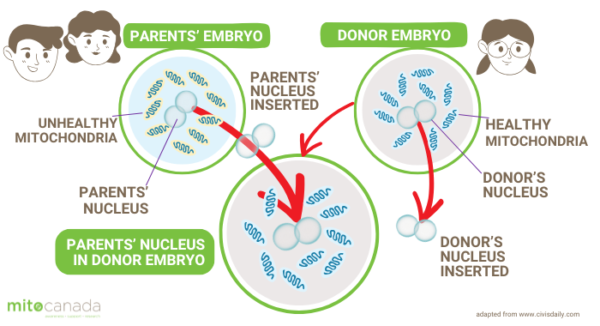
    Studies using new IVF techniques performed by expert scientists at Britain's Newcastle University and and Monash University of Australia resulted in eight healthy babies being born. This new strategy combines the DNA from the mother, father, and an additional donor to lessen the risk of inheriting rare mitochondrial diseases. 

    The procedure is called pronuclear transfer, where the nuclear DNA from the mother and father is transferred into a donor egg that acquires healthy mitochondria, yet lacks the nuclear DNA. This results in the child having over 99% of their genetic material derived from the original parents, while allowing just enough DNA from the donor to replace disease-causing mitochondria. 

Figure I: chart demonstrating pronuclear transfer

    The outcome was a success, where all 8 babies (four girls and four boys) demonstrate on track development while presenting low non-disease causing and even undetectable levels of mitochondrial mutations.

    The downsides to this research is that long-term monitoring is required before this is an everyday practice. Additionally, it is also an ethical debate being that this technique involves gene alterations to humans. However, it is important to note that this is an incredible opportunity for families affected by mitochondrial diseases to be able to have children without passing down that unforgiving variant and it is a major stepping stone for other hereditary diseases as well. 

Sources:

https://mitocanada.org/what-is-mitochondrial-replacement-therapy/


https://www.scrippsnews.com/health/healthy-babies-born-in-britain-after-scientists-used-dna-from-three-people-to-avoid-genetic-disease 

 https://www.nejm.org/doi/full/10.1056/NEJMoa2415539 

Tuesday, November 19, 2024

Mitochondrial DNA Insertions into Nuclei of Brain Cells


It has recently been discovered that mitochondria have been inserting bits of mitochondrial DNA into the nuclei of brain cells at unusually high rates. During a study on over 1,200 older adults, it was found that the more mitochondrial insertions an individual had, the younger they died. One of the normal functions of mitochondria is to ship their DNA into the nucleus of the cell to integrate it with the nuclear DNA in a process called numtogenesis. Numtogenesis has been commonly observed in reproductive cells and cancer cells but has never before been observed in brain cells. These insertions were studied on blood cells and brain tissue from the cerebellum and the dorsolateral prefrontal cortex, or DLPFC. What they found is that cells from the DLPFC had an average of 15 times as many insertions as the blood cells and 5 times as many insertions as the cerebellar cells. It was also discovered that mitochondrial insertions increased under certain stressors such as drug treatments or genetic mutations.


In my opinion, this is something that definitely needs more attention. I believe this is something necessary to further study. This study seems to suggest that numtogenesis is somehow linked to life span. Since the DLPFC has been known to be affected by many age related and neurodegenerative conditions, the higher rate in mitochondrial insertions in the DLPFC could provide a potential explanation or be linked as a factor. With this knowledge we could potentially develop improved treatments for these conditions.


Tuesday, July 30, 2019

Cats Domesticated Humans

        The house cat is the most popular pet in the world. Today's house cat is only domesticated species in the family Felidae. This carnivorous mammal comes in 60+ recognized breeds from designer breeds, like the Toyger, to regular mixed breeds like the domestic short-hair. At one point, these animals were bred for milk, fur, labor, or meat. However, it has been long believed by scholars that around 3,600 years ago Egyptians started to keep them as pets. However, new research in the last 10 years has given us a more knowledge on our relationship with cats, and how they evolved with humans.
        Researchers examined 1,000 wild and domestic cats to help determine which subspecies of wildcat gave rise to today's domestic cat. Wildcats are very territorial and typically defend their homes for life. This lead researchers to believe that although the genetic composition of the cats would vary from region to region, in each particular region the genetic composition would be fairly stable over time.  In analyzing their collected data, they were able to determine that the DNA clustered into 5 groups, Middle Eastern Wildcat, Central Asian Wildcat, South African wildcat, European wildcat, Chinese Mountain cat, and Sand Wildcat.  They noticed that wildcats from each of these groups can all have their ancestry traced back to the same region, today's Middle East, and that all are descendants from the wildcat F.s. lybica. In comparing the mitochondrial DNA, and DNA microsatelites of the domestic cat to the wildcat data, it became clear the domestication occurred again in the Middle East. Leading researchers to now believe that domestication actually occurred in the Fertile Crescent and not Egypt.
                                                          (Scottish wildcat)
        With new genetic evidence pointing to the Fertile Crescent as the sight of domestication, another break-through discovery was made in cat domestication. In 2004, on the island Cyprus, archeologist uncovered human remains buried next to a cat. After dating the evidence, it was determined to be 9,500 years old, roughly 6,000 years before the Egyptian domestication theory. This finding is extremely crucial in dating the domestication of house cats because wildcats are not native to the island Cyprus, meaning the only way a feline could have gotten there is if it was transported there by boat.  This suggests again, that people of the Middle East had been keeping cats long before Egyptians, and were even transporting them on boats.
       The newest theory of cat domestication revolves around the Middle East and the Fertile Crescent. It is believed that maybe humans did not originally intend to domesticate cats at all, and the felines were exploiting our newly found agriculture to survive. Wildcats are strictly carnivourous animals, so crops do not appeal to them, however, the new rodents that came along with farming did. Wildcats could take advantage of the field new mice and rodents that came along with humans newest agriculture trend. When thinking about the domestication of the house cat, it's quite comical that essentially cats have not served much purpose to humans. They do not listen to commands. Do not carry out specific tasks for humans unless it benefits them. And rarely do they want to be held captive inside a house. Even the house cats of today still display these qualities.
        All of this evidence comes down to one new theory. Humans never domesticated cats. Cats just chose to live near us because we provided them food. In today's day we still provide them with food but also with shelter, and in typical cat fashion, they even have us picking up their feces and throwing it out for them. It seems like cats really have domesticated us in a way that their wildcat ancestors could only dream.
       I love cats, and thought this article was great because it gave insight into a thought that is commonly misinterpreted. Humans never really domesticated cats with a particular purpose.  It is remarkable to think that we now take care of our house cats because their ancestors decided to feed on the rodents from ancient crops. When thinking of dogs, horses, chickens, or most domesticated species the animal typically serves a purpose. However, without the mice for cats to eat in the Fertile Crescent, cats would probably not be house pets today, and most definitely not the most popular one.

https://www.ncbi.nlm.nih.gov/pmc/articles/PMC5790555/
https://science.sciencemag.org/content/317/5837/519
https://books.google.com/books?hl=en&lr=&id=GgUwg6gU7n4C&oi=fnd&pg=PA179&dq=cat+domestication&ots=V07J3Eg67f&sig=MeFR_gQpnNMzWgwk9Ggbmk16uTo#v=onepage&q=cat%20domestication&f=false
Friday, April 12, 2019

A Baby Boy born with three Biological Parents

Through a new in vitro fertilization (IVF) technique a boy was born with DNA from three parents. Researchers have questioned if the number of mitochondrial DNA will help with a successful pregnancy. This trial was done on a woman will taking her egg a mans sperm and also introducing a female donors mitochondrial DNA. The woman had tried IVF four times and was unsuccessful each time until the experiment. There not the only ones trying this method of in vitro fertilization currently there are already eight other implanted eggs and 24 other women signed up for the trial.
Although, this may seem like the perfect solution for women that want to get pregnant it's only been approve for families that have rare mitochondrial diseases. I think that the mitochondrial DNA could've been helpful in the IVF treatment but this is the first of this kind of study and not enough information to justify using mitochondrial DNA. This seems very interesting and would definitely be helpful to some but I think could mislead or give false hope to others. However, I think that this sort of thinking would be correct based on how mitochondrial DNA is important to cell function and because everyone obtain mitochondrial DNA from their mother.

Wednesday, November 21, 2018

Mitochondrial DNA and Metabolic Disorders

Mitochondria are organelles that provide cells with a source of energy for their metabolic processes. Because the organelles posses their own separate DNA, they are theorized to have previously been separate cells evolved to live within a larger host cell in an endosymbiotic fashion. Though human mitochondrial DNA only posses 13 genes, researchers at The University of Alabama-Birmingham are now linking this organelle to metabolic diseases that disrupt the body’s normal energy production, expenditure, or maintenance.


This study was a breakthrough from typical disease studies that only utilize chromosomal genetic techniques to explain disease susceptibility. This is because mitochondrial DNA is passed along solely through maternal lineage in comparison to chromosomal genes that rely on both parental gene pools. Mitochondrial genes exist in 25-35 basic haplotype states, which means each set of alleles are inherited together.

In short, this study tested the differences in mice susceptibility for metabolic diseases based on their particular subtype of mitochondrial DNA. When mice were switched from a low fat-diet to a high fat diet, scientists noticed that total fat composition and metabolic activity was correlated with specific mitochondrial DNA sequences.  Chromosomal DNA was eliminated as a variable by including control groups with similar nuclear DNA sequences but different mitochondrial backgrounds. Different mitochondrial backgrounds were also found to influence the amount of genes affected as a result of exposure to a high fat diet. The final consensus of this research study was that different combinations of nuclear and mitochondrial DNA dictate how metabolic processes are carried out in organism. This informational link is very plausible because mitochondria regulate a lot of the energy conversion processes within the cell but, it will be interesting to see what solid conclusions can be made regarding patient disease susceptibility and specific genetic backgrounds as research in this area continues to progress.