Studies using new IVF techniques performed by expert scientists at Britain's Newcastle University and and Monash University of Australia resulted in eight healthy babies being born. This new strategy combines the DNA from the mother, father, and an additional donor to lessen the risk of inheriting rare mitochondrial diseases.
The procedure is called pronuclear transfer, where the nuclear DNA from the mother and father is transferred into a donor egg that acquires healthy mitochondria, yet lacks the nuclear DNA. This results in the child having over 99% of their genetic material derived from the original parents, while allowing just enough DNA from the donor to replace disease-causing mitochondria.
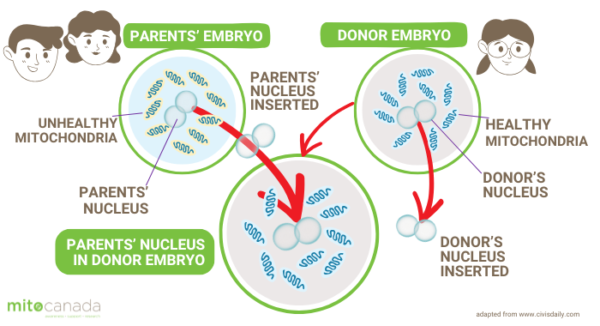
The outcome was a success, where all 8 babies (four girls and four boys) demonstrate on track development while presenting low non-disease causing and even undetectable levels of mitochondrial mutations.
The downsides to this research is that long-term monitoring is required before this is an everyday practice. Additionally, it is also an ethical debate being that this technique involves gene alterations to humans. However, it is important to note that this is an incredible opportunity for families affected by mitochondrial diseases to be able to have children without passing down that unforgiving variant and it is a major stepping stone for other hereditary diseases as well.
Sources:
https://mitocanada.org/what-is-mitochondrial-replacement-therapy/
https://www.scrippsnews.com/health/healthy-babies-born-in-britain-after-scientists-used-dna-from-three-people-to-avoid-genetic-disease
https://www.nejm.org/doi/full/10.1056/NEJMoa2415539

This is such a powerful example of how reproductive genetics can directly change families’ lives. I like how you explained pronuclear transfer in a clear way especially the point that more than 99% of the baby’s DNA still comes from the biological parents, while the donor only contributes healthy mitochondria. That really helps counter the oversimplified “three-parent baby” headlines you sometimes see and shows that the goal is disease prevention, not designer babies.
ReplyDeleteI also appreciate that you mentioned both the success (eight healthy babies with low or undetectable mitochondrial mutations) and the need for long-term monitoring. Since mitochondria are passed down through generations, it makes sense that scientists need to watch carefully for any unexpected effects. The ethical questions are definitely real, but for families with severe mitochondrial disease, this technology could be the difference between having a sick child and a healthy one. Your post does a nice job showing how this research sits at the intersection of hope, risk, and ethics.
This is such a well-written summary of cutting-edge IVF research! I really like how you clearly explained pronuclear transfer and how it allows families to have children with healthy mitochondria while keeping nearly all of the parents’ genetic material. It’s amazing to hear that all eight babies are healthy and developing on track. It really highlights the potential of this technique. I also like how you addressed the ethical considerations and the need for long-term monitoring. It’s important to recognize both the promise and the caution in this kind of research. Overall, this post does a great job showing how science is providing new opportunities for families affected by mitochondrial diseases, and it’s inspiring to see how this could pave the way for treatments of other hereditary conditions as well.
ReplyDelete