Showing posts with label receptor. Show all posts

Monday, November 22, 2021

The Brain Cell Receptor that is Linked to Depression and Anxiety


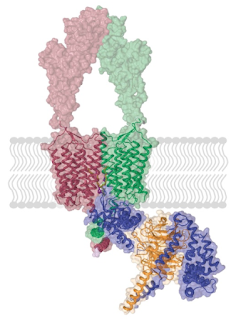
GPR158-RGS7-Gβ5 Structure Rendering

The structure for the GPR158-RGS7-Gβ5 Brain Cell Receptor was recently published by Scripps Research, Florida, Columbia University, and the Indian Institute of Technology in Kanpur in the journal Science in a paper called “Cryo-EM structure of human GPR158 receptor coupled to the RGS7-Gβ5 signaling complex”. This signaling complex is responsible for acting as the receptor for feelings of anxiety and depression. The structure was discovered using Cryo-EM, or Single-Particle Cryo-Electron Microscopy.

This structure appears on brain cells and can either be genetically inherited or can develop over time due to stress or trauma.

GPR158 is an orphan G-protein-coupled receptor, shown in the green and red colours of the rendering. RGS7, shown in blue, is the signaling complex. Gβ5 is shown in yellow and is paired together with RGS7 as part of the signaling complex. The lipid bilayer is shown in grey.

Now, with the structural information confirmed, drugs can be developed to disrupt the function of this receptor in a way that reduces the level of anxiety and depression in an affected person. More research for specific drug administration is needed, but having the structure of the receptor is a vast leap towards developing new medications to help with anxiety and depression.

Friday, April 13, 2018

A Glimpse Into Infrared Sensing

Fer-de-lance pit-viper; infrared sensing pits found below the eyes.
Not all snakes rely heavily on their pure vision to find and strike their prey. Pit-vipers and rattle snakes are able to sense the infrared radiation given off, in the form of heat, by mammals to find their next meal. But what genes had to evolve to allow these reptiles to sense that which is not visible to the naked eye? That would be the TRPA1 gene. Published in 2011, this study sequenced the genes of 24 snake species, which represented nine snake families as well as other non-snake outgroups. What they found, was that snake species that have the pit organs had a high positive selection for the TRPA1 gene, while the other species did not. This finding indicated that the TRPA1 gene only evolved in the species that are able to detect infrared. The TRPA1 gene codes for the TRPA1 protein, which are then showed to have some amino acid substitutions dependent on the high positive selection, or lack of high positive selection.

The specific proteins that the gene code for are receptor proteins. In humans, these receptors, also known as ion channels, drive the response that we have to spicy foods like wasabi. Dr. David Julius and his team found that TRPA1 evolved to be increasingly sensitive to heat, activating at temperatures as low as 80 degrees Fahrenheit (18 degrees cooler than the normal human body temperature).  This TRPA1 gene is described to be millions of years old, but the viper and other snake species that use infrared sensing are much younger in comparison.

I think that the analysis of the infrared sensing genes in the snake species as well as other animal species is a really great way to demonstrate evolutionary abilities of genetics. It's incredible the a gene that is also found in humans to be able to feel heat when tasting spicy things, can vary so differently as to code for infrared sensing organs in snakes. I think the New York Times article does the best job by stating "evolution of new abilities does not necessarily require new genes, but new variations of old genes".
Monday, February 1, 2016

Studies Show Correlation Between Infidelity and Genes

Marital infidelity is an issue we are all familiar with and often it is just sees as a poor life decision. In recent studies, researchers have found that some people are more inclined to cheat than others due to mutations in certain receptor genes. It has long been believed that men cheat because they can increase their chances of having more offspring. While this evolution theory may hold some relevance, more evidence seems to point to variations of the vasopressin receptor gene.


Vasopressin and oxytocin are both hormones that play a role in sexual bonding and attraction. When a study was carried out recently with 7,400 Finnish twins and their siblings surprising results were found. Out of the people in the study who had cheated, links between promiscuous behavior and vasopressin were only found in women. Dr. Zietsch, the psychologist who was in charge of the study, stated that there are many circumstances that contribute to infidelity but about 40% could be linked back to genetics. In a different study, relations between oxytocin receptor genes and marial infidelity were found in women and men had links between vasopressin receptor genes and marital discord.

Studies have not only been done on humans, but also animals to help prove this theory. For example, the difference between the sexual behavior in montane voles and prairie voles is due to where the vasopressin receptor genes are located in their brains. The receptors for prairie voles are located in proximity to the brain's reward center causing them to remain in monogamous relationship. Where as in montane voles the receptors are found in the region associated with anxiety and fear causing no attachment to be formed to their partners. Experiments showed that it was possible to make a montane  male vole act monogamously by increasing the number of vasopressin receptors in the brain's reward center. The same goes for female voles except by increasing oxytocin receptors instead of vasopressin.

Although, the studies prove that infidelity may be caused due to certain hormones it is still a choice. The article even states, "Correlation is not the same as causation; there are undoubtedly many unmeasured factors that contribute to infidelity." From this it can be concluded that some people are more wired to cheat, but this does not mean they can use it as an excuse.


Thursday, November 13, 2014

Cold-Induced Pain Linked to the Garlic, Mustard Receptor


Depicted Above: Researchers Edward Högestätt, Lavanya Moparthi, Urban Johanson and Peter Zygmunt.

A group of researchers from Lund University in Sweden identified what causes the connection between cold and pain. Ten years ago they discovered the receptor that reacts to the substances in mustard and garlic. The purpose of this experiment was to see if this receptor also responds to cold, which seems to be the case. 

The research group's findings "increase our knowledge of the human body's temperature senses, [and can] also help all those who suffer from cold allodynia [: people] who are over-sensitive to cold and experience pain when exposed to cold." Edward Högestätt explained how these issues occur in patients containing chronic pain or diseases that affect the nervous system, like diabetic neropathy. "Patients undergoing chemotherapy can also become over-sensitive to cold as a side-effect of their medication. The discomfort and pain experienced by patients can start at relatively mild temperatures, within the temperature span to which the mustard and garlic receptor reacts." Peter Zygmunt states that we now know the mustard and garlic receptor reacts to temperatures under 20°C, thanks to this experiment. Additionally, the chilli receptor reacts to temperatures over 42°C (burning your hand), while the menthol receptor reacts to temperatures under 28°C (pleasantly cooling).

The research group believes that if the receptors that cause pain from cold temperatures are blocked, than pain will be relieved for individuals undergoing this issue. Because of this, drugs designed to block the receptors that cause itching, incontinence and pain are in the midst of being created. Potential new drugs for people who are affected by perfume, solvents, cigarette smoke, car exhausts can also benefit those who are over-sensitive to cold in the airways, since the mustard and garlic receptors are sensitive to this. I think this is very convenient for individuals who suffer from these conditions. New drugs that help people sensitive to these conditions can relieve a lot of stress and other issues that arise from these sensitivities. However, the expense for these drugs may not be worthy for individuals who cannot afford them, or even feel they are necessary. Pharmaceutical companies should definitely take this concept into consideration.

Article:
http://www.sciencedaily.com/releases/2014/11/141113085154.htm

Related Article: 
http://www.news-medical.net/news/2006/03/28/16936.aspx

Wednesday, March 20, 2013

Is Empathy in our Genes

A Health.com article among other articles found discusses whether our emotional reactions to others is the result of coding in our genes. A new study suggests that traits such as being open, caring and trusting are linked so closely with this genes, that a trained individual monitoring human interactions could determine whether there was variation in said gene. Previous studies have also linked genes to behaviors such as bonding empathy and anxiety. This gene acts as a docking station for the chemical oxytocin found in the brain. People with two "G" variants of this receptor tend to have better social skills and higher self esteem while those with at least one "A" variant have a more difficult time with stress and have worse mental health.

It is also important to recognize that these oxytocin receptors are not the only determining factor of social behavior. Life experiences and surroundings are known to effect the oxytocin receptors, thus affecting an individuals social behavior. Having the "A" variant does not automatically result in poor social skills, but it is interesting to see thehigh correlation between the two.