Showing posts with label protein structure. Show all posts

Friday, April 12, 2024

Neurological conditions have sex biases found in brain protein expression

 A team from Emory University used more than 1200 donated post-mortem brains to identify 10,200 proteins for sex-based differences. From the 10,200 proteins, 1200 of them showed differences in expressed levels based on biological sex. As the article explains, "They assessed protein expression between alleles with single nucleotide polymorphisms and looked for pQTL differences to determine if sex influenced this allele expression" (The Scientist). Ultimately, they found that these 1200 proteins corresponded to about 150 proteins with sex-based expression. The team compared these proteins to other sex-based proteins associated with psychiatric, neurologic, or morphologic traits and found 35 similarities. The team currently believes that with extended research, time, and genomic studies, this data could improve treatments and therapeutic remedies in the future. 

While reading about the research done, I found it important to take note of such a big sample size provided by the donation of the brains but also from the 10,200 proteins found during the study, having a large protein database can offer a lot to a study. The connection that was shown between specific protein expression levels and neurological conditions is crucial to understanding the condition itself but can also lead to other benefits. The findings could hopefully help those affected by these neurological conditions by refining treatments that accommodates these specific proteins and reviewing treatment plans in general. 


https://www.the-scientist.com/biological-sex-influences-brain-protein-expression-71763
https://medicalxpress.com/news/2023-10-reveals-biological-sex-brain-proteins.html#google_vignette


Monday, November 22, 2021

The Brain Cell Receptor that is Linked to Depression and Anxiety


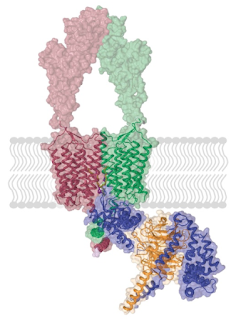
GPR158-RGS7-Gβ5 Structure Rendering

The structure for the GPR158-RGS7-Gβ5 Brain Cell Receptor was recently published by Scripps Research, Florida, Columbia University, and the Indian Institute of Technology in Kanpur in the journal Science in a paper called “Cryo-EM structure of human GPR158 receptor coupled to the RGS7-Gβ5 signaling complex”. This signaling complex is responsible for acting as the receptor for feelings of anxiety and depression. The structure was discovered using Cryo-EM, or Single-Particle Cryo-Electron Microscopy.

This structure appears on brain cells and can either be genetically inherited or can develop over time due to stress or trauma.

GPR158 is an orphan G-protein-coupled receptor, shown in the green and red colours of the rendering. RGS7, shown in blue, is the signaling complex. Gβ5 is shown in yellow and is paired together with RGS7 as part of the signaling complex. The lipid bilayer is shown in grey.

Now, with the structural information confirmed, drugs can be developed to disrupt the function of this receptor in a way that reduces the level of anxiety and depression in an affected person. More research for specific drug administration is needed, but having the structure of the receptor is a vast leap towards developing new medications to help with anxiety and depression.

Thursday, April 18, 2019

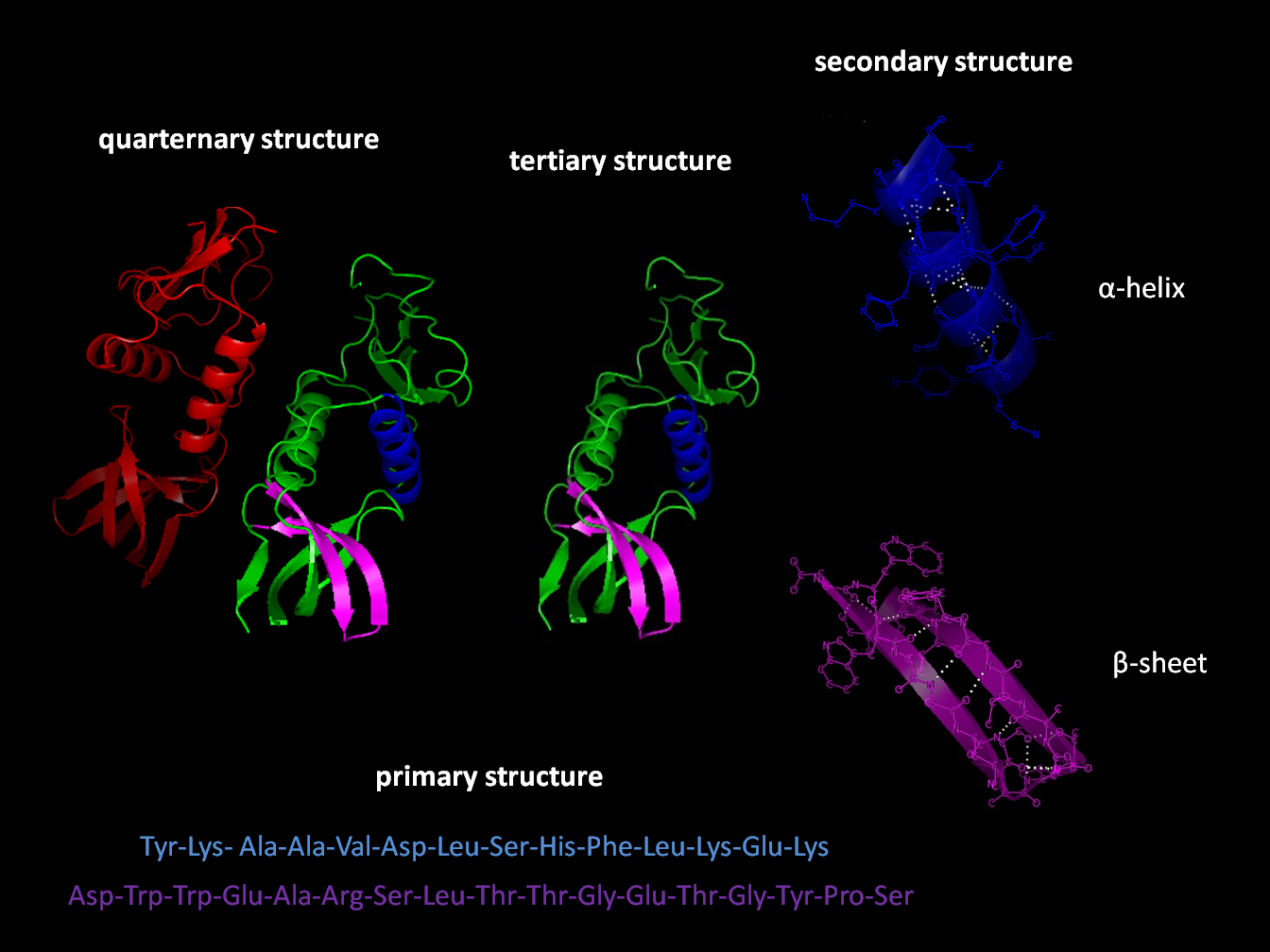
Protein structure

A article by Harvard Medical School explains how A scientist has used a form of artificial intelligence known as deep learning to predict the 3D structure of effectively any protein based on its amino acid sequence. This new approach for computationally determining protein structure achieves accuracy comparable to current state-of-the-art methods but at speeds upward of a million times faster.

Tuesday, April 28, 2015

Possible universal code of protein structure

A new study finds there may be a universal code to predict protein structure, which could help to determine why certain mutations cause disease and how to fix them. As the article explains, the human genetic code is a like a prescription for making proteins. Our cells follow this code to make individual protein molecules, which then fold up into 3D structures to carry out their function. Gevorg Gringoryan, the co-author of the study says "If we can predict the final 3D structures of proteins from their genetic sequence, we would be one step closer to understanding the cell on a molecular level and curing disease." The researchers believed that by breaking them up into fragments they called tertiary motifs or TERMs, they would be able to predict protein structures. As a result of their study researchers found that TERMs from natural proteins are reused by many unrelated proteins and from that information they can make models that connect sequence to structure. 

I found this article interesting because these findings suggest there is a possible universal code for protein sequence-structure relationships. The implications of understanding this code can be a great tool for determining how mutations cause disease and possibly ways to fix them. 


Primary Article can be found here