Showing posts with label plague. Show all posts

Sunday, April 18, 2021

Ancient Siberian DNA Reveals Plague


The picture above shows Lake Baikal where Siberians were infected with the plague bacterium, Yersinia pestis, about 4,400 years ago. A group of evolutionary geneticists extracted the DNA from 40 eastern Siberian human skeletons. From the 40 DNA samples, 2 of them contained the Yersinia pestis plague bacterium. The 2 skeletons dated back to 4,400 and 3,800 years ago. This data aligns with these two other studies very closely: Paleolithic to Bronze Age Siberians Reveal Connections with First Americans and across Eurasia  and Plagues plagued the Bronze Age. Researchers believe that ancient Siberians may haven been infected with version of Y. pestis that was not so harmful and virulent. Though this hypothesis has not been supported quite yet. In the end, this research has provided new insight on population shifts in that region. There has been research conducted in order to compare the ancient DNA from this region to present-day DNA from participants in Europe, Asia and North America. It was determined that ancient Siberias mixed several populations from within and outside of Siberia. It was concluded that this blending of populations occurred from the Late Stone Age to medieval times. Lastly, it was determined that the 2 ancient Siberians containing the Y. pestis in their DNA underwent large population changes during their lifetime. This genetic information is certainly fascinating and can be referenced when looking at ancient Siberian history. 

References 

Bower, B. (2019, August 08). Plagues plagued the Bronze Age. Retrieved from https://www.sciencenews.org/article/plagues-plagued-bronze-age

Bower, B. (2021, January 07). Plague may have caused die-offs of ancient Siberians. Retrieved from https://www.sciencenews.org/article/plague-bacteria-die-offs-ancient-siberians-genetics-dna

Yu, H., Spyrou, M. A., Karapetian, M., Shnaider, S., & Radzevičiūtė, R. (n.d.). Paleolithic to Bronze Age Siberians Reveal Connections with First Americans and across Eurasia. Retrieved from https://www.cell.com/cell/fulltext/S0092-8674(20)30502-X

Monday, December 10, 2018

The Plague in Ancient Neolithic Farming Communities

The large population decrease of European Neolithic farming communities had always been a mystery up until a group of researchers discovered a strain of plague found in a the genetic material of a woman in a rural farming area of 5000 years ago.  Another person buried near her also had traces of the strain of plague.  Based on the fact that this plague had reached Northern Europe earlier than the Eurasian migrants (how people originally believed it reached the area), scientists now believe that it developed in the communities by poor sanitation, too many people and animals.  Trade routes allowed for the disease to spread amongst Europe.  Once the Neolithic communities were wiped out, it allowed for the Eurasian migrants to spread out amongst Europe and this changed the genetic makeup of the continent.  After these discoveries, scientists recreated the genome of the ancient plague to dive deeper into how diseases can spread, and how they can disappear or stay prominent.
https://www.cnn.com/2018/12/08/health/ancient-plague-study-scli-intl/index.html
https://www.cell.com/cell/fulltext/S0092-8674(18)31464-8?_returnURL=https%3A%2F%2Flinkinghub.elsevier.com%2Fretrieve%2Fpii%2FS0092867418314648%3Fshowall%3Dtrue

Saturday, July 14, 2018

Sea Stars Started Dissolving. What Helped Some of Them Survive?

Sea stars are predators and their diet controls the ecosystem. In summer 2013, a plague effected the sea stars in California that caused them to slowly disintegrate. Researchers then compared the genes of sea stars before the epidemic and the survivors. They found that the current population of sea stars is genetically similar to the survivors than past generations; which made sense because the survivors then reproduced. In another testing along the coast of California, biologists found that some sea stars’ genes were still similar to the old generations. Before the epidemic wiped out the previous generation, they had already laid eggs. Biologists hypothesized that those eggs are most likely to hatch and resemble that same generation. 

I think it's fascinating how we are now able to view the genes of any organism and it allows us to control the environment by physically manipulating it. This research helps us keep on eye on the sea star's population, which is important towards maintaining the ecosystem.

Article Link
Related Article

Monday, December 7, 2015

Can teeth really show us evidence of plague?

Eske Willerslev and his colleagues, at the University of Copenhagen, in Denmark, began studying DNA from bacteria on teeth that caused plague during the Bronze Age and Iron Age. This time was marked between 4,800 and 3,000 years ago. Willerslev concluded the early plague germ, Yersinia pestis, was spread from person to person among the herders migrating across Europe and Asia during the Bronze Age. Coughing could have spread the plague, and if the germ caused a lung infection, the illness was considered pneumonic plague. If the blood of an individual became infected, it was considered septicemic plague.
            Willerslev and his team identified Y. pestis DNA on teeth from Bronze and Iron Age individuals. The DNA pieces showed up in seven of the 101 people. Two people with the strain were from Russia roughly 4,800 years ago. Another was from North Central Europe, 4,500 years ago. The third infected person examined was in West Asia from almost 4,200 years ago. Several more teeth collected were from Siberia and Poland and were 3,700 to 4,000 years old. The last sample was from an individual who lived in Armenia 3,000 years ago.
            From the evidence Willerslev and his team gathered, it is clear the germ spread over a wide area and for a large amount of time. Further investigation was concluded of the entire genome in the Bronze Age DNA. The analysis showed the earlier germ lacked the gene, which was present in the Iron Age individual. This gene allowed bacterium to survive in a flea’s gut. The plague germ would have been able to spread via flea bites at some point during 3,700 and 3,000 years ago.
            The biologists have compared plague DNA in one of the oldest Bronze Age individuals and the most recent Bronze Age individual and concluded both lacked a form of one plague gene that keeps an infected persons immune system from attacking the disease. This suggests that the earlier forms of the germ would have been vulnerable to attacks by the immune system. 

            One reason I found this article to be interesting was due to the time periods Willerslev and his team worked with. They collected and screened 89 billion pieces of DNA from teeth of individuals from the Bronze and Iron Age. That was almost 5,000 years ago! It is fascinating to know a scientist can pull ancient DNA from teeth of individuals that lived thousands of years ago. Another captivating point in the article mentioned this disease took over even when there really was no urbanization. But certainly this plague evolved and survived longer than expected. 

Wednesday, November 4, 2015

Gene alteration makes an ordinary stomach bug a dangerous virus

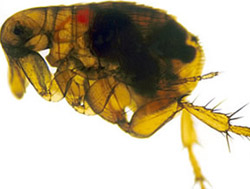
Tourists from the Yosemite National Park were diagnosed with a virus assumed to be the Black Plague. The plague, caused by the bacterium Yersinia pestis, has spread to multiple Western Americans through flea transmission. Recent findings suggest that the Y. pestis became lethal after altering the gene pla. The gene pla is originally responsible for preventing blood clots. Any bacterium with pla would be capable of preventing the body from forming clots during an injury and prevent further bleeding. The gene alteration made pla more virulent, so it could spread more easily with human contact or flea transmission. With the gene alteration in pla, Y. pestis can cause pneumonia at an alarming rate, and kill any person who hasn't receive proper antibiotics.

Oriental rat flea with Y. pestis in its intestinal tract
With findings in how the plague became more dangerous, scientists began to how the plague came to occur. They found that the plague existed for over 20 million years after finding an amber encased flea carrying an ancestor bacterium of Y. pestis. Other findings revealed that Y. pestis had an evolutionary precursor pathogen strain called Y. pseudotuberculosis, which at worst could cause slight diarrhea. After an experiment with the two pathogens, it was shown that the Y. pseudotuberculosis was poisonous to fleas, which made it impossible to carry to other organisms. On the other hand, the Y. pestis was not poisonous to fleas, so that could easily carried to other living organisms, such as humans. This made Y. pestis a more effective virus strain. Further research is being performed, but all that is known now is that Y. pestis has become a dangerous strain because of only one small gene alteration.

Original Article

Secondary Article

Saturday, March 23, 2013

The DNA of "Black Death"

[caption id="attachment_7272" align="alignright" width="412" caption="Excavators dig up remains of Londoners believed to have died from the Black Death."][/caption]

According to Sciencedaily.com, construction workers in London recently unearthed a burial ground containing victims of the Black Death while digging a new railway line on the edge of historic Charterhouse Square. Archeologists that are currently excavating the burial site say that it contained more than a dozen remains of people suspected of dying from the plague that ravaged 14th century Europe and claimed 75 million lives world-wide. Historical records revealed that a burial ground had been located in the area of the dig but were unclear as to the exact location until now. According to The Associated Press, thousands of Londoners were killed by the plague, though the exact number is unclear because record-keeping was so poor, said Roy Stephenson, head of the Museum of London's archaeological collections and archives.
Stephenson also said the bacillus is quite fragile and dies without a host so there is no chance that a new outbreak of bubonic plague might be ignited from the find.

The remains have been brought to the Museum of London Archaeology for testing. Project archaeologist Jay Carver said scientists will study the bones to confirm cause of death, and hope to map the DNA signature of the plague bacteria, which could be found in the teeth or bones of these victims. Radiocarbon dating could also be used to establish burial dates.
"This is a pretty rare find within London," Carver said Friday.

Though it may be a rare find these days in London, I have found that they are not all that uncommon around part of the rest of the country and other parts of Europe. The remains of over 75 million people are bound to crop up sooner or later with more of the world being transformed into modern communities. My concern is that though bacillus dies without a host, could it be possible that either a mutated strain is waiting to be revived or that a genetically modified version might rear it’s ugly head. Keep this away from Kim Jong-Un.