Showing posts with label Pla. Show all posts

Wednesday, November 4, 2015

Gene alteration makes an ordinary stomach bug a dangerous virus

Tourists from the Yosemite National Park were diagnosed with a virus assumed to be the Black Plague. The plague, caused by the bacterium Yersinia pestis, has spread to multiple Western Americans through flea transmission. Recent findings suggest that the Y. pestis became lethal after altering the gene pla. The gene pla is originally responsible for preventing blood clots. Any bacterium with pla would be capable of preventing the body from forming clots during an injury and prevent further bleeding. The gene alteration made pla more virulent, so it could spread more easily with human contact or flea transmission. With the gene alteration in pla, Y. pestis can cause pneumonia at an alarming rate, and kill any person who hasn't receive proper antibiotics.
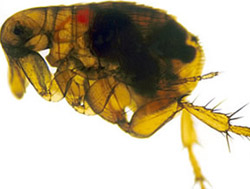
Oriental rat flea with Y. pestis in its intestinal tract
With findings in how the plague became more dangerous, scientists began to how the plague came to occur. They found that the plague existed for over 20 million years after finding an amber encased flea carrying an ancestor bacterium of Y. pestis. Other findings revealed that Y. pestis had an evolutionary precursor pathogen strain called Y. pseudotuberculosis, which at worst could cause slight diarrhea. After an experiment with the two pathogens, it was shown that the Y. pseudotuberculosis was poisonous to fleas, which made it impossible to carry to other organisms. On the other hand, the Y. pestis was not poisonous to fleas, so that could easily carried to other living organisms, such as humans. This made Y. pestis a more effective virus strain. Further research is being performed, but all that is known now is that Y. pestis has become a dangerous strain because of only one small gene alteration.

Original Article

Secondary Article

Thursday, October 1, 2015

Did One Gene Mutation Launch the Black Death?

     Scientists have always wondered what caused an epidemic like the the Bubonic Plague; what could have caused a mild germ, the bacteria Yersinia pestis, to turn into such a deadly bug? According to the U.S. Centers for Disease Control and Prevention, humans can contract this bacteria by being bitten by an affected flea being carried by a rodent or by just handling the rodent itself. Although now-a-days there antibiotics to battle against plague, in the mid-1300s, when the Bubonic Plague hit, there were no medicinal advancements like there are today. This is interesting because we were able to come up with a cure for such a lethal disease, but what made it so lethal in the first place?
     There was a team led by Wyndham Lathem, an assistant professor in microbiology-immunology at Northwestern University’s Feinberg School of Medicine in Chicago. They analyzed ancestral strains of Y. pestis to learn how the bacterium developed from a “bug” that primarily cause digestive tract related illness to one that could cause pneumonic plague, which infects the lungs. They found that the oldest ancestor was able to infect the lungs of the host, however it did not affect the lungs in the way that happened during the Black Death. 
The gene that could be the answer is Pla. The researchers theorized that the presence of this gene helps that bacteria to infect the lungs as well as make it as serious as it became. To test their theory, the team inserted the Pla gene into a less-lethal ancestral strain of the bacteria. By doing this, they were able to see that the changed bacteria was able to become just as dangerous as modern-day strains of Y. pestis. The researchers looked at many different variations of the Pla gene, and they found that there was one “tweak” that was found in modern day strains that allows the bacteria to infect the lymph nodes, which caused the Bubonic Plague. 
     Personally, I like this article because it always amazes me how disease evolve and become as deadly as the Black Death became. According to the researcher’s data, it is a minor "tweak" in one gene that caused the bacteria Y. pestis to go from just infecting the lungs and becoming a respiratory disease to becoming the deadly, lymph node infecting plague. The role of genetics here amazes me as well. Through looking at the genes of the bacteria, the researchers were able to discover why the bacteria became so deadly in the first place- and the cause is because of one gene mutation!
Original Article
More info on Y. pestis