Showing posts with label nose. Show all posts

Friday, April 26, 2019

The Bigger the Nostril, the Hotter the Air


It has been found through a study by a team of scientists from Pennsylvania State University that the shape of one’s nostril may share a relationship with the climate of the region that that person’s ancestors descended from. While noses are used for smelling, they are also used to warm and humidify the air that we breathe. It had been found that the more narrow the nostril, the more efficient the nose would be at warming and humidifying the air. Thus, people that descend from colder climates have more narrow nostrils, as they need noses that are more efficient at warming the cold air, and people that descend from warmer climates have wider nostrils, as they do not need noses that are as efficient at warming the already-warm air. It is stated, however, that the climates of past ancestors’ regions are not deciding factors on nose width; other genes may come into play that affect the shape of one’s nose. 
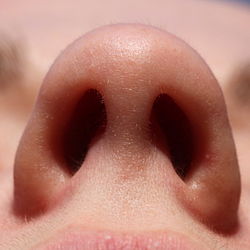
Image result for nostril

I love studies that center around the morphology of humans, so of course I was very interested reading this article. Reading articles that center around humans evolving to have advantageous traits is so interesting to me because I love to think that there are some humans out there that for some reason have higher-functioning noses than I do. It intrigues me that a larger-nostriled friend might have an easier time breathing in the Canadian wilderness than I would, simply because of the morphology of their nose. The study does make sense, anyhow, that humans in colder regions would evolve to breathe easier, and humans in warmer climates would evolve as to not have noses that are too efficient at heating already-warm air. It makes sense that someone like myself, who descends from a tropical country like the Philippines, has such large nostrils. 


Tuesday, April 11, 2017

Ancestral Climates May Have Shaped Your Nose


At Pennsylvania State University, a team of scientists have uncovered more evidence on the relationship between the present nose and the climates of where our ancestors have lived in. An experiment was done my measuring the height, the width, and skin pigmentation of men and women whose ancestors that were born in corresponded regions. The experiment has proven that the width and height of the nostril may vary depending the region one lives in, such as people whose ancestors that lived in warm and humid areas will have a wider noses. However, people whose ancestors that lived in cold and dry regions of the world would have nostrils that are narrowed. In addition, natural selection may act on the shape of the nostril due to the climate of the region favoring the structure of the nose. Other contributors, such as inheritable traits and genetic variation can play a role in demonstrating the shape of the nose.


New York Times Here
WebMD Here

Wednesday, April 5, 2017

Climates Shape our Noses


        The human nose contributes more than just smell to us. The nose is used to humidify and warm the air we breathe as well as help prevent illness and damage in the airways and lungs. No one nose is exactly the same. Everyone has a slightly different nose, although people claim they got their nose from one of their parents. Many people believe that genetics plays a huge role in the shape of the nose. It is believed to be hereditary trait and that parents can envision their child's nose before they are even born. Research done at the University of Pennsylvania have recently discovered that this is not the case.
       New research as shown that human nose shape is effected by the climates in which our ancestor's once lived. Researchers compared nostril widths from different regions around the world and found that they all significantly differed. The widest nostril widths were found in geographical locations where the temperature was high and had high humidity rates. In comparison the narrowest width nostrils were in cold, less humid regions.
      While nose shape is found to be a heritable trait, it is greatly influenced by climate and geographical location one lives in. Further research on the effects of climate and regional location are being conducted to see if they influence other parts of our body.  

Wednesday, March 22, 2017

Ancestral Climates May Have Shaped Our Noses

 
Our noses have several functions. They warm and humidify the air that we breathe. They prevent illness and damages in the airways and lungs. Because of the ways our noses are shaped, scientists always have suspected that the nose evolved partly due to locate climate conditions. Natural selections favored noses that were better at heating and moisturizing air. 
A study in PLOS Genetics and from a team of scientist from Pennsylvania State University have found evidence between the nose we inherited and the climates in which our ancestors lived. Nostrils that are slightly different are due from the different regions around the world. The higher the temperature and increased humidity, the wider the nostril is. 
This is an important aspect of traits since it is natural selections that shaped our noses. This trait was passed down from one generation to the next. Along with the shape of our noses, skin pigmentation is another aspect that is related. Depending on what part of the world the ancestors were from, the skin pigmentation varies. This is an interesting aspect to bring to genetics since it goes back to ancestors to determine which and what traits evolved in what climate and environment. It also shows how traits such as how big the nostril is can be traced back to a long time ago. 


Friday, March 17, 2017

The Climate (and Genetics) Shaped Your Nose!


Noses undoubtedly, and sometimes unfortunately, get passed down from parent to offspring. This article sheds light on research showing how nose shapes are sculpted overtime in response to local conditions of our various ancestors. Although there are a wide variety and diversity of nose shapes, when we take a closer look we can see many similarities that happen to be linked to climate. The research conducted on this topic analyzed the dimensions, angles, and protrusions of 2,637 noses of individuals of four populations: North Europeans, South Asians, East Asians, and West Africans. By comparing this data to local climates and humidity levels of those different populations, researchers were able to define what nose shapes thrived in what areas. It is believed that natural selection called for narrow nostrils in cold/ dry climates because long narrow nostrils better humidify and warm the air in cold and dry areas.


When studying genetics, it is important to consider all external causes for a trait, condition, illness, etc. Our environment plays an important role in who we are and what we look like.


Wednesday, September 14, 2016

The genes for your face

A team of scientists from the University of Pittsburgh in Pennsylvania has further advanced the understanding of how gene variation can contribute to the diversity of facial shapes and sizes. Their genome-wide association study, published in PLOS Genetics, analyzed the association between 20 facial characteristics measured from 3D images of 3,000+ healthy individuals and about one million single base pair variations called SNP's. They succeeded in identifying genetic variants that contribute to the facial morphology of a normal human. Their analysis of the study concluded that certain facial features had statistically significant associations with certain SNP's. Various traits that compose a person's face, such as nose size, facial width, the distance between the eyes, and the distance between the lips and eyes, originate from specific genetic variations. Variation in specific regions of the genome relates to the kinds of distinguishing facial characteristics that give us our unique identities, and it also explains why we share facial features in common with our close relatives than with unrelated individuals.  This insight to understanding how facial shape/size is controlled by one's genes can also be useful for understanding craniofacial development and abnormalities.
Dr. Seth Weinberg, corresponding author of the study, says: "What is exciting is that many of these associations involve chromosomal regions harboring genes with known craniofacial function. Such findings can provide insights into the role genes play in the formation of the face and improve our understanding of the causal factors leading to certain craniofacial birth defects."
I think this article is awesome because it marks the beginning of the genetic understanding of human facial morphology.  Perhaps this knowledge will eventually allow us to create forensic facial reconstructions of a person from the DNA left of them. The ability to connect specific genetic variants to ubiquitous facial traits can also inform our understanding of normal and abnormal craniofacial development.  Their study was limited to a population of individuals with European ancestry, but it'd be interesting to analyze the genetic developmental relatedness of other worldly populations, e.g. individuals with Down Syndrome.


Friday, May 2, 2014

Humans have a Nose for Gender.

According to researchers who report their findings in the Cell Press "Current Biology," the human body produces chemical cues that communicates genders to members of the opposite sex. Whiffs of the active steroid ingredients androstadienone, which in males and estratetraenol, which is in females, influences our perceptions on movement as being either more masculine or more feminine. this affect, which occurs completely without awareness, depends on both our biological sex and our sexual orientations. Wen Zhou of the Chinese Academy of Science states that, "our finding argue the existence of human sex pheromones, they show that the nose can sniff out gender from our body secretions even when we dont think we smell anything on the conscious level." researchers also found that homosexual males respond to gender pheromones more likely than heterosexual females, but bisexual or homosexual females responded the same as in heterosexual males and females. gender cues were very extreme and ambigous, smelling the hormones produced. this article is interesting and good to know fro scientific study. It shows how many other types of research is being produce for the human curiosity.


Original article: http://www.sciencedaily.com/releases/2014/05/140501123449.html
secondary article: http://www.smithsonianmag.com/ist/?next=/science-nature/human-nose-can-distinguish-between-one-trillion-different-smells-180950175/