Showing posts with label mitochondrial. Show all posts

Tuesday, October 17, 2023

Mendelian Inheritance: Genes and Types

Genes can be said to be the bedrock of Genetics. They are the basic unit of heredity that can be passed from parents to offspring. Coined from the name of the biologist that proposed the rules of inheritance, Gregor Mendel; Mendelian inheritance is used to describe the biological inheritance principles of how certain traits are inherited by offspring from their parents. There are different types of Mendelian inheritance like autosomal dominant, autosomal recessive, X-linked dominant, X-linked recessive and mitochrondial. These modes of inheritance are expressed in single-gene diseases. Let us discuss them:

In autosomal dominant, the offspring requires only a single copy of a gene variant to develop a disease or condition. In this inheritance mode, one of the parents of the child needs to possess the gene. It is important to note that this inheritance pattern occurs in every generation. Examples of diseases that can be expressed through autosomal dominant inheritance are neurofibromatosis, Huntington's disease and familial hypercholesterolemia among others.


On the other hand, in autosomal recessive, each parent contributes a gene variant each for the offspring to have two copies of the gene variant to develop a disease or condition. Here, the pattern may not be seen in every generation. Examples of diseases that are expressed through this inheritance pattern are sickle-cell anemia, Tay-sachs disease, phenylketonuria and so on.


The X-linked dominant is a sex-linked mode of inheritance. Here, it is common to see that both males and females carry the trait in each generation. The only thing is that fathers cannot pass their X chromosomes to their sons, instead they pass it to their daughters and pass their Y chromosomes to their sons. Consequently, females are mostly affected here. Examples of diseases that are expressed in this inheritance patterns are ornithine transcarbamylase deficiency and hypophatemic rickets.


X-linked recessive like their dominant counterpart are sex linked. However, here males that have an affected allele on their X chromosomes are unable to pass the traits to their sons because they are hemizygous. Their daughters nonetheless, will carry those traits. Mothers that are heterozygous and healthy can pass the affected traits to their sons. So here, males are mostly affected and these affected males are seen in every generation. Hemophilia A and Duchenne muscular dystrophy are some diseases expressed by the X-linked recesssive.


In mitochondrial, female parents are the only ones that can pass the affected traits even though both males and females can be affected. It is possible for this inheritance pattern to appear in each generation and Kearns-Sayre syndrome is a disease that can be expressed by this patterns.


References

National Human Genome Research Institute "Gene" October 16 2023

https://www.genome.gov/genetics-glossary/Gene#:~:text=Genes%20are%20passed%20from%20parents,approximately%2020%2C000%20protein%2Dcoding%20genes.

 National Library of Medicine "Classic Mendelian Genetics (Patterns of Inheritance)"

https://www.ncbi.nlm.nih.gov/books/NBK132145/#:~:text=There%20are%20five%20basic%20modes,and%20complex%20multi%2Dfactorial%20diseases.

Thursday, April 15, 2021

Lizard-like tuatara carry two distinct mitochondrial genomes


Lizard-like species tuatara has two distinct mitochondrial genomes. This revelation was reported recently in January 2021. Tuataras genomes are a very important discovery in nature today as they are the first vertebrate species that are found to have multiple copies of mitochondrial genomes. Mitochondria are tiny energy factories, and their genetic material is usually important in building the structures and keeping them running. Mitochondrial is essential in the development of aging, cancer, and many other biological diseases. 

Finding animals and other species that carry additional mitochondrial genomes can help advance the research of finding cures and diseases that stem from mitochondrial DNA. By studying animals' mitochondrial genomes, we may potentially be one step closer fully understanding how some human diseases work. Efforts to decode the tuatara’s genetic makeup began in 2012, with the launch of the Tuatara Genome Project led by Neil Gemmell, an evolutionary biologist at the University of Otago in Dunedin, New Zealand. His team discovered that the tuatara genome is 50 percent larger than the human genome. This led to a deeper exploration of the mitochondrial part of the genome which is where they discover that this species has two mt- genomes. The discovery raised concerns since mitochondrial DNA is usually inherited only from a mother’s egg, so the scientists expected to see a single copy of the mitochondrial genome, not two copies like they would see in nuclear DNA, which is inherited from both the mother and father. They believe that the purpose of the two mt- genomes are to provide flexibility in how their metabolisms respond to temperature extremes. This finding of the genetic basis for the animal’s metabolic feats can eventually help explain the mitochondrial genome’s function which will then help find treatments for human metabolic diseases. It is wild to me to think that a species can carry two distinct genomes.

Links

1. https://www.sciencenews.org/article/lizard-like-tuatara-mitochondrial-genomes-cold-tolerance

2.https://www.reptilesmagazine.com/tuataras-two-sets-of-mitochondrial-genome-may-help-it-withstand-cold-temperatures-better/#:~:text=Researchers%20have%20discovered%20that%20the,adaptive%20advantage%20to%20harsher%20weather


Friday, February 12, 2021

Lizard-like tuatara carry two distinct mitochondrial genomes


In this Science News article it states that researchers have discovered two distinct mitochondrial genomes in the Tuatara, these extra set of genes may be the reason why the Tuatara are tolerant to the cold which is very unique for a reptile. In Tuatara scientist discovered evidence of two distinct copies of genetic instruction manual for making mitochondria in a vertebrate. Mitochondria is important for building the structures and to keep them going. Finding this discovery could not only help other reptiles but humans as well when deal with different kinds of diseases. In 2012 the Tuatara Genome Project was created to decode the Tuatara's genetic makeup which was led by Neil Gemmell. The team was provided a sample of the reptiles blood and what they found was that the Tuatara's genome is 50 percent larger than the human genome.

    Further investigation of decipher the DNA which they compared by chopping it into small pieces with the overall structure they found differences in the mitochondrial DNA which appeared to have striking differences in their gene sequences. This created many of the people working on the project to be stunned because usually mitochondrial DNA is inherited by the mother's egg resulting in a single copy of mitochondrial genome not two copies. They conclude that the genomes were different by 10.4 percent so when comparing it to humans and chimpanzee mitochondrial genomes differ 8.9 percent. 

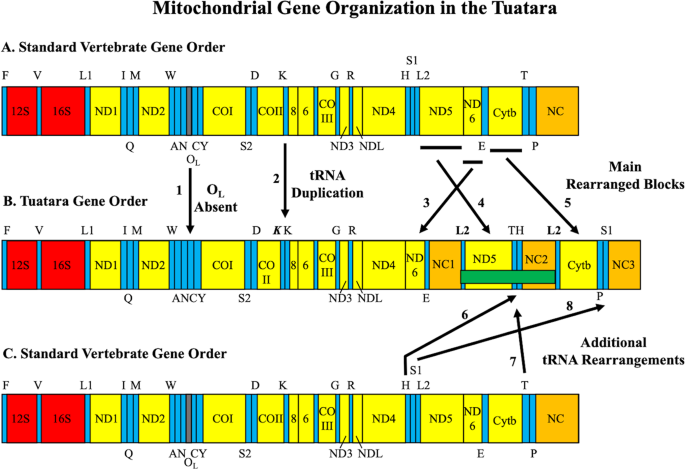
    I think this discover is very important because if we could find the genetic basis of what causes them to have two distinct mitochondrial genomes we can help find treatments for human metabolic diseases. The picture use above is from Neil Gemmell own experiment article where you can also find a little bit more about the Tuatara. 

Thursday, December 5, 2013

Oldest Hominin DNA Sequenced: Mitochondrial Genome of a 400,000-Year-Old Hominin from Spain Decoded

Recently, bones of a hominin was found in cave in northern Spain. The genus Homo from Sima de los Huesos was found to be 400,000 years old. The DNA sequence of the hominin was found. They ran test to determine its relation to other species and it was found that the hominin was closely related to Denisovans which are extinct relatives of neanderthals from Asia.Sima de los Huesos, the bone pit, is a cave system in norther Spain which accounted for the largest amount of hominin finds.


http://www.nature.com/nature/journal/vaop/ncurrent/full/nature12788.html
http://anthro.palomar.edu/hominid/australo_1.htm