Showing posts with label migration. Show all posts

Friday, May 1, 2026

The “Wanderlust” Gene


 Scientists suggest that the migration-linked genetic variants may be the cause of some people moving away from their birthplace.  These variants are mainly found during brain development in active excitatory neurons.  The article talks about the inheritance of moving away from a person’s birthplace- known as the “wanderlust” gene.  A neurogeneticist conducted a study at the University of Iowa, analyzing data from 250,000 individuals in the United Kingdom.  He found that those who moved farther away from their original home shared similar gene variants.  These findings were then compared to DNA from over 10,000 years ago from 1,300 different people.  Through this comparison, the same genetic variants found today were the same ones that predicted migration patterns in people from over a thousand years ago.  Over time, the frequency of this variant has increased, suggesting that natural selection has favored movement as humans continue to grow.  This genetic variant has effects that translate into a person’s life.  Those with this variant are more likely to see faster income growth and have “risk-taking” thought processes.


Picture/Article: https://www.sciencenews.org/article/wanderlust-dna-brain-development 

Second Article: https://www.biorxiv.org/content/10.64898/2026.02.05.703995v1.full 

Monday, April 8, 2024

Unraveling the Genetic Impact of Demographic History: Insights from Simulation Studies on Complex Traits


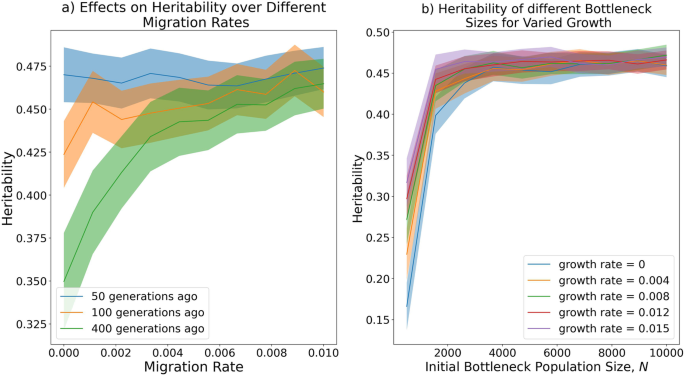
In this study, the authors delve into the significant role demographic history plays in understanding the heritability of complex traits and the outcomes of Genome-Wide Association Studies (GWAS). By leveraging a simulation-based approach, they explore how genetic drift, population expansion, and migration shape the genetic architecture of complex traits, focusing on the consequences of these demographic processes on heritability. The study specifically addresses the impacts of population bottlenecks, where isolated sub-populations experience an increase in the frequency of otherwise rare genetic variants with substantial effect sizes, thus providing unique insights into the genetics of complex traits.

The study concludes that demographic history profoundly impacts the heritability of complex traits and the power of GWAS to detect genetic associations. It calls for explicitly modeling demographic histories to accurately quantify the selection history of complex traits. By doing so, researchers can improve the interpretation of GWAS results and gain deeper insights into the genetic underpinnings of complex traits across different populations.

While the study's simulation-based methodology provides valuable theoretical insights, it would also be beneficial to complement these findings with empirical data from diverse populations. Doing so could validate the simulations' predictions and address the variability in demographic histories and their genetic effects across human populations.

Friday, November 13, 2020

Swedish, Finnish, and Russian Wolf Genome All Closely Related


 This article is about the confusion behind the Scandinavian wolf genome in terms of evolution and migration patterns. At Uppsala University a study was conducted using the Y-chromosome of the DNA, the paternal lineages showed that the genome had not been infected by dog genetics and the migration pattern was determined to come from England. The reason this is interesting is due to the migratory patterns of wolves on the specific Scandinavian peninsula. This can provide information into the future with regards to species populations and climate change. With regards to dog genetics and wolf hybridization the article states that if crossbreeds were allowed to reproduce this can jeopardize the integrity of the wolf genome. With comparison to one hundred different dog breeds, the study had shown that the population did not have any implications due to any dog genome. This study will be interesting to see for future populations and understanding the genetics of how climate change will effect migratory patterns and move populations closer and farther apart. Only time will tell with regards to how important this information will be. 

https://www.sciencedaily.com/releases/2020/11/201110112508.htm

https://onlinelibrary.wiley.com/doi/10.1111/eva.13151

Sunday, November 24, 2019

Melanin in Manta Rays

There are only two species of fish with dark melanin spots on their skin. Both of these species are manta rays. Some manta rays exhibit dark spots on their otherwise completely white underbellies. These dark blotches are caught the eye of researches for that reason. They figured that there must be a reason that melanin is so rare in the ocean and there must be a reason that rays express it.
 Image result for melanin manta ray
Manta rays have very few known predators. One theory that offers an explanation as to why is that their white underbellies makes them difficult to see against the sky. In that case, the dark spots should be selected against. After following a population of melanistic rays, the researches determined that the dark spots do not affect fitness.

It is also possible that the gene causing this mutation is closely linked with another gene which is improving fitness. Perhaps there is an advantage within the manta rays that we cannot see which has the side effect of these dark splotches. However, as mentioned earlier, initial research shows that these spots do not appear to affect fitness.

Their new hypothesis is that the mutation may be a product of genetic drift. Not all populations of rays have this trait. Some have up to 40% while others have nearly none. It is believed that this neutral trait appeared as a mutation in a population and increased in frequency through random chance. The members of this population mated with other populations, spreading the gene further. If that is the case, this gene can be used to traced back through several generations and better understand migration habits of manta rays. Rays are currently a vulnerable species. Being able to predict where they will go may help the conservation effort. I hope that they find success in the conservation endeavor because mantra rays are an awesome animal that I want to see more of in the future.

Links:
https://www.nytimes.com/2019/10/14/science/manta-rays-black.html?searchResultPosition=14
https://marinemegafaunafoundation.org/blog/scientists-explore-the-occurrence-of-black-manta-rays-in-the-indo-pacific/

Friday, April 28, 2017

Trout find their way back home due to a special gene
 Scientists from Duke University studied Trout and their migration home to their freshwater habitat where they were born without mapping or GPS. These fish use the magnetic molten lava in the earths core to migrate home. This technique is used by birds, sea turtles, and more recently honey bees. By pulling fish from tanks at Duke University, scientists were able to pinpoint the specific genes that detects the electrical current. The optic nerve was connected to the production of iron which turned out to be the linked system to the internal mapping. Magnetite is the small particles that were found inside the trout and are consistent with other theories for internal mapping. This study will continue with other tissues like the retina to further the target region of the genes that create the internal GPS system.
I believe this study will help with what can effect these animals that use the magnetic core of the Earth to return home. This could be important in new research that shows harmful effects of things that interfere with the magnetite. These animals that return home to spawn need this adaptation to continue. The work being done is important to understand so these species can continue to safely travel back to their original nesting grounds.

Wednesday, April 19, 2017

Bear Breeds and Evolution

     Is it possible to analyze the evolutionary history of all bears at the genome level? Now it is! Scientists have sequenced the entire genomes of four bear species. It shows that gene exchange between species occurs through extensive hybridization. DNA samples of different species were taken from European zoos that are important for both conservation and research. Through these studies, it discounts previous assumptions of hybrid bears occurring due to climate change.

Image result for bears
     I too was under the impression that climate change played a huge role in different hybrids of bear species. According to the article, brown bears invade northern regions and polar bears move onto the sea ice later than usual due to changes in climate. This new genomic data showed there must have been gene flow between the polar and sun bears, however the two live in completely different geographic areas and thus have never met. The researchers explanation of this suggested an "intermediate host" has passed the genes on in various directions.


Bear Hybrids
Types of Bears

Tuesday, November 8, 2016

How the Brown Rat Conquered New York

Rats are known to contaminate the places that they inhabit with feces and urine in addition to viruses and bacteria. In many ecosystems they even threaten other species with extinction. They have managed to inhabit wherever humans have. Dr. Munshi-South, a biologist at Fordham University and his colleagues conducted an in-depth genetic study on brown rats after they posed to question “What is a New York rat?” They found that once brown rats settle into a new city, they repel newcomers.

            In order to conduct the study, the team contacted researchers from all over the world in order to compare DNA of rats from around the world to rats in New York. They ended up analyzing the DNA samples of 314 brown rats from thirty countries; from this data, they were able to conclude that different population of rats mixed together over time in order to produce the brown rat. They found that brown rats originated in northern China or Magnolia even though it was previously believed that the brown rat originated in Norway. Farming societies and widespread trade became more and more popular and rats began to migrate, which gave rise to the rats that we know now.

            A biologist at Rice University, Michael Kohn, said that that the brown rats are territorial, so it is hard for other types to get in. Many of the rats that he and his team examined were missing eyes, tails, and had scars that looked like they had been in a brutal fight. He said that this is most likely why we do not see many different kinds of rats in that area. I used to live in New York and now that I am thinking about it, all of the rats that you see in subways, all did look the same. It is cool though that the rats are so territorial that they do not let other types of rats into the city. 

Wednesday, September 21, 2016

How We Got Here: DNA Points to a Single Migration From Africa

The question of where humans came from has been one of the biggest in science for years. Three separate teams of geneticists from different places, all sampling different people, sequenced the genomes of 787 people from hundreds of different populations and found that all humans came from a single population from Africa between 50,000 and 80,000 years ago. The genomes were taken from a variety of people from every continent and were examined separately to finally come up with the same conclusion as to where people came from. Before now, there were very few sequenced genomes from people outside of population centers like China and Europe, but this new data with genomes from indigenous populations adds great value to our understanding of human DNA. 


The first team was Dr. Willerslev and a few colleagues who first sequenced the genome from a century-old lock of hair of an Aboriginal Australian. The results raised many questions, so the group joined David W. Lambert and the University of Oxford to obtain DNA from people from Papua New Guinea and from Aboriginal Australians to sequence. Mait Metspalu from the Estonian Biocentre sequenced genomes mostly from populations from Europe and Asia.  David Reich and his team from Harvard Medical School formed their database of genomes from people from all six inhabited continents. All coming up with the same results, the teams each established that there was an exodus from Africa 80,000 to 50,000 years ago, resulting in the populations we have today. There is also evidence of other groups migrating from Africa much earlier than 80,000 years ago, but these groups have since disappeared, having been wiped out by others who came after them who were stronger in number or in technology. 

Friday, October 3, 2014

One gene has a large effect on Monarch Butterflies

Each and every year, one of the most iconic insects in the world, the monarch butterfly, usually migrates across North America. However, a group of researchers from the University of Chicago Medical Center, have been sequencing genomes from these distinctive orange and black winged butterfly and found a single gene that is involved with migration. In order to find the one single gene, the researchers compared the genomes of migratory butterflies against three types of non-migratory populations. They were able to find over five hundred genes that are involved with muscle and also developmental and neural function. The gene that different between the migratory and non-migratory butterflies was collagen IV α-1. It was the migratory butterflies that had a reduced level of this gene, the researchers discovered that these butterflies consumed less oxygen and had lower metabolic rates when flying that gives them the ability to fly long distances.

White and Black Monarch
Orange and Black Monarch
Apart from researching the monarch butterflies to figure out how certain butterflies migrate and others do not, the researchers also investigated the monarchs coloration. As I stated earlier, most monarchs do have orange and black wings, but a small percentage of them that are mostly located in Hawaii, have white and black wings. They are sometimes known as the Hawaiian Monarch. When conducting their research, they found that once again, a single gene has a drastic effect of the pigmentation of the monarchs. This gene codes for a protein that is of the myosin motor protein family, and it has never been implicated to the coloration of insects. The mutation in this gene for monarchs disrupts the pigment transportation to the wings, is closely related to the myosin 5a gene in mice that affects the coat color of mice.


I was interested in this article because butterflies have always intrigued me and through this article, I gained a lot of knowledge that I did not know previously. I never knew that one single gene could change a species so much and I also did not know that all monarch butterflies do not migrate during the winter. The results of the study conducted by the researchers showed a need to conserve the efforts to preserve the migrating monarchs and extend the extraordinary evolutionary history of the species as well.

Wednesday, October 1, 2014

A Single Gene Affects a Butterfly's Ability to Migrate


Everyone knows about the monarch butterfly and most of us believed that it migrates south every year when it gets colder - but not every monarch butterfly migrates.  A study of butterflies, including 92 monarch butterflies, has shown that only some are migratory - the others were non-migratory.  In the study, there was a correlation between a single gene called Collagen IV alpha-1 and a monarch's ability to migrate.  Research shows that this gene affects the muscle building component and metabolism of a monarch butterfly, therefore affecting its ability to fly long distances.  When the monarchs are not migrating, there is no observed difference between those that have the gene and those that don't.

In addition to researching Collagen IV alpha-1, scientists studied the genome of migratory monarchs and determined that they did not originate in South America, but originated in North America or Mexico 1 to 2 million years ago.  The population began to grow about 20,000 years ago after the Last Glacial Maximum when milkweed became more readily available for consumption.

Lastly, researchers looked into the genes behind the orange and black coloring of the monarch butterfly.  When comparing a normal looking monarch butterfly to the black and white variety found in Hawaii, a gene called DPOGS206617 had a strong correlation with wing coloration.  This gene is similar to the one found in mice that gives their coats coloration.

This article initially caught my interest simply because the monarch butterfly brought back memories of my first grade class when we raised monarchs from the time they were caterpillars until they grew into butterflies.  I was intrigued when I read that not all monarch butterflies are migratory - I thought that all monarchs migrated!  It was interesting to learn that this is caused most likely by a single gene.