Showing posts with label electrode. Show all posts

Sunday, November 24, 2019

Microbe "Eats" Electrons

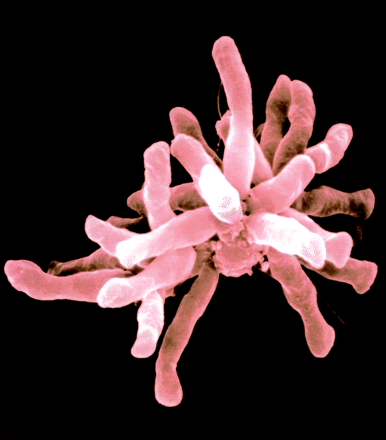
Some phototrophic microbes can pull electrons in from an electrode source and use them as fuel. They do this by using a unique processing step to regulate the production of an electron transfer protein used during this process. This process is involves getting electrons across the barrier of the bacteria, which is difficult since the outer layer is non-conducive and impermeable to iron and/or electrodes. A strain of Rhodopseudomonas palustris TIE-1 builds a channel by processing a protein called deca-heme cytochrome c, to help electrons pass through the membrane. This process is called extracellular electron uptake, or EEU, and it is done by bacteria when nutrients are low. Researchers now understand this process better and are going to use these biological markers to identify other microbes in the wild that are able to use electrons as a fuel source. Doing so will help to further understand why this process is important in metabolic evolution and microbial ecology.

Image result for rhodopseudomonas palustris tie-1

I find it very fascinating how microbes are able to develop unique ways to survive harsh conditions. Microbes are so adaptable when it comes to change in the environment and seeing a process like this is very cool. I've never heard of a bacteria using electrons as fuel before and didn't even think of it as a possibility, so learning that this is something some can do is incredible.

Link:

Related Article:

Thursday, November 13, 2014

Oxytocin Used to Help Patients Overcome Fear

A team of researchers working under the guidance of the University of Bonn Hospital in a recent study showed that the bonding hormone oxytocin inhibits the fear center in the brain and allows fear stimuli to subside more easily. The hope is that this research will provide the basis for future treatment of anxiety disorders.


Significant fear can become entrenched in a person’s brain with individuals involved in car accidents providing a key example. Individuals involved in car accidents often find it very difficult to handle street traffic after their accident due to significant anxiety. Scientists refer to this as conditioning where certain images or noises, such as screeching tires, are associated in the brain with pain or fear.

Overtime the original contents of the fearful memory are not erased; however, positive experiences overtake the original memory through the process of extinction. Nonetheless, if encountered with a dangerous situation similar to the original fear, the original fear comes back.

Dr. RenĂ© Hurlemann from the Department of Psychiatry and Psychotherapy of the University of Bonn Hospital stated, “Oxytocin actually reinforces extinction: Under its influence, the expectation of recurrent fear subsequently abates to a greater extent than without this messenger.”

Specifically the team of researchers showed various images to 62 male patients. For 70 percent of the images the research subjects received a very brief electrical shock to their hand via electrodes. When the images, where the electrical shock was experienced, were viewed again anxiety was noted in the tests subject’s brains. For the second portion of the study half of the test subjects received oxytocin via a nasal spray while the other half received a placebo.


After receiving either the oxytocin or the placebo the patients were shown the same images as before; however, this time there were no electrical shocks experienced. In those patients who received the oxytocin the amygdala, fear center in the brain, was far less active than in the control group who received the placebo. In those patients that received the placebo the fear-inhibiting regions were more stimulated. The researchers hope that with the aid of oxytocin anxiety patients can be helped more quickly and that a relapses can be prevented more easily.


This article was very interesting because anxiety is something that is often overlooked and forgotten about. It’s clear that something that happens every day, such as car accidents, can have a long lasting effect on an individual even after the physical injuries have subsided. I am curious to see the results of further clinical trials that have larger sample sizes and potentially with patients with severe anxiety disorders to see how well oxytocin alleviates the anxiety in these patients.  

Wednesday, November 12, 2014

Deep Brain Stimulation May Unlock the Cure to Tourette’s Syndrome

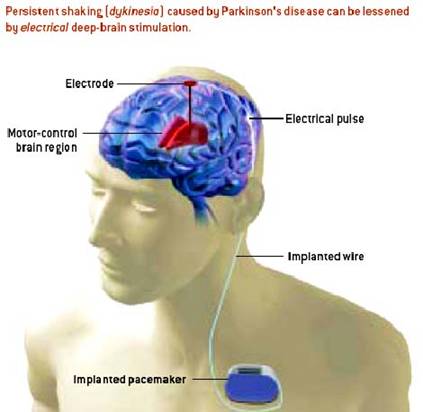
Tourette’s syndrome is a neurological disorder that causes individuals to make involuntary movements and loud noises. There is currently no cure for Tourette’s syndrome; however, specialists at the University of Florida's Center for Movement Disorders are looking to change that. Specialties at the center are performing experimental surgery in Tourette’s patients.  The procedure, deepbrain stimulation (DBS), is currently used in patients with movement disorders such as Parkinson's disease or tremors.


Deep brain stimulation is based off the delivery of electricity and works by implanting small electrodes into the brain in order to stimulate affected regions in patients with movement disorders. The electrodes are attached to an impulse generator and the generator, which is also referred to as a pacemaker, provides electrical impulses to the affected regions of the patient’s brain. The connections between neurons are affected by the impulses which stop the abnormal activity that the patients are presenting with.

While DBS has been performed in over 100,000 patients since 1997 it has never been performed in Tourette’s patients. The underlying neurology in Tourette’s patients is different from that of other conditions treated with DBS because it combines both emotion and motor activity. Specifically, in Tourette’s patients the movement is not there all the time; the patients have a buildup, tic, and an urge and until they can move the patients do not feel better. The only current available treatments for Tourette’s syndrome are behavioral therapy and drug medications; however, these treatments only alleviate the severity of the tic they do not prevent the tics all together.

In September 2014 DBS was performed in a patient with Tourette’s syndrome for the first time. Additionally, the patient had a new grid-like device implanted on top of her brain. This device is intended to gather information from the patient’s brain that can hopefully lessen her tics, and possibly someday stop them. Over the next six to twelve months the patient’s brain activity will be monitored with the grid providing key insights into the underlying cause of her Tourette's syndrome. Understanding the underlying causes of the syndrome will allow doctors to regulate the electrical impulses to in order to manage and hopefully eliminate the tics all together.


This article really caught my attention me because I am very interested in neurological disorders and learning more about them. Tourette’s syndrome is an interesting and difficult disorder because of both the physical and emotional combination. It will be interesting to see over the next several months how well DBS works in this patient. I am hopeful that this procedure will be the next step in learning not only more about the disorder but will be able to eliminate the symptoms experienced by Tourette’s patients.