Showing posts with label microbe. Show all posts

Sunday, November 24, 2019

Microbe "Eats" Electrons

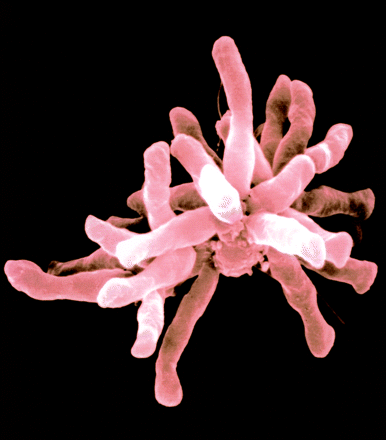
Some phototrophic microbes can pull electrons in from an electrode source and use them as fuel. They do this by using a unique processing step to regulate the production of an electron transfer protein used during this process. This process is involves getting electrons across the barrier of the bacteria, which is difficult since the outer layer is non-conducive and impermeable to iron and/or electrodes. A strain of Rhodopseudomonas palustris TIE-1 builds a channel by processing a protein called deca-heme cytochrome c, to help electrons pass through the membrane. This process is called extracellular electron uptake, or EEU, and it is done by bacteria when nutrients are low. Researchers now understand this process better and are going to use these biological markers to identify other microbes in the wild that are able to use electrons as a fuel source. Doing so will help to further understand why this process is important in metabolic evolution and microbial ecology.

Image result for rhodopseudomonas palustris tie-1

I find it very fascinating how microbes are able to develop unique ways to survive harsh conditions. Microbes are so adaptable when it comes to change in the environment and seeing a process like this is very cool. I've never heard of a bacteria using electrons as fuel before and didn't even think of it as a possibility, so learning that this is something some can do is incredible.

Link:

Related Article:

Wednesday, October 18, 2017

New mechanism points the way to breaking ribosome antibiotic resistance

Image result for antibiotic

In a article on Science Daily, research groups collaborated in researching in the dimerization of the bacterium Lactococcus Lactis by using cryo-electron microscopy. It involves a single protein Called the HPFlong. Which is capable of dimerizing on its own and pulling two copies of ribosomes together. When the ribosome is in dimerizing state it is unable of producing proteins . This leaves the ribosomes in a state of hibernation which allows for researchers to attack the cells with antibiotics. Researchers stated that protein HPFlong is present in all known bacteria which could result to the development of new generation of antibiotics.

I believe that this could help us with some current issues that involve antibiotic resistant bacteria. with these new results, we could use these methods to prevent bacteria from becoming more antibiotic resistant. this method will disable the microbial from creating a antibiotic resistant strand for the future generations of microbes.This will allow us to treat microbial infections more efficiently.


https://www.sciencedaily.com/releases/2017/09/170928084754.htm


https://www.eurekalert.org/pub_releases/2017-09/uog-nmp092517.php


Wednesday, March 30, 2016

Microbes With Limited DNA May Reveal Secrets of Life

Scientists recently deleted nearly half the genes in a microbe, which created a stripped-down version that still fully functions. This achievement can potentially reveal secrets of life and how life works. This finding may also help researchers create new bacteria specially made for pumping out medicine and other valuable substances. 

This newly created bacterium contains less genetic information than any other natural free-living counterpart. This bacterium had 531,000 DNA building blocks, and 473 genes, while humans have more than three billion DNA building blocks, and more than 20,000 genes. Unfortunately, scientists still consider this simple microbe as a mystery, because they are still unsure what one third of their genes actually do. 

Some of these mystery genes could possibly reveal unknown fundamental processes of life, which Clyde Hutchinson III and J. Craig Venter said in an interview, the two authors of a paper on the project release in the journal Science. The brand new genome, or DNA code, is contained in a brand new bacterium called JCVI-syn3.0. 

This is not the only set of minimal genes needed for life itself. If the researchers had paired DNA from a different bacterium, they probably would have gotten a different set of genes. The minimum genome an organism needs would depend on its environment in which it lives. Additionally, the genome includes genes that are not essential to life, because they help the bacteria populations grow fast and this makes it easy for lab work. 

A goal of this work is to find out what every single gene living cell does, which would give a very good understanding of how cells work and function. Another goal is to use minimal-DNA microbes as a chassis for adding genes to make the organisms produce medicines, and other substances for uses like nutrition and agriculture. 

This work began with a man-made version of a microbe found in sheep, called M. mycoides, which has about 900 genes. The scientists identified 428 non-useful genes, and built their genome without it but was still complete enough to let the bacterium survive. 

I believe this work is only the beginning to a huge finding in genetics. With this information, scientists can get closer to defining each and every gene in a living cell and understand what the function is of each. It is hard to believe that more than half of the genes in a microbe could be non-essential, yet not understood. With this study, there will be advances in medicine and public health research. 
Friday, November 7, 2014

Foster Bugs Inside Yourself For Weight Loss

How would you like to put a bug in your stomach?

Researchers have learned in the past few years there are some organisms that promote thinness and other triggering weight gain. In a twin study, researchers identified a microbe that appears to keep waistlines trim--and that gene influence its abundance. According to geneticist Oluf Pedersen of the University of Copenhagen, this is the first evidence in proving the human gut can be genetically controlled.

In previous twin studies, no genetic connections were identified between microbiome diversity and abundance; however these studies looked at microbiome diversity as a whole. The new study takes a species-by-species approach. By sequencing and analyzing DNA from the fecal samples, more than 9600 genetically distinct microbial "species". While most of the microbe varied according to environmental factors, some were apparently influenced by genetics because they are more similar in identical twins than fraternal twins.    


The recently discovered microbes comes from a family of bacteria called "Christensenellaceae." This family was most abundant in lean twins and rare in obese ones. To see how this bacteria family influence weight, fecal material from lean and obese twins in germ-free mice. The mice gained weight just as expected, however when the obese twin mice were presented with Christensenella minuta, the mice stayed lean.

This article was definitely interesting to read. I've always seen a show known as "The Monsters That Lives Inside Me" so that was my first thought when the idea of putting a bug inside our body to promote weight loss. I understand that being obese can be due to genetics, but I wonder if there is nothing a healthy diet, exercise, and a bit of encouragement cannot due. Humans have been taking looking for other ways instead of the cheapest and efficient way to stay healthy; such as sucking fat out the body surgically. I hope that humans would not go to the extreme to host a weight-loss organism inside our body just to meet the demands of society.

Article: http://www.sciencemag.org/content/346/6210/687.full  

Related article: http://www.the-scientist.com/?articles.view/articleNo/41395/title/Gut-Microbiome-Heritability/