Showing posts with label neurological disorders. Show all posts

Wednesday, April 22, 2026

Gene Activity in Male vs. Female Brains


Hsiao-Ying Wey/Science Translational Medicine

Past studies revealed that the risks of developing neurological disorders vary depending on a person’s sex. Males have a higher chance of developing Parkinson’s disease, ALS, or neurodevelopmental disorders such as autism or ADHD. Females have higher percentages of Alzheimer's disease or other dementias, as well as mood-related disorders such as depression or bipolar disorder. A recent study involving the effect of sex on gene expression explains why.

The study found that sex chromosomes and hormonal influences on cell-type gene expression might explain sex differences in susceptibility to neurodevelopmental, psychiatric, and neurodegenerative diseases. The study analyzed samples of transcriptomic cell types of the brain’s cortex from 15 adult males and 15 adult females across six different areas of the brain. They found that more than 3000 genes showed sex biased gene expression, and over 100 of these genes were consistent across the different regions and cell types. Furthermore, most of these genes with sex-biased expression are not located on sex chromosomes but are autosomal and can be activated by sex hormones. Overall, this data can be used to link the differences we see between the sexes in hormone regulation, cortical structure, and susceptibility to brain-related disorders.

​Source:
Additional: 

Monday, March 10, 2025

black children are less likely to get gene testing for different neurological disorders:

    In the recent article from US News, it has been proven that black children are less likely to get different neurological tests compared to children who are white. These neurological tests can assist with the diagnosis for certain diseases such as autism, epilepsy, and any other kinds of cognitive delays. In addition to determining a diagnosis, these kinds of tests are very important in order to identify which gene(s) are instrumental to certain disorders and figure out a treatment plan. A huge contribution to these low numbers is due to the fact that many insurance companies are more likely to deny black children rather than white children for genetic testing. 

Study finds more barriers to genetic testing for Black children than white  children - North Dallas Gazette

    During an 18 month study, where health records were analyzed by researchers, there were approximately 11,400 participants. Of that sample size, around 78% of the children were white and 15% were black. This is a significant difference between the two races. There are definitely more reasons, other than insurance, as to why black children are less likely to get genetic testing. Regardless of the reasons, these tests should be advocated more to the black community. It is an added layer of protection and can give individuals a head start of any diseases or disorders that may potentially arise. Genetic testing is a good option for all individuals, despite their race. 

Monday, November 20, 2023

Brain Disorders Are Tied to Genetic Mutations


     New research was found which may lead to better diagnostics and the care and treatment for different types of diseases that occur during the early development of the brain, such as epilepsy. In the study, around 300 children coming with different types of forms of MCD gave in some brain tissue samples. These samples were collected when these children underwent epilepsy surgery to treat this disease. With each tissue sample, there was also a blood and saliva sample along with samples from the parents. Along with the samples given by the patients and their parents, there were also a small number of outside people that had no brain conditions that also donated their brain tissue for comparison. Comprehensive screening happened in three steps. The first step examined genes in the mTOR pathway. These genes regulate metabolism, cell growth, and show a huge amount of signaling in brains with epilepsy. The second step identified new genes through unbiased gene discovery to associated genes that may be tied with MCD. The third step consisted of testing a new sample independently to confirm the genes tested and identified in the first and second steps. The study came back with 69 mutated genes tied with MCD for the first time. Twelve of these mutated genes were mutated repeatedly which means that they were found in two different brain samples. The study confirmed that the mTOR pathway is a very important pathway to our body and the dysregulation of it can cause human diseases. However, the study concluded that there is much more to research, as it has never fully gone in depth. There may be more identifiable genes in the studies to come. To test mutation functions, the researchers put one of two forms of the MCD genes into the brains of mice, mutated or non-mutated. When mutated genes were introduced into the mice body, there were abnormalities in the brain very similar to the findings that were seen in humans with MCD which means that the mutated genes are very likely to contribute to the disease and they are vital to cortical development.

     This study was very remarkable. There are lots of patients who deserve better care and it must be hard for patients with conditions like epilepsy or any neurological disorder to receive it. This study just proved that there needs to be more in depth studies of many disorders, but it also proved that there is an insight to the origin of these disorders. This is a start to the treatment of many conditions. This also brings hope to people who are diagnosed with these disorders. This research opened a new area of focus, and with more in depth studies, the findings will lead closer to better treatment and diagnostics, and hopefully a cure.


Sources:
https://www.nimh.nih.gov/news/science-news/2023/researchers-unlock-genetic-mutations-contributing-to-disorders-in-the-brain
https://medlineplus.gov/geneticbraindisorders.html

Sunday, December 8, 2019

SCN3A gene, linked to Polymicrogyria.

Smith et al. have discovered that a gene called SCN3A (sodium voltage-gated channel alpha subunit 3), when mutated it results in a condition of abnormal brain development, polymicrogyria. Normal copies of the gene SCN3A help us speak and swallow. Their study included measurements of electrical currents generated by neurons in ferrets which led to the discovery relation between SCN3A and brain malformation and the oral motor impairment. SCN3A is primarily expressed during human fetal development in progenitors and neurons, they observed SCN3A mutations increased persistent sodium current and disrupted cerebral cortical folding. How could the gene SCN3A that enables the flow of sodium ions into the brain lead to speech and swallowing problems is still unknown.

 
I think such findings might turn out to be extremely helpful in the future. Every new discovery on genes that are linked to a specific disease can help many scientists around the world find a genetic diagnosis. It might even help with future advancements in gene therapy. Such advancements could potentially help a lot of people diagnosed with polymicrogyria and many other disorders. This study helped us better understand the genes involved in the formation of the most complex tissue ever created. It might also help us better understand the sodium ion channel in the future. 😄


Article publication by Cell Neuron on August 23, 2018
Article link: https://doi.org/10.1016/j.neuron.2018.07.052
Related article: https://vector.childrenshospital.org/2018/08/scn3a-brain-folding-speech-motor-development/

Monday, February 8, 2016

Genes Influence Human Intelligence


Human Intelligence 
 Scientists discovered that genetic plays a major role in intellectual behavior. Recent studies, show that 40% of human intelligence is inherited in our genes. The two networks known as M1 and M3 gene are essential for understanding the development of neurological disorders such as epilepsy, autism and schizophrenia. " We know that genetics play a major role in intelligence but until now haven't known which genes are relevant." Hence, this could be a possibility for scientists to manipulate a different set of genes that are relevant to human intelligence. Which could be a possibility for doctors and patients to find better treatments for neurological disorders.  

I think this article was interesting because researchers have the potential of understanding how mutated genes are associated with neurological disorders. It will be a new insight for scientists to gain knowledge about cognitive disabilities and provide early prognosis for individuals with learning disabilities. This might help understand how autism spectrum disorder can be a possible cause of mutation in the genes.


Monday, March 23, 2015

Genetic links helps unravel myths of A.D.H.D.


For many years since the disorder known as ADHD was first officially diagnosed and introduced in the scientific community, there have been certain people who have denied the existence of this disorder outright. Many people have tried to argue that with the wide array of technology children use these days such as video games and cellphones, there is more of a reason for them to become distracted and it is this increase in technology that is causing the lack of attention amongst many children. However, there has been clear evidence by many scientists specializing in neurological disorders that have proven the existence of ADHD by linking this disorder to its genetic components. For example, the National Human Genome Research Institute has discovered this link amongst identical twins. According to their research if one twin is diagnosed with this attention disorder, there is a 80% chance that the other twin will be diagnosed as well. There have also been numerous studies regarding the gene LPHN3 and its association with ADHD. According to Dr. Muenke this gene can affect certain pathways in the brain that affect this attention disorder and it also responds well to certain medications that are common given to patients diagnosed with ADD such as adderall.
I believe that these genetic relations will allow people to gain a further understanding of this attention disorder and will allow us to advance and obtain more effective means to treat this disorder. Since my brother has just recently been diagnosed with ADHD I have begun to further look into this disorder in  order to find ways to better understand what he has to go through on a daily basis. Hopefully this linkage discovered in our genes can help scientists discover a way to effectively treat this to the best of their ability.

Wednesday, November 12, 2014

Deep Brain Stimulation May Unlock the Cure to Tourette’s Syndrome

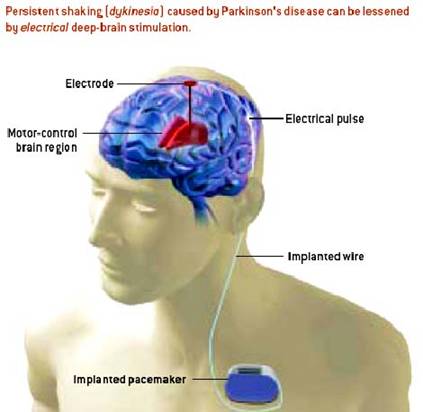
Tourette’s syndrome is a neurological disorder that causes individuals to make involuntary movements and loud noises. There is currently no cure for Tourette’s syndrome; however, specialists at the University of Florida's Center for Movement Disorders are looking to change that. Specialties at the center are performing experimental surgery in Tourette’s patients.  The procedure, deepbrain stimulation (DBS), is currently used in patients with movement disorders such as Parkinson's disease or tremors.


Deep brain stimulation is based off the delivery of electricity and works by implanting small electrodes into the brain in order to stimulate affected regions in patients with movement disorders. The electrodes are attached to an impulse generator and the generator, which is also referred to as a pacemaker, provides electrical impulses to the affected regions of the patient’s brain. The connections between neurons are affected by the impulses which stop the abnormal activity that the patients are presenting with.

While DBS has been performed in over 100,000 patients since 1997 it has never been performed in Tourette’s patients. The underlying neurology in Tourette’s patients is different from that of other conditions treated with DBS because it combines both emotion and motor activity. Specifically, in Tourette’s patients the movement is not there all the time; the patients have a buildup, tic, and an urge and until they can move the patients do not feel better. The only current available treatments for Tourette’s syndrome are behavioral therapy and drug medications; however, these treatments only alleviate the severity of the tic they do not prevent the tics all together.

In September 2014 DBS was performed in a patient with Tourette’s syndrome for the first time. Additionally, the patient had a new grid-like device implanted on top of her brain. This device is intended to gather information from the patient’s brain that can hopefully lessen her tics, and possibly someday stop them. Over the next six to twelve months the patient’s brain activity will be monitored with the grid providing key insights into the underlying cause of her Tourette's syndrome. Understanding the underlying causes of the syndrome will allow doctors to regulate the electrical impulses to in order to manage and hopefully eliminate the tics all together.


This article really caught my attention me because I am very interested in neurological disorders and learning more about them. Tourette’s syndrome is an interesting and difficult disorder because of both the physical and emotional combination. It will be interesting to see over the next several months how well DBS works in this patient. I am hopeful that this procedure will be the next step in learning not only more about the disorder but will be able to eliminate the symptoms experienced by Tourette’s patients.  


Sunday, November 9, 2014

Ghost Illusion Created in the Lab

EPFL researchers in Switzerland have finally revealed how they recreated the illusion of a ghost in the laboratory. Olaf Blanke's research team demonstrated that an unusual "feeling of presence" actually occurs because of alterations in sensorimotor brain signals. Many of these "feelings of presence" occur in people with neurological or psychiatric conditions. 


The researchers did an experiment where they analyzed the brains of 12 patients with neurological disorders, most of them having epilepsy, that have experienced these "feelings of presence." They found that these patients had alterations in three areas of the brain: the insular cortex, parietal-frontal cortex, and temporo-parietal cortex. These three areas are involved in self awareness, movement and sense of position in space. They then took these patients and blindfolded them and had them perform movements with their hand in front of their body. 

The first half of this experiment consisted of them doing a movement while a robot behind them reproduced the same movement and touching them on the back. Since the first part of the experiment consisted of both of these happening at the same time the patients did not think anything of it, the brain was able to balance it out. The second half consisted of the patient doing a movement and the robot reproducing it but at a delayed time. This distorted the temporal and spatial perception in the brains of the patients. After a few minutes of the touch being delayed many patients said that they felt the "feeling of presence" and some of them actually felt it so strongly that they asked to stop the experiment. 

They used this experiment to prove that ghost illusions are actually caused by an alteration of perception due to an alteration of the sensorimotor brain signals. They also used this information to explain why people with schizophrenia often suffer from hallucinations and delusions. 

I found this article very interesting because I never thought that a "feeling of presence" could simply be from an alteration in sensorimotor cortex. Although I am a full believer of spirits and I do think that experiments and information like that can cause people to become more skeptical. 

http://www.sciencedaily.com/releases/2014/11/141106131849.htm