Showing posts with label brain function. Show all posts

Wednesday, December 6, 2023

Every Brain Needs Music

 One of the most fundamental aspects of the human condition is the creation, consumption, and subsequent adoration of music. Think of your favorite song right now, this is called "audiation", as you do this synapses in your brain fire in a pattern similar to brains that are actively listening to music. In fact music is so fundamental to our brains, that there are specific cell clusters in the auditory cortex of the human brain that only activate in response to music and sounds with musical qualities (i.e. ringtones, jingles, etc.). 

An fMRI of a brain listening to music

Not only does music feel good emotionally, it also may help prevent and lessen the effects of degenerative cognitive conditions such as Alzheimer's. For a long time it was assumed that humans stopped producing new neurons after they were born. This assumption was based on a simple fact, neurons themselves do not go through mitosis. Therefore, the rationale was, no mitosis, no new neuron cells. It is now known that while neurons themselves cannot divide, the stem cells that produce neurons can divide well into adulthood, this is called neurogenesis. Neurogenesis is well documented in the pharmaceutical industry as many medications for the treatment of depression and anxiety such as SSRIs and SNRIs actively stimulate neurogenesis. It is well documented now too that listening to music can stimulate a bit of neurogenesis. Playing music can stimulate even greater neurogenesis creating meshes of new neurons and synaptic pathways in the brain. These additional and strengthened neural pathways give the brain a surplus of neurons that can help resist and soften the effects of diseases like Alzheimer's without the use of medication. 

Pianist and OHSU Neuroscientist Dr. Larry Sherman playing piano

This is a very interesting field of research because it is clear that the act of music has lasting effects on our brain's chemistry. Future questions could potentially investigate if there is any epigenetic effects that correlate with long term music use. Given the fact that no other primates make music in the way humans do, it would be interesting to see if there is/are a "music gene(s)". It also goes to show that learning music is not only good for the soul, it is objectively good for your body. So make sure to eat your vegetables, get plenty of sleep, and enjoy your favorite musical artists, your body will thank you!


Link to article here

Monday, November 13, 2023

Study Connects Neuron Gene Expressions to Differing Functional Distinctions

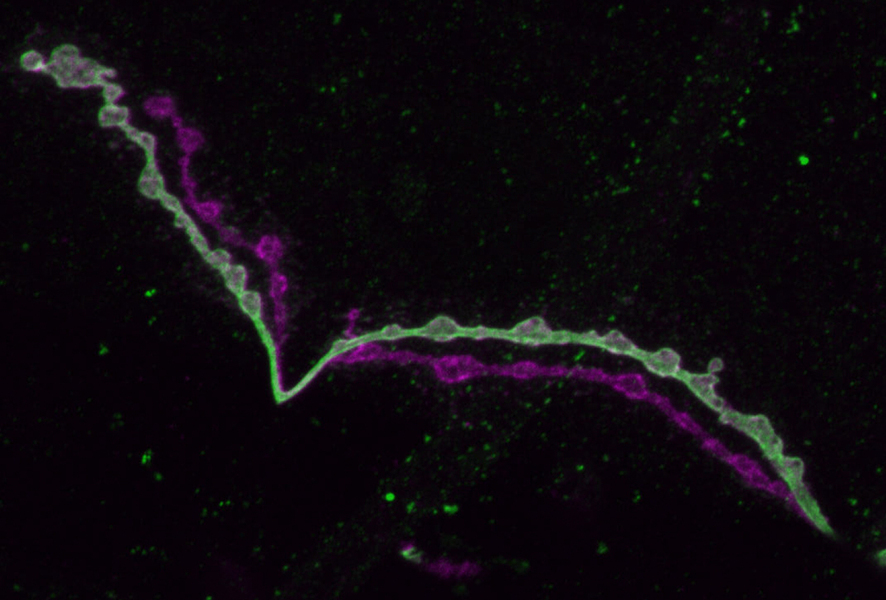
 Long, thin, bumpy extensions of two neurons extend from upper left to bottom right across a black background. One is light green, the other is magenta. The light green one features patches of darker green amid little bumps along its length.

In a new study in Neuron, neurobiologists at the Picower Institute for Learning and Memory found that two closely related neuron subtypes in drosophila differed from each other in how they expressed more than 800 genes, about 5% of the total amount of genes in the fly genome. The two neuron types studied were both from what could be considered the spinal cord of the fruit fly. These neuron types control the muscles by releasing the neurotransmitter, glutamate. The main functional differences of the two subtypes are that the “phasic” neurons connect to a lot of muscles and emit big, occasional bursts of glutamate, and the “tonic” neurons connect to only one muscle and emit a constant, small amount of glutamate. Phasic neurons make fewer synapses on an individual muscle than tonic ones do, but make about 4 times as many synapses in total because they innervate so many more muscles. Tonic neurons have more inputs from other neurons due to it having more widely branching dendrites. Of the expressed genes of the neuron types, a significant amount helped with the growth of the axon branches, some helped with the structure and function of synapses, and others played a role in the types of chemicals the neurons were sensitive to as inputs. Researchers disrupted the functions of some genes to see which were the most different between the two subtypes. By disrupting the Wnt4 gene, a gene expressed 40 times more by the tonic neurons, the synaptic growth decreased significantly in the tonic neurons. By mutating a calcium ion buffering gene found 30 times more in phasic neurons, the phasic neurons had higher resting calcium levels similar to tonic neurons.

This study holds a lot of significance in not only discovering how different genes can overlap and differ in different cell types, but also specifically in how neuron subtypes can differ. The research presented in this article is exciting because figuring out how different kinds of neurons develop from their expression of different genes helps in advancing how a brain works. It could also help in understanding what can change or go wrong in disease. The study compares two similar cells in a very detailed manner and shows that even similar cells can have a lot of differences in gene expression to develop specific, distinct functions. 

https://news.mit.edu/2023/study-connects-neural-gene-expression-differences-functional-distinctions-0825  

https://news.mit.edu/2020/two-seemingly-similar-neurons-show-distinct-styles-in-muscle-interactions-0720#:~:text=The%20%E2%80%9Ctonic%E2%80%9D%20neuron%2C%20which,spring%20the%20muscles%20into%20action

Tuesday, April 2, 2019


Is insomnia an issue in your life?


    If you do not suffer from insomnia there is a high chance that at least you know someone that does. The negative effects of not being able to sleep at night are more serious than what we think. This involves physical health overall and also the efficiency at work or any other activity. Researchers have found that the inability of falling asleep involves a genetic component. Nature genetics provided information related to the issue and this implicates issues in brain regions related to heart diseases as well as psychiatric disorders such as depression. These studies have used DNA from many individuals. The first study done by Danielle Posthuma from Vrije University Amsterdam examined 1.3 million people using data from the genetics company 23andMe. Their results states “ 202 areas of the genome linked to insomnia were identified, indicating 956 genes”. 
    The next part of the investigation was to figure in which regions of the brain this was taking place. As a result they found them to be within the axons of neurons and parts of the cortex and the deep subcortical brain regions such as the striatum which is involved in movement. Another researcher, Richa Saxena from of Massachusetts General Hospital surveyed 450,000 genomes also from a Biobank. This investigation resulted in 236 genes in 57 regions. An extra step taken in this case was the observations of participants who wore motion detectors for a week in order record tossing, turning and sleepwalking. Their conclusion was that insomnia is related to neuropsychiatric disorders. Cognitive behavioral therapy can be more helpful rather than taking drugs which might not be as effective and can be addictive.
woman lying in bed stares at clock in the middle of the night
 People with insomnia have trouble falling asleep, staying asleep and in some cases both.

Even though I do not have this issue, I do know people that suffer from insomnia on a daily basis. Sometimes even people that stay awake all night due to their work schedules, are still not able to sleep at night. To people that do not suffer from insomnia as myself, we might think how is that even possible but it is a problem that unfortunately many people have. As mentioned, this will eventually cause health issues as well as not being productive due to lack of sleep.

Thursday, November 30, 2017

New genetic variations linked to educational attainment: Genetic overlap between cognitive ability and longevity

Researchers from the Feinstein Institute for Medical Research have recently discovered a link between genetic variations and a person's cognitive ability. An international team of 65 scientists led by Dr. Lencz led the largest peer-reviewed study of its kind and analyzed the genomes of over 400,000 individuals. These individuals took neuropsychological tests to measure their brain function and cognitive ability. By profiling the ability of these individuals, the researchers discovered a genetic predisposition in certain individuals towards higher cognitive ability and longer lifespan. Dr. Lencz explained that this genetic information has the potential to be used to develop targeted treatments for cognitive and memory disorders. 
These findings were released two days ago and it is amazing that these researchers performed such a widespread study on the genomes of a large population. This genetic information is beneficial in the development in the treatment for cognitive and memory disorders. It can be used to produce and manufacture new drugs such as Alzheimer's disease, schizophrenia, and attention deficit hyperactivity disorder. While there are many drugs currently available to treat these disorders, novel treatments can be introduced that are more effective.