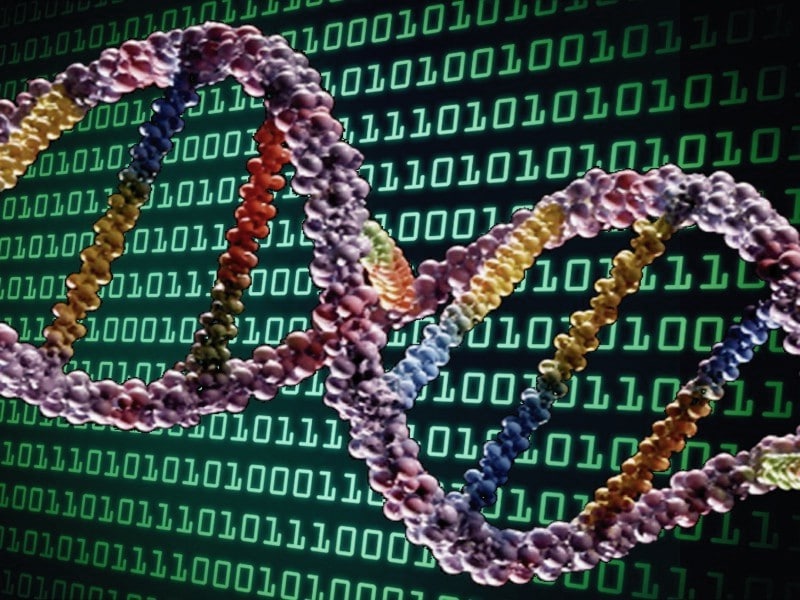
I think this is amazing that we know so much about DNA and genes that we are synthetically making ways to store "700 terabytes on a single gram."
Showing posts with label Microsoft. Show all posts
Thursday, April 28, 2016
Genetics startup Twist Bioscience is working with Microsoft to store the world’s data in DNA
There is a way to store all of the world's knowledge in the trunk of your car. Using synthetic genes Twist Bio science, along with Microsoft will now start to encode vast amounts of information in their DNA. This process allows for the information to be stored for thousands of years, which is much longer than the amount of time it would last being stored on media. When perfected, this way to store information will one day become commercially available and will change the way we store valuable and vast amounts of data forever.
Tuesday, April 12, 2016
DNA Data Storage
A recently published article in the New York Times discusses new research involving computer data storage. Two recent experiments involving teams from the University of Washington and Microsoft, as well as a separate group at the University of Illinois, have shown that DNA molecules can be the basis of an archival storage system. This system could potentially have the capability of storing all the world's digital information in only nine liters of a solution! This new technology would allow retrieval of specific digital files in an immense amount of data. This vast amount of information has the potential to last for thousands of years. This length of time is a huge benefit in comparison to current microelectronic data systems because they can only store data safely for several decades. This storage capacity will be essential to keep up with the exponential growth of digital storage needs in the technological age.
The raw data storage capabilities of this technology are incredible and are completely unfeasible even with the most advanced electronic magnetic storage systems. The researchers theorize that DNA could store up to an exabyte of data in the volume of a grain of sand. Douglas M Carmean, a researcher from Microsoft said, "In the last year, it suddenly hit us that this fusion of computer technology and biology will be where future advances come from." The ingeniousness of DNA data storage is that scientists exploit the self-assembly nature of DNA replication, essential for life in living organisms.
The scientists admit that there are technological advancements that must occur in order to write the information in DNA, but they say that the technology is improving quickly. A current issue with the technology is that data retrieval is "snaillike" in comparison with magnetic storage. In addition, the technology is still very expensive but Dr. Leproust says, "The cost of digital information in DNA will soon come down by several orders of magnitude." This new research is an exciting biotechnological advancement and almost sounds like something out of a science fiction movie. The research is still new and there still needs to be further technological advancements but if Moore's law holds true then DNA data storage will be commonplace in the future. This type of research is exciting and makes me appreciate how quickly the genetics field has progressed.
Labels:
biotechnology,
Computer science,
data,
DNA,
Microsoft
Monday, March 7, 2016
Treating HIV Like Spam
David Heckerman is a Microsoft Research scientist as well as a medical doctor who has found similarities between HIV mutations and spam. In the late 1990's, Heckerman created the spam filter by using machine filtering. At first, the filter worked by filtering spam from other emails by finding specific words. Spammers then caught on to this and started ti manipulate the messages to look the same to the human, but different to the computers. Heckerman then changed the filter so that it filtered out emails that were meant to collect money.
The researcher began to find interest in finding the treatment for HIV. He stated, "Spammers mutate their spam messages to work around our filters, and HIV mutates itself to avoid attack by our immune
system." Based on this analogy, Heckerman and his team used machine learning to find weak links in mutated HIV. Their first approach was finding out where the immune systems of people who were infected by HIV, but not extremely ill were attacking HIV. They compared the location of this attack to people who were infected and very sick. The researchers did find some differences in the location of the attacks between the controlled and non-controlled. The other method was to simulate the physical properties of the protein after mutation and see which mutations destabilized the proteins. The results for the 2 methods were quite similar.
Heckerman and his team have a new and unique approach to treating HIV. Heckerman's next step is to find a safe and effective vaccine that will attack vulnerable regions instead of attacking at random. This research could lead to a breakthrough in treating a virus that kills 1.8 million people yearly. Being able to relate his research on spam to HIV will hopefully have a significant impact on many people's lives.
Labels:
David Heckerman,
HIV,
HIV vaccine,
Microsoft,
mutations,
proteins,
spam,
vaccine
Subscribe to:
Posts (Atom)