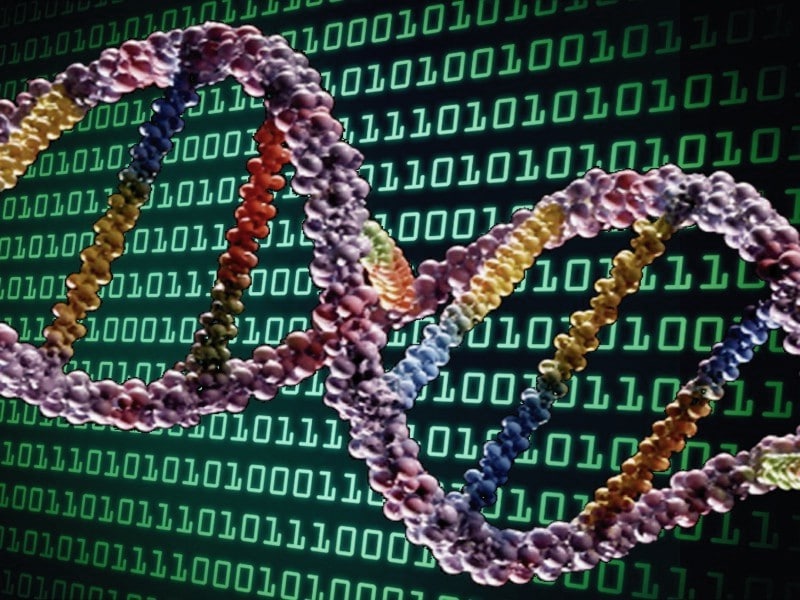
A recently published article in the New York Times discusses new research involving computer data storage. Two recent experiments involving teams from the University of Washington and Microsoft, as well as a separate group at the University of Illinois, have shown that DNA molecules can be the basis of an archival storage system. This system could potentially have the capability of storing all the world's digital information in only nine liters of a solution! This new technology would allow retrieval of specific digital files in an immense amount of data. This vast amount of information has the potential to last for thousands of years. This length of time is a huge benefit in comparison to current microelectronic data systems because they can only store data safely for several decades. This storage capacity will be essential to keep up with the exponential growth of digital storage needs in the technological age.
The raw data storage capabilities of this technology are incredible and are completely unfeasible even with the most advanced electronic magnetic storage systems. The researchers theorize that DNA could store up to an exabyte of data in the volume of a grain of sand. Douglas M Carmean, a researcher from Microsoft said, "In the last year, it suddenly hit us that this fusion of computer technology and biology will be where future advances come from." The ingeniousness of DNA data storage is that scientists exploit the self-assembly nature of DNA replication, essential for life in living organisms.
The scientists admit that there are technological advancements that must occur in order to write the information in DNA, but they say that the technology is improving quickly. A current issue with the technology is that data retrieval is "snaillike" in comparison with magnetic storage. In addition, the technology is still very expensive but Dr. Leproust says, "The cost of digital information in DNA will soon come down by several orders of magnitude." This new research is an exciting biotechnological advancement and almost sounds like something out of a science fiction movie. The research is still new and there still needs to be further technological advancements but if Moore's law holds true then DNA data storage will be commonplace in the future. This type of research is exciting and makes me appreciate how quickly the genetics field has progressed.

