Showing posts with label HIV prevention. Show all posts

Monday, April 11, 2016

HIV Defeats Gene Editing Attack By CRISPR

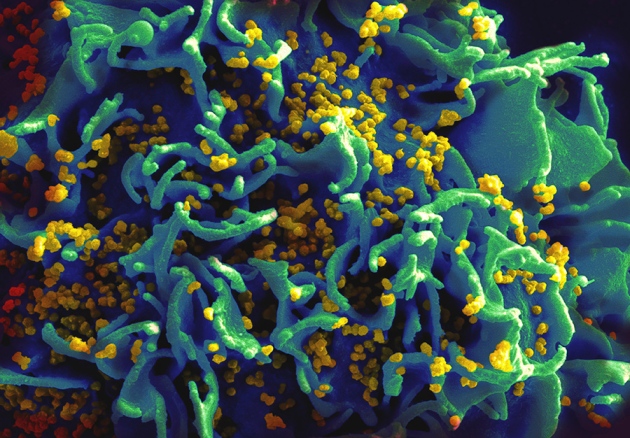
A scanning electron microscope image showing HIV attacking a T cell.

Researchers have conducted over a dozen studies to investigate the ability of CRISPR- Cas9 to conquer the human immunodeficiency virus. Scientists use CRISPR-Cas9  as a gene editing technique that targets a specific genetic sequence and edits the DNA at precise locations. Some researchers have used this technique in two different ways to tackle HIV. One way involves editing the genes made by T- cells so that HIV has no way of attacking the T cell. Another way involves modifying the genes of the T cells with gene- editing tools so they are able to wipe out HIV when it tries to attack them. Researchers at McGill University in Montreal decided to take the second approach and provided T cells with gene editing tools so they can demolish HIV. However, after a couple weeks the group of researchers found that the T cells were rapidly developing copies of the virus that escaped from the CRISPR attack. The researchers were able to identify through DNA sequencing that the virus had developed genetic mutations that were very similar sequences to the CRISPR- Cas9 enzyme. This result was no surprise to the team of researchers because HIV has evolved to a point where it is capable of resisting anti- viral drugs and is adaptable to genetic mutations. The virologist in charge of the team, Chen Liang, proposed that the cause of this genetic mutation happened when the Cas9 enzyme cut the viral DNA. Liang explains that when the DNA is cut, its host cell attempts to repair the break and while doing so a deletion or insertion in the DNA sequence occurs and the CRISPR usually inactivates the gene that was cut. Sometimes the CRISPR doesn't always work correctly and the insertion or deletion of bases made by the T cell machinery allows them to leave the genome of HIV with the capability of replicating and infecting other cells. The worst part about this situation is the fact that T cells machinery cannot detect virus because of the change in its genetic sequence which allows the virus to be resistant to future attacks. However, Liang and molecular biologist Atze Das believe that this issue can be fixed by either inactivating several HIV genes at once or use CRISPR with HIV attacking drugs.


With the help of other advanced gene editing technologies, I think that researchers will be able to eventually detect at least one or two specific mutations within HIV's genetic sequences and find or create a drug most suitable for that mutation. This of course would take years to work out since viral DNA is constantly evolving and able to adapt to genetic mutations very easily making it resistant to many drugs. If researchers can figure out a way to somehow alter  the machinery of T cells so that they are able to overcome invading HIV then treatment for HIV would be more effective for some individuals, maybe not all, but it would be a good start. 

Tuesday, February 24, 2015

New HIV Molecule Proven to Protect Cells from Virus


        Scientists have been conducting research on the HIV virus and its genetics and have created and begun testing a new vaccine that partially protects monkeys from an HIV-like infection. This article suggests that scientists are homing in on the ingredients for a HIV protective vaccine that could potentially be sent off for human trial. The Simian Immunodeficiency Virus (SIV) prime-boost vaccine offers partial protection  to monkeys from acquiring the disease by about 80%.  On the contrary, those individuals that became infected, the vaccine regimes reduced the amount of virus found in the bloodstream. Scientists are now working on a human-adapted vaccine for experimental trial. 
        I found this article to be very interesting and short, sweet and to the point. I know scientists have been researching HIV/AIDS for decades upon decades trying to find a preventative measure or cure. The risk of contracting HIV is real. I know many individuals personally who have been infected.  Could this be the cure?

Thursday, April 18, 2013

The Future of the Prevention of HIV

An article in ScienceDaily says that the researchers at Albert Einstein College of Medicine have figured out how regulation occurs of the protein that blocks HIV-1 from multiplying in white blood cells. HIV-1 is the virus that causes AIDS and this discovery could serve as a potential elimination of the virus. It can eliminate the residue of the HIV-1 that remains in patients that have undergone antiretroviral therapy which reduces HIV-1 levels in the blood until it is undetectable, but it still remains in the phages. Dr. Felipe Diaz-Griffero says, “If you stop antiretroviral therapy, the virus emerges from these reservoirs and returns to the general circulation in a matter of days, as if the patient had never been treated.” Now that they have identified the protein and its regulation, they can prevent the HIV-1 from arising form reservoirs, eliminating them completely. Scientists have always known that the protein is SAMHD1 but they have never been able to figure out why it only prevents HIV-1 replication in certain cells but not other crucial ones such as macrophages. SAMHD1 exists in two forms: phosphorylated and unphosphorylated. A cell is only protected from the replication of the HIV-1 when there is unphosphorylated SAMHD1 proteins present. They are now trying to figure out a way to permanently keep SAMHD1 in its unphosphorylated state.

[caption id="attachment_8000" align="aligncenter" width="625" caption="T-cell Infected by HIV "]HIV Infection[/caption]

I think this is a great discovery in science. It can potentially lead to a cure of a disease that people have been searching for the longest time. It would be a great success in medicine if this technique could be introduced to the public. However, I am curious to know how they will be able to account for the differences that exist from patient to patient.