Showing posts with label rabbits. Show all posts

Thursday, August 5, 2021

Bunnies Do Handstands Instead of Hops: Genetic Defects

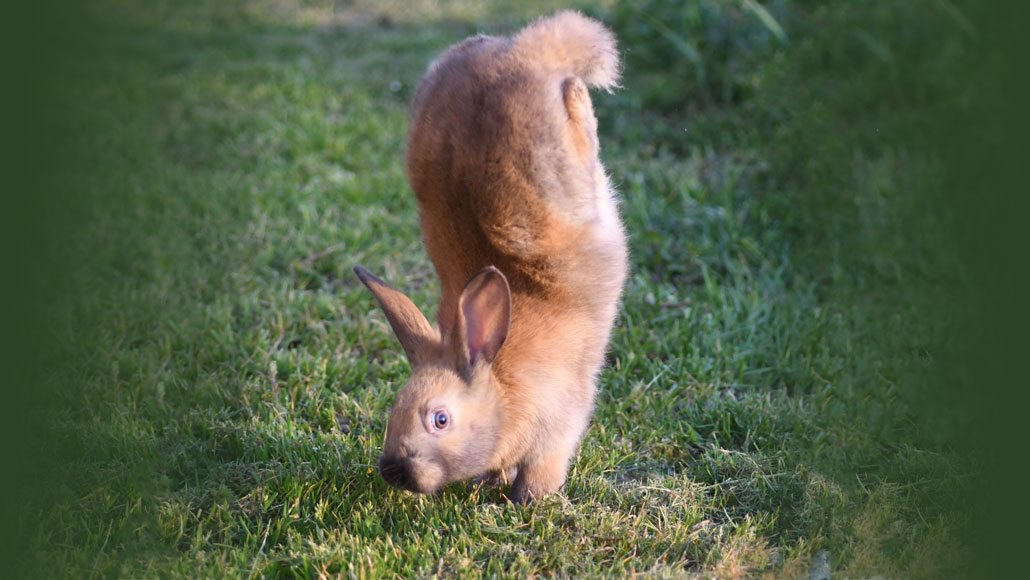
 rabbit standing on front paws

In this article, Erin Garcia de Jesus discusses how a genetic defect may cause bunnies to do handstands instead of hopping as a way to move fast. A rabbit called sauteur d’Alfort sends its back legs sky high and walks on its front paws. That strange form may be the result of a gene tied to limb movement, researchers report March 25 in PLOS Genetics. Mice have also shown this similar trait and walked on their front limbs to run. 

Understanding this genetic defect and how they move, can help improve our knowledge on the spinal cord. A mutation in the RORB gene is a likely candidate for the rabbits’ handstands. That mutation causes faulty versions of the genetic instructions that cells use to make proteins, which means there is less of the RORB protein in specialized nerve cells in rabbits that have the mutation compared with rabbits that don’t. Without the RORB protein in spinal cord nerve cells (interneurons) , the rabbits may lack the ability to coordinate what their hind limbs are doing, which affects their ability to hop regularly. Understanding this, and how one possible mutation affects how animals move, and ultimately help develop ways to repair the body when defects in RORB cause diseases/immobility. 

Links:

https://www.sciencenews.org/article/rabbit-handstand-front-paws-gene-defect-video

https://www.nature.com/articles/d41586-021-00775-9#:~:text=An%20unusual%20rabbit%20that%20walks,hind%20legs%20in%20the%20air.

Friday, April 16, 2021

Handstand Gene Defect in Rabbits


One breed of rabbits has been found to do handstands and walk on their front legs rather than hop. This may be a result to a mutation of the gene RORB, scientists have found. RORB is a gene connected to limb movement. This finding is truly fascinating to see and learning more about this study may also help researchers discover more about the spinal cord. 

The article describes one study where the hop-less rabbits are bred with rabbits that can hop. The researchers compared the offspring that could hop to those that could not. This is where the mutation of the RORB gene was found to be the likely culprit of the hand stands. However, more research needs to be completed to find how exactly this gene affects the coordination of limbs and why it causes handstands in rabbits and other animals. 


Sources: 

Sunday, March 28, 2021

A gene defect may make rabbits do handstands instead of hop

 This article written by Erin Garcia de Jesus discusses how one defective gene might turn some  bunnies hops into handstands. It may be a result of a gene tied to limb movement. Mice with a  mutation to a gene also do handstands when they start to run. Leif Andersson, a molecular geneticist at Uppsala University in Sweden, ran a study where hop-less d'Alfort male rabbits were bred with Zealand white rabbits that can hop. There seems to be less of the RORB protein in specialized nerve cells that have the mutation compared with rabbits that don't. Without the RORB proteins the rabbits could lack the ability to coordinate what their hind limbs are doing. This restricts their ability to hop. 


This article provides more information on the RORB protein(in humans).

Monday, April 8, 2019

Rabbit genes could help pollution

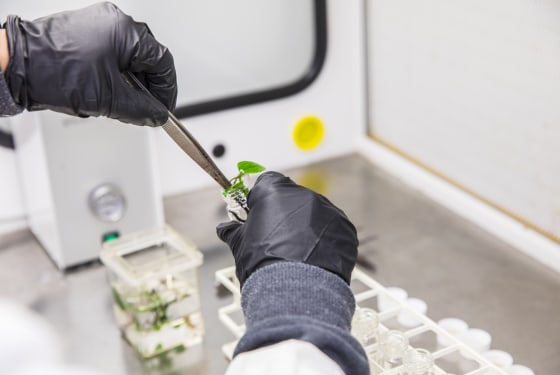
New research has shown that if scientists slightly alter the genes of plants, they could degrade different air pollutants.  Even better, the air pollutants that collect in our houses and could have an effect on our health.  The goal is to see if common houseplants can be modified to break down volatile organic compounds (VOCs).  To do this scientists inserted a synthetic version of a rabbits gene into a houseplant called Devils Ivy.  This gene caused the plant to make toxin-neutralizing enzymes and suck up chloroform and benzene turning them into useful molecules for the plant.  The only catch to these plants is that, if used in a house, there would need to be a fan constantly blowing air over the plants leaves.  The team is still currently doing research to see if the plants can be modified to remove other VOCs in the air.  Scientists are also wary about how people will react to "genetically engineered houseplants" since there is such a big issue about genetically modified organisms (GMOs).  They also voice issues about if these plants are released to the wild with modifications, how they would survive, if they would be resistant to certain herbicides, or severe weather, etc.  After more testing they are hoping to get approval to put the plants on the market within the next two years in the U.S.
Image: The researchers put both types of plants in glass tubes and then added either benzene or chloroform gas into each tube. Over 11 days, the team tracked how the concentration of each pollutant changed in each tube.