Showing posts with label lymphocytes. Show all posts

Thursday, November 24, 2022

Discovery proposes new way to target mantle cell lymphoma


Mantle cell lymphoma is a rare type of B cell non-Hodgkin lymphoma (NHL). NHL is a cancer of the lymphatic system. The lymphatic system has tubes that branch all over parts of the body. It transfers a colorless liquid, the lymph, and circulates it around the body tissues.  This liquid holds a large number of white blood cells (lymphocytes) that fight infection. When you have lymphoma, some of your lymphocytes do not work properly. This is, they start to divide constantly, but don't fully develop, losing their ability to fight infection. There are two main types of lymphocytes: B cells and T cells. Mantle cell lymphoma affects B cells and develops in a part of the lymph node called the mantle zone. These abnormal lymphocytes collect in body organs or lymph nodes, form tumors, and begin to create problems within the lymphatic system or the organ in which they are growing. 

Mantle cell lymphoma (MCL) is critically dependent on a protein that coordinates with gene expression.  A recent research study has found that blocking this activity with an experimental drug adequately slows the growth of the lymphoma in preclinical tests. Through gene-editing technology on arrays of mantle cell lymphoma grown in the lab to block different transcription factor proteins. Transcription factors are proteins that bind to DNA and work as programmers of gene activity. This process revealed many transcription factors whose disruption caused a severe slowdown in MCL division without slowing the growth of other cell types. One that worked as a critical factor in sustaining the pattern of gene activity in MCL is FOX01. A biotechnology company had tried to develop FOX01-inhibiting compounds to possibly use in the treatment of type 1 diabetes. Researchers found that it also had similar effects on MCL cells as blocking genetic means. In the study, it was found that adult mice tolerated a month of FOX01-inhibitor treatment with no major side effects. 

There is a strong need for better therapies against mantle cell lymphoma and I believe that this study's findings to inhibit FOX01 could be an effective strategy to try alone or in combination with other drugs for more durable responses. If a drug that blocks this protein's activity and slows down the growth of lymphoma is put on the market for treatments for MCL, it will truly save many lives.  

Thursday, April 15, 2021

Gamma-delta T Cells and it's Relationship With the Gut


In the article “Mysterious Immune Cells Change the Gut Lining to Accommodate Diet” scientists observe the mechanism in which epithelial cells keep pathogens out as it absorbs nutrients and minerals from the food we eat. Based on a study conducted with mice researchers saw that immune cells called gamma-delta T cells are responsible for epithelial cells of the gut being able to maximally absorb nutrients. Research has shown that animals have genetically adapted their intestines to their specialized diets; pandas, koalas and other animals. 

A study conducted on mice, consisted of having changed the normal diet to two specialized both with the same calorie intake but one was higher in protein while the other had a higher carbohydrate intake. The results of this study indicated that mice had a higher adaptability of absorbing the carbohydrate diet. Upon inspecting even further into the genetic changes that occur in the single cell RNA had indicated that the gut selectively expands. The study was conducted again without micro bacteria present in the gut and the same result occurs which further establishes that the accommodation which the gut undergoes is independent to whether or not bacteria is present. However when the experiment was repeated once again limiting the amount of lymphocytes present in the gut, gamma-delta T cells had indicated that they were responsible for the expansion and contraction of the gut and the potential of the absorption of nutrients. 

Gamma-delta T cells besides being the causes of mucus blocking the airways when contracting the flu, it may also be responsible for regulating tissue homeostasis. Not only is the immune cell versatile but it contributes to the guts ability to accommodate diets to extract the most nutrients from foods. Studies like these are important to make note of because many of the components of the body are still very much not understood when it comes to their functions and relations with other functioning systems to keep the body working. 


Monday, October 13, 2014

New Vector for Treating X-linked Severe Combined Immunodeficiency

X-linked severe combined immunodeficiency (SCID-X1) is an inherited, life-threatening condition which affects approximately 1 in 50,000 to 100,000 newborns, almost all of which are boys. SCID-X1 rarely affects girls because the mother must be a carrier for the mutation, and the father must have SCID-X1. SCID-X1 is caused by a mutation in the IL2RG gene. This mutation essentially prevents lymphocytes from properly maturing and functioning. Ultimately, in SCID-X1, the immune system is drastically weakened, resulting in chronic infections and probable death.

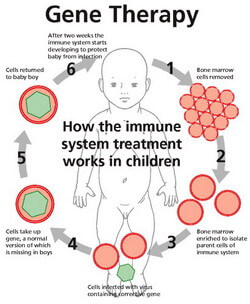
SCID-X1 is ideally treated via a transplantation of blood-forming stem cells and gene therapy; however, some patients do not have a matched bone marrow donor. In the case of lacking a suitable donor, "doctors remove stem cells from the patient's bone marrow." Then, using a Maloney murine leukemia virus-based-gamma-retrovirus vector, a corrected gene is inserted into the cells, and the cells are then returned to the patient. This method has worked in restoring immune function; however, after two to five years from receiving the treatment, one-quarter of the patients developed leukemia. This vector "may activate genes that control cell growth," unluckily leading to leukemia.


Currently, a study is being conducted to evaluate the outcome of using an engineered self-inactivating gamma-retrovirus vector to treat SCID-X1. The study consists of nine boys with SCID-X1 who received gene therapy using this vector form. This treatment has produced positive results in seven of the nine boys who "developed functional T cells at levels comparable to those seen in previous studies and have remained healthy for one to three years after treatment." The results from analyzing the boys' T cells indicate that the self-inactivating vector "causes fewer genomic changes that could be linked to leukemia." One of the boys who did not respond well to the treatment passed away from a previously existing viral infection, and the other received a stem cell transplant. The boys who did respond to the treatment will be regularly monitored for the development of leukemia.

Although the condition appears fairly rare with only 1 out of 50,000-100,000 boys being affected, this number means there are anywhere from 3,161 to 6,322 boys suffering from this condition in the United States. Knowing that 3,000-6000 boys may have to be placed in a bubble to prevent infections is very saddening; however, the development of the self-inactivating vector can ultimately strengthen the boys' immune systems. This will allow them to live life the way a young boy should while also reducing and potentially eliminating the increased risk of developing leukemia from the treatment.

This article reopened my eyes to the complexity of the human body almost leaving me dumbfounded. While it may seem like the human species has everything figured out, there is so much information to be learned.

Article: http://www.niaid.nih.gov/news/newsreleases/2014/Pages/SCIDtherapy.aspx
Related Article: http://www.nejm.org/doi/full/10.1056/NEJMoa1404588#t=articleResults