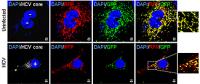
http://jcs.biologists.org/content/123/9/1389.abstract
Showing posts with label hepatitis c. Show all posts
Friday, April 18, 2014
Breaking Bad Mitichondria
http://jcs.biologists.org/content/123/9/1389.abstract
Labels:
biology,
cells,
disease,
Genetics,
hepatitis c,
liver disease,
mitochondria
Wednesday, April 16, 2014
Breaking bad mitochondria: How hepatitis C survives for so long
Researchers at the University of California, San Diego School of Medicine have now discovered why people with hepatitis C virus get liver disease. People infected with the "hard-to-kill" pathogen, which infects nearly 200 million people worldwide, attacks the liver cells energy center, the mitochondria. This dismantles the cell's innate ability to fight infection by altering the cells mitochondrial dynamics. Aleem Siddiqui, Professor of medicine and senior author, states that " the virus damages mitochondria in liver cells. Cells recognize the damage and respond to it by recruiting proteins that tell the mitochondria to eliminate the damaged area, but the repair process ends up helping the virus." He also states that, "it's like the bad part of the house is demolished to the benefit of the virus." In the researchers experiments, it showed that hepatitis C-infected cells with higher Drp1 protein levels also produced less interferon, the body's natural immune booster. These cells were also less likely to undergo apoptosis, a process that would encourage damaged cells to essentially kill themselves. While reading this, I hope to see improvement with developing a cure or type of antidote to reduce the attack or kill the attack of the pathogen on the cells mitochondria. Knowing how many people are affected by this is scary, and I'm glad to see that they are taking a step forward with this research.
Original article: http://www.sciencedaily.com/releases/2014/04/140415143959.htm
Secondary article: http://www.latimes.com/science/la-sci-hepatitis-c-cure-20140412,0,3083638.story#axzz2z4qUMnPX
Monday, December 9, 2013
Genetic Analyses: a helpful tool in identifying the source of Hepatitis C
Genetic analyses have been used more and more each year in the identification of the source of diseases. Specially, the article linked here shows how the genetic analysis of the transmission of the virus Hepatitis C was used to decipher where the disease spread from and how fast it spread. It is interesting to see just how complicated these analyses can get when diseases are involved. Unfortunately, with this type of research disease sometimes spreads faster than the scientists can research it. This was often the case when the scientists in Spain were using these analyses on the Hepatitis C virus. Another complication with these methods is the high rate of mutation amongst the Hepatitis c virus. As the article reads, "another consequence of the high viral mutation rate is that there are millions of variants of HCV kicking around in each infected person’s liver, and only a very small fraction of those are present in any given blood sample, making matches between viral sequences in the source and those suspected to have been infected by that source even harder to pin down." All of these components make it exciting to see the world of genetics spreading in all areas of life, and hopefully eventually helping solve the mysteries of diseases.
http://www.geneplanet.com/personal-genetic-analysis.html
Labels:
epidemiology,
Forensics,
genetic analysis,
hepatitis c,
virus,
virus transmission
Subscribe to:
Posts (Atom)

