Showing posts with label dog breeding. Show all posts

Wednesday, December 15, 2021

Cavalier King Charles spaniels carry more harmful genetic variants than other breeds

Mitral Valve Disease in Dogs – My Vet Animal Hospital


    New studies have shown that recent dog breeding practices among Cavalier King Charles Spaniel breeders has caused gene mutations linked to myxomatous mitral valve disease, or MMVD for short. In this condition, the mitral valve in the heart degenerates, allowing blood to leak from the left ventricle back into the left atrium. Researchers are looking for the variants that cause this mutation, and have, so far, been able to identify two. These genetic mutations appear to regulate a gene that codes for a common protein in heart muscle. Researchers have speculated that years of breeding have caused these mutations. In the 1600's, cavaliers were a very popular breed amongst royalty, and according to researchers, experienced several "bottlenecks" throughout their history. Bottlenecks are explained to be where only a small percentage of individuals were used for breeding and passed on their genes, so the hypothesis is that these individuals possessed the mutations or made the harmful genes for MMVD through centuries of selective breeding. 

Wednesday, November 24, 2021

Goldendoodles: Glorified Mutts?

Goldendoodle Breed Information, Facts, Images! (2021) - We Love Doodles


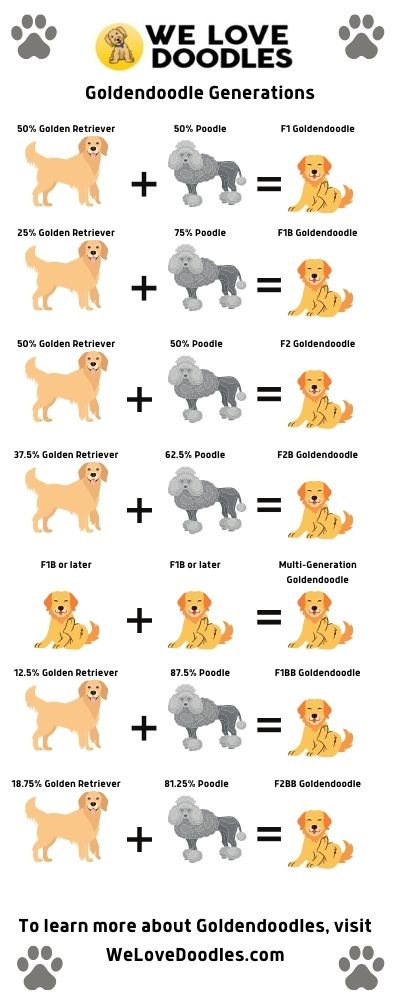
    Doodle varieties have become the newest craze in the dog breeding world. Goldendoodles, bernadoodles, labradoodles, and so many more are being sold for thousands of dollars as purebred dogs. But are doodles really purebred, or are they just glorified mutts? According to the American Kennel Club (AKC), Goldendoodles are not AKC, and cannot be registered. This is because there is no breed standard for Goldendoodles or any of the doodle varieties, because there is so much variation with breeding. The main reason why Goldendoodles have become so popular is because they have to potential to be hypoallergenic like poodles, while also still possessing the fun personality of a golden retriever. The word "potential" is very important here, though. Because of the amount of variation in breeding, as seen from the diagram above, some Goldendoodles will have more or less poodle or golden retriever in them. This means that some Goldendoodles will still shed, some will have longer wiry hair, and some will have tight curly hair. There are also variations in size, coat color, and behavior. 

Sunday, October 29, 2017

Hot Dog! We Know What's Causing IVDD!


In an article recently published on ScienceDaily, a study was done revealing the connection between genetic mutations and chondrodystrophy. This is more commonly known as a disorder causing abnormally short legs and intervertebral discs. Danika Brannasch, who studies veterinary genetics, explains that "dogs with intervertebral disc disease (IVDD) are 50 times more likely to have this mutation." The ability to identify the cause of the pain is a huge step towards relief for the suffering pets. In extremely severe cases, which I've actually experienced with my own dachshund, the herniated discs can lead to paralysis. The treatment for this condition is insanely expensive, and often the dogs are euthanized because the treatment doesn't guarantee 100% success.
Danika Brannasch began her study with finding importance on chromosome 12, showing a link to unusually long bone growth. During the study, Brannasch's team found that the breeds that shared this DNA sequence were among the beagles, dachshunds, and spaniels. With connections to the University of California, Davis, veterinary hospital, the team was able to get a closer look at many IVDD cases to observe the DNA sequences of the dogs involved. A veterinarian student, Emily Brown, was the one to identify the FGR4 retrogene mutation, which was causing the growth abnormalities. As the study continued in depth, the more clear it became to see a connection with the mutation in humans as well (comparing to animals). Brannasch explained that "having the ability to eliminate a disease as painful and debilitating as IVDD is the most satisfying result of my scientific career."
I think this is an absolutely amazing discovery. It can really save a lot of families from the heartbreak of watching their pets suffer, and it can save the poor pets from experiencing a lot of pain. I really wish this study had been completed years ago! Maybe we wouldn't have had to put down our poor little pup. Knowing the cause of the mutation is extremely important to not only owners, but to breeders as well, in hopes that one day the condition can be bred out completely.

Tuesday, February 23, 2016

Breeding a Champion, Ridding the Mutants

The precision of dog breeding has greatly improved since the tool of DNA tests has become available to breeders. Whether or not the standards of some breeding techniques are ethically correct is still under debate. The NY Times article As Breeders Test DNA, Dogs Become Guinea Pigs explores the genetic breeding in racing dogs called "Whippets" as well as several other examples of genetic breeding in dogs.

Left - Regular whippet, Right - "Bully" whippet 

Eyebrows were raised once abnormally muscular mutant whippets starting arising in the litters of champion racing whippets. Scientists gathered DNA samples from race meets across the country and found that the oversized or "Bully" whippets have a genetic mutation that enhances muscle development. The mutation was found to be a defective copy of the myostatin gene, which inflates the muscles of some whippets while making others the quickest dogs on the track. Elaine Ostrander,  scientist at the National Institutes of Health, discovered that the fastest champion whippets had a single defective copy of the gene, while the "bullies" had two. Breeders are continuing to mate these fast dogs with one another even while knowing that they may have to kill off the unwelcome bullies that will often be produced. Some breeders express that breeding these genetic champions cause a championship to be "less earned", however these whippets are still being judged and raced along with the naturally gifted dogs.

The article also explains how the innovation of genetic testing on dogs is creating a model for scientists to study the unknown consequences that may arise from genetic testing. These models will be beneficial as DNA tests start to become further applied into our society. Not only is genetic selection disturbing the natural biodiversity in some dog breeds, it has also backfired in some ways. For example, since genes are often tied to multiple traits, scientists are finding that genes responsible for coat colors are also causing skin problems. Some positive uses of DNA screening are those that aim at improving health in dogs and also create models for improvement in human health. For example, Dobermans are being screened for a gene responsible for von Willibrand disease, a bleeding disease like hemophilia that also affects humans.

Overall I find it wrong to modify and rid dog breeds based just off of aesthetic and athletic purposes. This is diminishing the creative expression of dogs, killing off breeds, and is truly unnecessary. I think the whippet breeders should no longer be able to purposely breed and cultivate these racing dogs. Dog racing, which I'm not a fan of to begin with, should be left for the naturally gifted dogs to compete in. Mutants shouldn't be knowingly produced and killed either just so dog breeders can win a trophy. Genetic testing on dogs in my opinion is only ethical if it is being done in the name of health and medicine.