Showing posts with label Human Migration. Show all posts

Thursday, November 29, 2018

Discovering Britian's past from DNA


In the early 400’s, the Roman empire was forced out of the area we now call Britain by the Anglo-Saxon forces, and with it brought what was believed to be the end of a group named Romano-British. However a fine-scale genetic analysis of genes shared in British inhabitants shows that the Romano-British survived the invasion and slowly interbred with the Anglo-Saxons to form the British population we know today. The British islands were completely empty around 10,000 years ago due to the ice age receding and exposing the land, nomads slowly trekked from mainland Europe over land bridges to the newly exposed land. The researchers determined that those in western wales share the most genetic information with these original inhabitants of the land. Another discovery was that the population of Northern Scotland shares about 25% genetic makeup with ancestors from Norway supporting a theory that the two lands were once connected. Oddly enough the researchers discovered little to no traces of foreign rule from the Danish in early 11th century nor Norman population in the 1060’s but were mostly dominated by the Roman linked DNA as Caesar's rule put a high priority on intermarriages between local populations and the Roman Empire. The Infrastructure of the Roman empire allowed for easier relocation to Britain from all across the Roman Empire, creating a more diverse population.

It is interesting to find out the background and the different populations that contributed to what we currently call Britain. Britain may seem like a small nation if you compare population sizes of the different nations in the world however Britain plays a key role in many cultures throughout the world. Seeing as Britain once controlled 3/4ths of the entire world and is now reduced to a small mound of land that is no larger than the US state of Michigan, fragments of British DNA are scattered around the world and knowing what makes up this DNA lets us understand what influences other cultures that were once under British rule.

References

Wade, N. (2017, December 21). Study Reveals Genetic Path of Modern Britons. Retrieved from https://www.nytimes.com/2015/03/19/science/study-reveals-genetic-path-of-modern-britons.html?rref=collection/sectioncollection/science&action=click&contentCollection=science&region=stream&module=stream_unit&version=search&contentPlacement=8&pgtype=sectionfront

O'Hanlon, L. (2012, October 22). Tracing Your Ancestry. Retrieved from https://www.technologyreview.com/s/405384/tracing-your-ancestry/

Friday, September 30, 2016

Blood Samples Connected to Malaria's Migration

Spain contained many accounts of malaria in 1925, and Dr. Canicio was specifically interested in this outbreak. He worked with patients and extracted some of their blood, leaving behind samples.  These samples were key to determining the number of strains throughout Europe and how they got there in the first place. 
The samples were recently given to Dr. Lalueza-Fox where he worked specifically with them.  His goal was to gain more factual knowledge about malaria and the strains that were prominent around Europe at that time.  He was able to retrieve genomic data of malaria by reversing a commonly used method.  Dr. Lalueza-Fox searched for DNA in the "leftovers" of the sample and emerged with the parasites that cause malaria.  From his findings, he was able to construct the entire genome of the strain P. falciparum and most of the genome of P. vivax.  His findings were remarkable.  From just a few drops of blood taken about fifty years ago, an entire genome was reconstructed. 

P. vivax, which was found in blood samples from Spain, is found today in areas including Asia, Middle East, South America, Central America, and sections of Africa.  P. falciparum is only found in India.  With this information, conclusions can be made that malaria follows the path of humans.  With people traveling from India to Europe to the Americas, malaria has been consistently with us.

This information builds curiosity about what else can be traced along with the migration of humans. There is no doubt that human movement has caused a transportation and introduction of different species to new areas.  This discovery about malaria has just been made, so what does the future hold?   

Thursday, September 22, 2016

Genetics and Human Migration

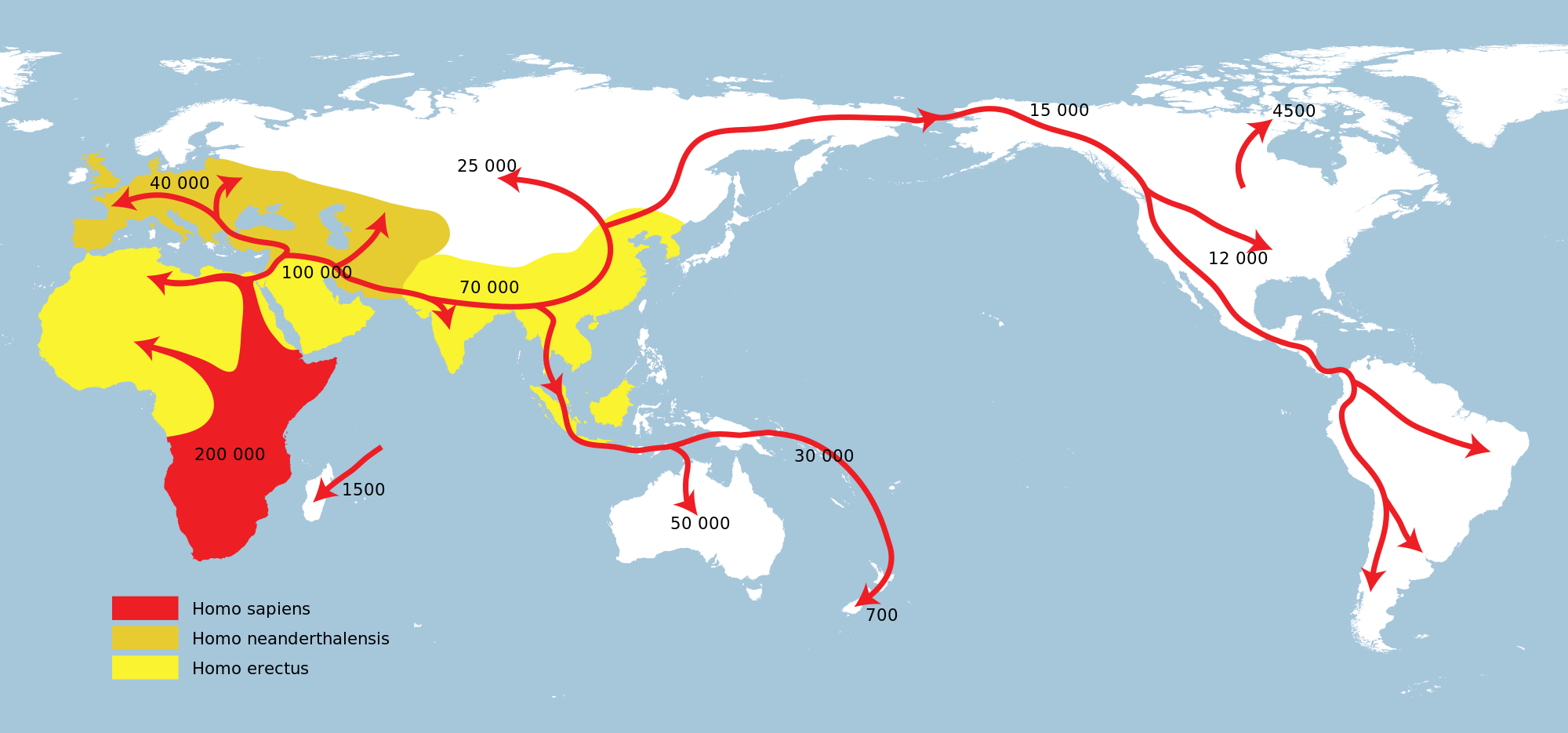
     For the past decade, geneticists have been studying the link between migration patterns of human and genomic variation. 

     What is understood today is that Africa is the human's evolutionary birth place. But what is not completely understood is how migration patterns have influenced or effected our genomic variation. To study this, scientists have collected genomic data for individuals from more than 270 populations across the world. Genomic data was collected from countries including Africa, Australia, New Guinea. Countries including Australia and New Guinea contain some of the earliest archaeological and fossil evidence of modern humans outside of Africa, and therefore it was important to study these locations as part of this research.

     After analyzing the collected data, scientists were able to conclude an approximate time period that different populations migrated from Africa. For example, current studies show that about 2% of genomes from individuals of Papua New Guinean ancestry, their ancestors separated from Africa earlier than Eurasians did. Eurasian countries- land lying between Asia and Europe- include Russia, Belarus, Ukraine, Uzbekistan, Kazakhstan, Tajikistan, and Kyrgyzstan.

     In addition to narrowing down the patterns of human migration, scientists have also discovered something else. Studying ancient DNA has shown that many large-scale populations have disappeared without a trace, except for their bones. This means that populations that used to live in Eurasia, for example, are no longer traceable by science.

    To discover migration patterns and connections between different countries and genomic variation, has lead to many discoveries and many more questions. However, scientists are still researching more migration patterns, hoping to discover more secrets of our past.

More about human migration and genomic variation is provided below.
http://phys.org/news/2016-02-genome-human-migration-evolution.html


Saturday, November 28, 2015


The First Americans


A question that everyone has always wondered but never truly questioned is, how were Americans first populated? Through recent DNA analysis questions are slowly being answered. A few studies have discovered genetic traces of human populations in places such as Australia and islands that surround it, but the only problem was that scientists could not find genetic affinity with Australasians in the ancient DNA of Native Americans from Mexico of Patagonia. The first study said that North and South America may have been peopled by a diverse set of founding populations, which offered the Austrailian signal as a type of evidence that humans could have arrived in the Americas in different pulses. On the other hand, another study stated that people crossed into North America via the Bering land bridge in a single wave about 20,000 years ago. There have been various questions involving this topic and a lot of different theories. Some theories included what is called the Paleoamerican hypothesis, which says that the first people to arrive in South America arrived from Polynesia, Melanesia, and Australasia and suggested that the Australasian signal in the DNA of modern Amazonians living in Brazil could of helping with a hint to human migration in the Americas.

On the other hand, what was most focused on was determining when populations in Serbia and East Asia has last shared a common ancestor with Native Americans. Scientists had believed it was about 23,000 years ago. In conclusion, they had said it had been peopled by a single wave of migration of people in Siberia who crossed the Bering land bridge and proceeded south. In opinion, the concept should be more researched since the topic is still so broad. It is true and knowledge that we know a little information about the topic, yet we still cannot come down to a conclusion even after months of research. I feel like if we look into more DNA analysis from other countries and more into North American soil, we will discover a lot more information.

Link to article:
http://www.the-scientist.com/?articles.view/articleNo/43069/title/What-s-Old-Is-New-Again/Link to alternative article:
http://csfa.tamu.edu/who.php

Tuesday, April 22, 2014

Snail Trail Reveals Ancient Human Migration


Geneticists have used snail trails to uncover evidence of an ancient human migration from the Pyrenean region of France to Ireland. Dr. Angus Davison and Adele Grindson from the University of Nottingham found that snails in Ireland we identical to snails in the Pyrenees, genetically, even though they were thousands of miles apart from each other. Geneticists used mitochondrial phylogenies instead of using just similar shells to find the connection. The simplest explanation for this is snails hitched a ride with humans approximately 8,00 years ago since they are the fastest animal out there. There are records of Stone Age humans using snails are a source of food and actually farming snails so this may also be help the theory of snails hitching a ride with humans. The results tied in with what we know from human genetics about human colonization in Ireland.
I believe these findings may seem small but they can help scientists with many other important findings in human colonization and tracing back where humans have evolved from. I also find it interesting that this all happen thousands of years ago and we can trace it all back now.

Wednesday, November 6, 2013

HaploSeq: New DNA sequencing technology


      ScienceDaily has recently posted an article about a new technique in the world of science, known as HaploSeq. Researcher Bing Ren, Ludwig scientist at the University of California, San Diego School of Medicine led the team to discover the new technique for studying DNA sequencing. Current DNA sequencing tools are becoming faster and cheaper and soon everyone will have their genome sequenced, but there is one problem with it. Ren states that everyone has two copies of each chromosome (accept sex). One copy comes from the mom, and the other comes from the father. The problem is that current technological techniques do not have any way of distinguishing between the two copies of each gene, and are not good at determining whether particular genetic differences come from a person's mother or father. HaploSeq combines molecular biology and computational biology, which enables researchers to quickly determine which genetic variants occur together on the same chromosome, in turn coming from the same parent. This technique will allow clinicians to better asses a person's risk for disease, by enabling them to determine if the gene mutations of that disease (ex: cancer) are on the same chromosome or different chromosomes.


     Also, HaploSeq offers the opportunity to refine the process of determining whether there is a genetic match between an organ donor and recipient. Genes express a lot of variability and this technique could help researchers and scientists determine whether DNA differences between the donor and recipient are going to be a good match. Furthermore, HaploSeq will also assist researchers in analyzing human migration and determine ancestry from their DNA. This technique will allow each individual and how one relates to other individuals to be studied specifically. As the data accumulates worldwide, researchers will be able to precisely determine their relationships. Ren says this study will become a worldwide human genetic variation, in which will be called the HapMap project.
Overall this new technique of studying DNA sequences seems like a very promising study. It will not only help determine which parent a specific gene comes from, but it will also help with disease risks and allow people to find the ancestrial relations to other individuals. HaploSeq seems like a positive triple threat to me. I think it will do great for the furture.