Showing posts with label Eurasia. Show all posts

Monday, November 22, 2021

DNA from Mysterious Asian Mummies Reveals their Surprising Ancestry

 The origins of the Tarim Basin mummies has long puzzled scientists. Now,  they have a new theory - CNN    

Naturally mummified bodies were found in the desert-like Tarim Basin located in western China. These preserved bodies were determined to be from about 4000 to 1800 years ago. The 4000 year old mummies that were excavated belonged to the Xiaohe population. These people's culture revolved around herding animals and growing plants. Their coffins were very different from the others as they had preserved cheese, wheat, and clothes that were actually made from western Eurasian wool. This hinted that the Xiaohe people had distant contacts or origins.

Archaeologists in China performed at a study where they analyzed DNA from 13 of the bodies found in the Tarim Basin as well as five human mummies from the Dzugarian Basin. From the analysis of the study, the Tarim population had traceable ancestry to hunters and gatherers who inhabited northern Eurasia more than 9000 years ago. The studies also suggest that the Xiaohe culture did not mate with any outsiders for a very long time. The analysis of the mummies from the Dzungarian Basin showed that their ancestry dates back to the Afanasievo culture. Milk proteins were found in the dental tartar of these mummies which indicates that they consumed dairy products in their lifetime. 

Thursday, September 22, 2016

Genetics and Human Migration

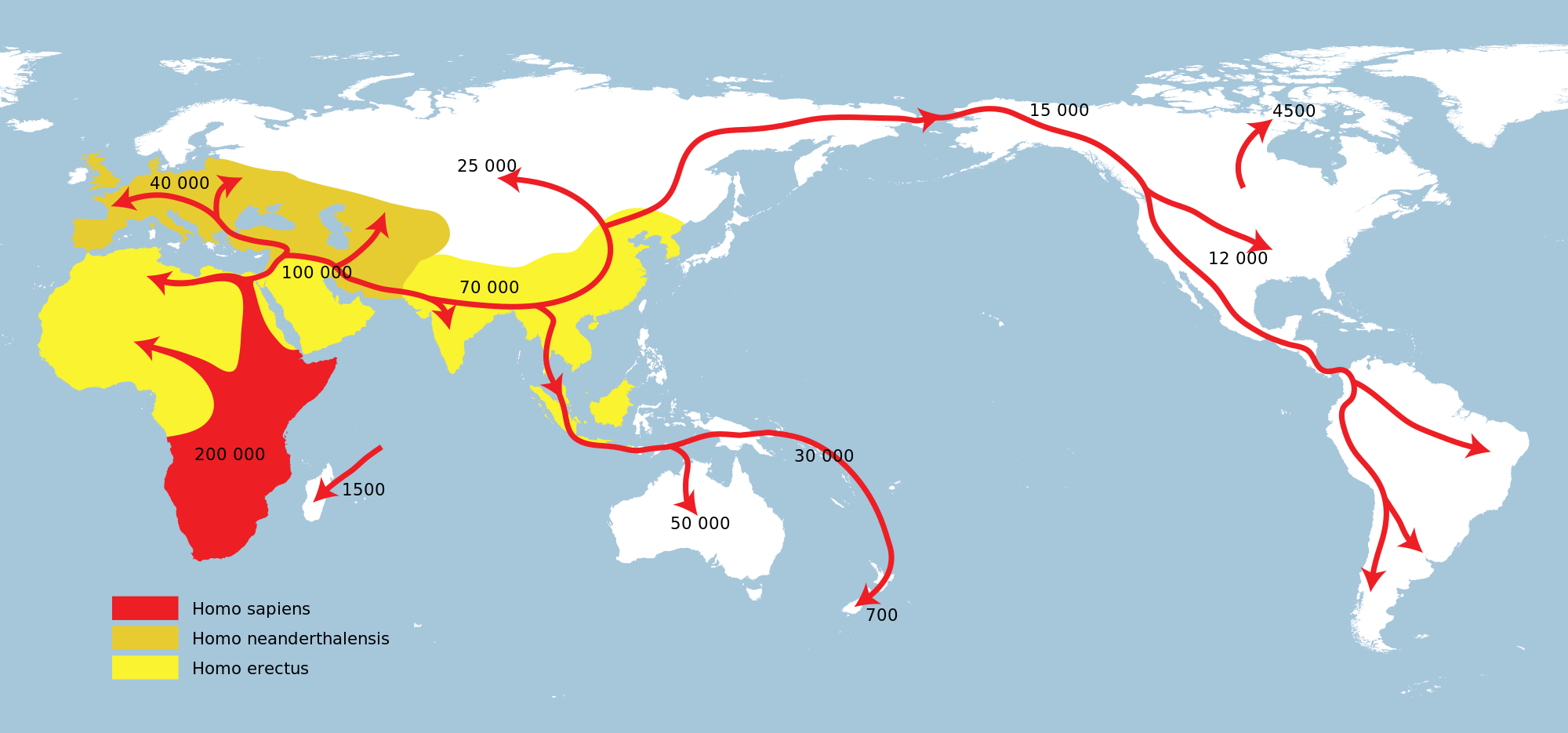
     For the past decade, geneticists have been studying the link between migration patterns of human and genomic variation. 

     What is understood today is that Africa is the human's evolutionary birth place. But what is not completely understood is how migration patterns have influenced or effected our genomic variation. To study this, scientists have collected genomic data for individuals from more than 270 populations across the world. Genomic data was collected from countries including Africa, Australia, New Guinea. Countries including Australia and New Guinea contain some of the earliest archaeological and fossil evidence of modern humans outside of Africa, and therefore it was important to study these locations as part of this research.

     After analyzing the collected data, scientists were able to conclude an approximate time period that different populations migrated from Africa. For example, current studies show that about 2% of genomes from individuals of Papua New Guinean ancestry, their ancestors separated from Africa earlier than Eurasians did. Eurasian countries- land lying between Asia and Europe- include Russia, Belarus, Ukraine, Uzbekistan, Kazakhstan, Tajikistan, and Kyrgyzstan.

     In addition to narrowing down the patterns of human migration, scientists have also discovered something else. Studying ancient DNA has shown that many large-scale populations have disappeared without a trace, except for their bones. This means that populations that used to live in Eurasia, for example, are no longer traceable by science.

    To discover migration patterns and connections between different countries and genomic variation, has lead to many discoveries and many more questions. However, scientists are still researching more migration patterns, hoping to discover more secrets of our past.

More about human migration and genomic variation is provided below.
http://phys.org/news/2016-02-genome-human-migration-evolution.html