Showing posts with label #history. Show all posts

Sunday, May 3, 2026

The Fall of Rome, The Rise of Genetic Diversity


The Roman Empire is regarded as one of the most prestigious and influential societies of all time. According to myth, the Roman Empire was thought to be founded by a group of Trojan individuals from Turkey. Unfortunately, this is just myth: as not only has this been proven false, but evidence points there to be a lack of Trojans in the Roman Empire; as the Romans were found to mingle and populate with local inhabitants. The Roman Empire, while it stood, did not particularly mix with the local population of Europe. But following the fall of the empire, with Roman Law dysfunctional, Roman citizens began to intermingle. This was found by examining cemeteries in Germania and comparing their DNA, and the isotypes left in their bones. Most of the genetic diversity in Europe at the time of the Roman Empire lied within the Roman Empire itself, with less diverse populations scattered about outside of it. By using isotopes, the scientists could measure half-lives and determine the age of the bones, thus placing an approximate date of the person's life. Then, they compared the percentage of regional DNA throughout the time, and found that as the Roman Empire fell, the genetic diversity of all of Europe began to rose. I find this interesting as nowadays, this type of thing wouldn't be possible. With such large amounts of immigration and emigration, I imagine genetic diversity will continue to climb over the next couple hundred years, maybe even thousands.

Sources:

 https://english.elpais.com/science-tech/2026-04-29/genetics-reveals-that-the-fall-of-the-roman-empire-shaped-europes-population.html

https://www.nature.com/articles/s41586-026-10437-3

Wednesday, April 23, 2025

Century-old genetics mystery of Mendel’s peas finally solved

 After More than 160 years after Gregor Mendel’s foundational experiments with pea plants, scientists have finally identified the genes responsible for the last three traits Mendel studied but never genetically explained. Mendel, considered the father of genetics, analyzed seven traits in pea plants, but the genes behind flower branching, pod color, and pod shape had remained elusive — until now.

In a landmark study published in Nature, an international team of researchers used advanced genome
sequencing and computational tools to solve this mystery. Building on the pea’s reference genome released in 2019, the team deep-sequenced nearly 700 pea genomes, uncovering around 155 million genetic variations. Through genome-wide association studies and selective breeding, they pinpointed the genes linked to the remaining traits. Pod color, they found, is influenced by a gene that affects chlorophyll production. Two genes tied to pod shape impact cell-wall development, and a gene deletion leads to fasciation — abnormal flower clustering.


The six-year effort highlights the power of interdisciplinary collaboration and modern genomics. According to co-author Noam Chayut of the John Innes Centre, the work not only closes a historical loop in genetics but also provides a treasure trove of data for crop improvement. The team also mapped 72 additional agriculturally significant traits, offering valuable insight for future pea breeding and sustainability research. With pea protein gaining popularity as a plant-based food source, the findings are expected to drive innovations in crop yield, disease resistance, and nutritional quality for years to come.

Wednesday, April 10, 2024

Past and Present Oral Microbiomes


In these articles scientists have extracted genetic information from 4,000 year old teeth in order to gather more information on how our diets have changed overtime. Researchers at Trinity College Dublin along with archaeologists from the Atlantic Technological University and University of Edinburgh, were able to recover the microbiome in the teeth from a 4,000 year old corpse. As we knew before, historically it was understood that overtime cavities became a more modern problem while back then the decaying of teeth was pretty common with the microbiomes they examined. However, this new study found an excessive amount of S. mutans which is the bacteria that is considered the main cause of cavities. This was interesting because the genome of the historic S. mutan is vastly different from the one found now. Continuing to compare modern and ancient teeth, they also found evidence to support the theory “disappearing microbiomes' ' which hypothesizes that modern microbiomes are less diverse. This poses an issue because it can be detrimental to human health. Overall, seeing the difference in microbiomes they were able to tell how our increase in sugar consumptions has altered our oral microbiome.

Sources:


Wednesday, December 4, 2019

The study of human heredity got its start in insane asylums


Article: https://www.sciencenews.org/article/study-human-heredity-got-its-start-insane-asylums
Relating Article: https://www.nature.com/articles/d41586-018-05313-8


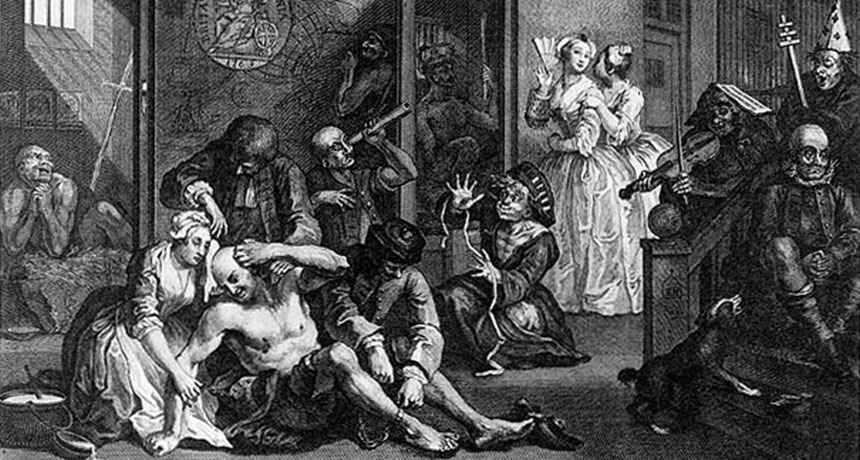
King George III's descent into madness sparked efforts to untangle the inheritance of mental illness by analyzing patient records at insane asylums as depicted in the above photo representing London's Bethiem Hospital in 1735.
The study of heredity emerged as an international endevour to mine data for associations to explain mental illness. It started with good intentions. Many asylum founders of the late 18th and early 19th centuries hoped to cure people of mental illness through a humane, psychosocial "moral therapy". At first, asylums claimed absurdly high 'cure' rates. Reports of 50% were routine. However by the mid-nineteenth century, asylum directors realized that they could simply say that although a cure seems distant, statistical patterns discovered in ever-larger study populations will one day reveal a cause, and a cure will follow. People bought it and asylum science grew. Eventually, having eliminating previous known causes for mental illness, scientist fixed on the patients' pedigrees. They promised to find more data and genes for diseases. After the 1927 Supreme Court decision Buck v. bell, the US programs forced sterilization on tens of thousands of people deemed mentally deficient. They launched their wider programs by gathering more than 10,000 people from asylums all over southern Germany.


This was a very interesting article to have read. These connections made so early on in history paved the way for future research. These connections are roots to today's genomics industry the tree. In the article it states that some will reject this idea, however the author of this article suspects that there is well-documented evidence to prove this making it difficult to dismiss.