Showing posts with label #heredity. Show all posts

Thursday, April 23, 2026

Genes Responsible for Melanin in Retinal Pigmentation Endothelial Cell Identified


In a recent study, researchers have determined several genes responsible for retinal pigmentation.

Retinal pigmentation, in humans, is extremely important for protecting the eye’s photoreceptors from light induced damage. Just like any other skin cell in the human body, the pigmentation of retinal endothelium is determined by the amount of melanin present. 


To determine what gene is responsible for the amount of melanin in an individual's retinal pigment endothelial cells, researchers created a learning framework dubbed “DeepGRP”. This framework analyzed images from the inside of many individuals’ eyes to provide the basis for a genome-wide association study. Upon analyzing the data, 42 heritable single nucleotide polymorphisms were identified. Out of these heritable polymorphisms, the gene ARHGAP18 was recognized as a factor for the creation of melanin. 


This research is important because it provides a look into the genetic components of retinal pigments in the eye, and could provide insight into how retinal disorders such as retinitis pigmentosa could be treated.


Sources:


https://www.science.org/doi/10.1126/sciadv.adw7768


https://pubmed.ncbi.nlm.nih.gov/38728357/


Wednesday, December 4, 2019

The study of human heredity got its start in insane asylums


Article: https://www.sciencenews.org/article/study-human-heredity-got-its-start-insane-asylums
Relating Article: https://www.nature.com/articles/d41586-018-05313-8


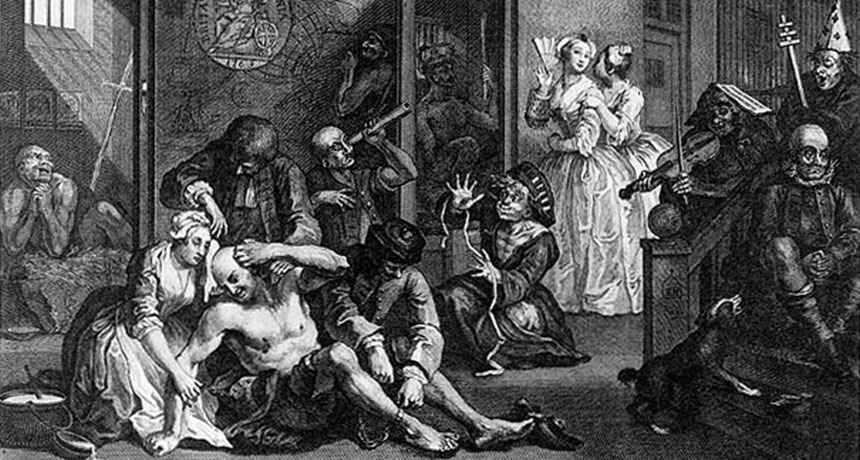
King George III's descent into madness sparked efforts to untangle the inheritance of mental illness by analyzing patient records at insane asylums as depicted in the above photo representing London's Bethiem Hospital in 1735.
The study of heredity emerged as an international endevour to mine data for associations to explain mental illness. It started with good intentions. Many asylum founders of the late 18th and early 19th centuries hoped to cure people of mental illness through a humane, psychosocial "moral therapy". At first, asylums claimed absurdly high 'cure' rates. Reports of 50% were routine. However by the mid-nineteenth century, asylum directors realized that they could simply say that although a cure seems distant, statistical patterns discovered in ever-larger study populations will one day reveal a cause, and a cure will follow. People bought it and asylum science grew. Eventually, having eliminating previous known causes for mental illness, scientist fixed on the patients' pedigrees. They promised to find more data and genes for diseases. After the 1927 Supreme Court decision Buck v. bell, the US programs forced sterilization on tens of thousands of people deemed mentally deficient. They launched their wider programs by gathering more than 10,000 people from asylums all over southern Germany.


This was a very interesting article to have read. These connections made so early on in history paved the way for future research. These connections are roots to today's genomics industry the tree. In the article it states that some will reject this idea, however the author of this article suspects that there is well-documented evidence to prove this making it difficult to dismiss.