Showing posts with label sex chromosomes. Show all posts
Monday, November 13, 2023
Whole Genome Assemblies for Two Southern African Dwarf Chameleons
Wednesday, April 14, 2021
Odorrana Swinhoana Provides Clues on the Evolution of XY Systems
Odorrana swinhoana is a frog species that has six sex chromosomes. This is rare in amphibians; scientists have only discovered multiple sex chromosome systems in 10 species of amphibian. "The O. swinhoana frog species is the first vertebrate known to retain descendant genes that now determine sex in mammals, birds, and fishes inherited from a common ancestor" (Hiroshima University).
Translocations are chromosomal abnormalities that happens when a chromosome breaks and its fragment fuses to another. The first discovered case of this occurred in 1980, with the Raina narina. Their sex chromosomes are X1Y1X2Y2 for males and X1X1X2X2 for females. The sex chromosomes for O. swinhoana for males and females are X1Y1X2Y2X3Y3 and X1X1X2X2X3X3 respectively; three translocations in males created this system of six sex chromosomes.
The male determining gene in birds, Dmrt1, and in platypus and fish, Amh, are located on the Y1 chromosome of male O. swinhoana. Also, the therian mammals' ancestral SRY gene, Sox3, is located on the Y3 chromosome. The major sex-determining gene out of the three aforementioned ones isn't known yet. However, the discovery of these genes gives some information on the relationship between these animals. They may share a common DNA sequence.
Their data suggests that these translocation are nonrandom. It gave them a new viewpoint on the evolution of multiple sex chromosome systems.
https://www.sciencedaily.com/releases/2021/04/210413081357.htm
https://www.technologynetworks.com/genomics/news/taiwanese-frog-species-found-to-have-six-sex-chromosomes-347609
Their data suggests that these translocation are nonrandom. It gave them a new viewpoint on the evolution of multiple sex chromosome systems.
https://www.sciencedaily.com/releases/2021/04/210413081357.htm
https://www.technologynetworks.com/genomics/news/taiwanese-frog-species-found-to-have-six-sex-chromosomes-347609
Labels:
amphibians,
Evolution,
genes,
Karyotype,
sex chromosomes
Sunday, November 27, 2016
The sparrow with four sexes
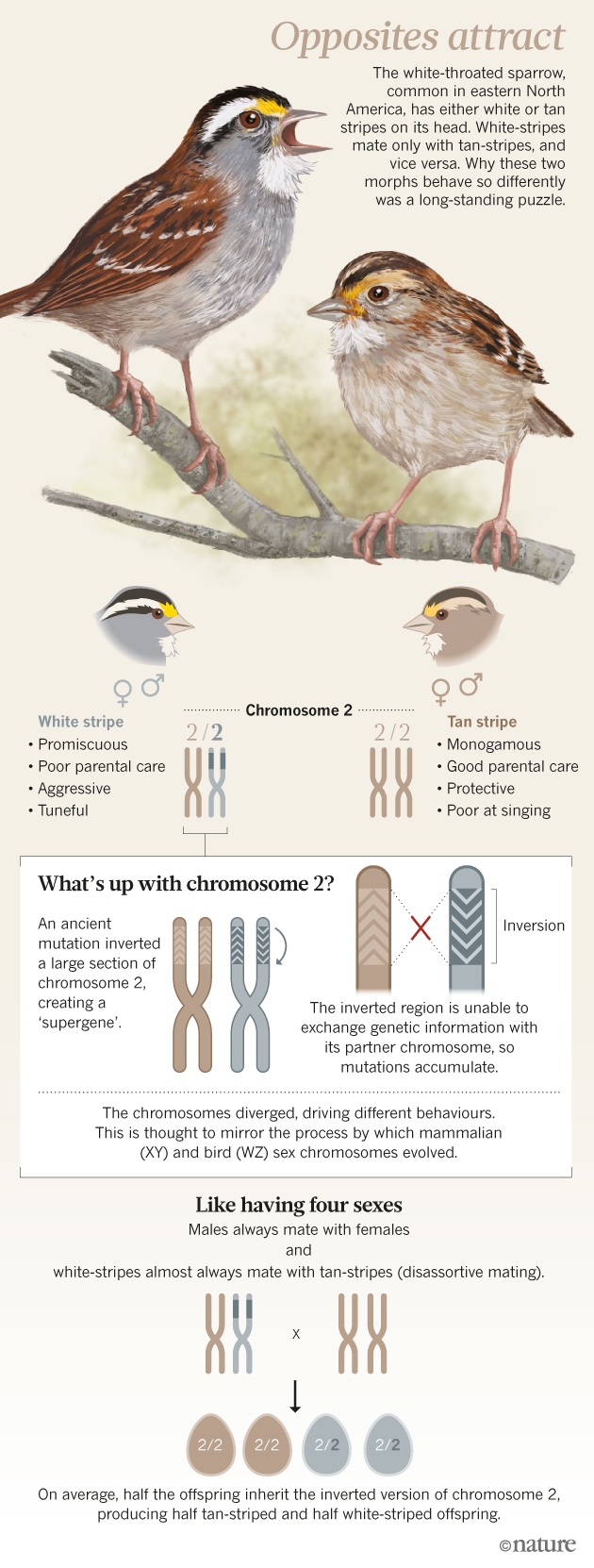
A scientific team consisting of husband and wife ornithologists has gathered years of research about the white-throated sparrow, Zonotrichia albicollis. The bird has a tan morph and a white morph, where there are males and females with white stripes on their head and males and females with tan stripes on their head. This difference in coloration is caused by a genetic mutation in Chromosome 2. Somehow, the chromosome was inverted so a large section of genetic information could not link up with a partner chromosome in reproduction. This led to the formation of a "supergene", allowing the chromosome and its information to evolve like how a sex chromosome would.
Over time, it was discovered that the sparrow acted as if it had four sexes instead of two. The difference in chromosomes allowed the birds to evolve into the different morphs with their own characteristic physical attributes and behaviors. The tan-striped birds are monogamous and overprotective of their offspring, while the white-striped birds are promiscuous and poor parents. The sparrow morphs do not mate with each other; tan-striped birds do not mate with tan-striped birds. Instead, in what is called disassortive mating, tan-striped birds almost always mate with white-striped birds, creating a further divide and establishment in the evolution of the four sexes.
This development in research allows so many different questions to be pursued. The role of genes in behavior can be investigated; the ability of an autosome to mutate and evolve like it is a separate sex chromosome can be analyzed; and finally, we can see if the formation of "supergenes" could possibly be used to benefit us or other organisms somehow.
Over time, it was discovered that the sparrow acted as if it had four sexes instead of two. The difference in chromosomes allowed the birds to evolve into the different morphs with their own characteristic physical attributes and behaviors. The tan-striped birds are monogamous and overprotective of their offspring, while the white-striped birds are promiscuous and poor parents. The sparrow morphs do not mate with each other; tan-striped birds do not mate with tan-striped birds. Instead, in what is called disassortive mating, tan-striped birds almost always mate with white-striped birds, creating a further divide and establishment in the evolution of the four sexes.
This development in research allows so many different questions to be pursued. The role of genes in behavior can be investigated; the ability of an autosome to mutate and evolve like it is a separate sex chromosome can be analyzed; and finally, we can see if the formation of "supergenes" could possibly be used to benefit us or other organisms somehow.
Labels:
inversion,
mutation,
sex chromosomes,
supergene,
white-throated sparrows
Thursday, November 24, 2016
Evolution of Chromosome 2 in White-Throated Sparrows May Give Clues to Evolution of Sex Chromosomes
White-throated sparrows are an incredibly
interesting and unique species due to the evolution of chromosome 2. A mutation caused a section of this chromosome, containing more than 1,100 genes, to flip.
This resulted in two different “supergenes” that are unable to undergo
recombination, and therefore created two different morphs. While the
white-striped morph is aggressive, promiscuous, and sings very well, the
tan-striped morph is protective, monogamous, and sings poorly. However, each
morph only mates with the other morph, and same-morph matings are extremely
rare. Because of the mating selection and lack of recombination between
chromosomes, scientists believe they are witnessing the evolution of another set
of sex chromosomes.
Through genetic analysis, scientists Rusty
Gonser and Elaine Tuttle discovered that chromosome 2 contains a series of
inversions rather than a single large one. The white morphs contain the
inverted chromosome, while the tan morphs do not. Many of the inverted genes code
for physical and behavioral differences, including the estrogen receptor alpha (ER-alpha), which dictates behavior. They also discovered that the inverted
part of the chromosome was undergoing mutations much faster than other
chromosomes, mirroring the rapid mutation rate of the evolution of sex
chromosomes. However, because of the limit on viable mates due to only being
able to mate with ¼ of the population instead of ½, scientists believe that
this is not an evolutionary advantage, as it would require much more effort for
individuals to find a mate. This may explain why most vertebrates only have two
sexes.
This experiment is imperative to
biologists so that we can learn more about how sex chromosomes evolved, and
subsequently apply this method to other species. It challenges scientists to
think outside the box about what we already know so that we can use our
knowledge and apply it on a broader scale. It may also improve research efforts
in researching other species that may have been overlooked as potentially
having a second pair of sex chromosomes.
Subscribe to:
Posts (Atom)