Showing posts with label Chromosome 2. Show all posts

Thursday, November 24, 2016

Evolution of Chromosome 2 in White-Throated Sparrows May Give Clues to Evolution of Sex Chromosomes

White-throated sparrows are an incredibly interesting and unique species due to the evolution of chromosome 2. A mutation caused a section of this chromosome, containing more than 1,100 genes, to flip. This resulted in two different “supergenes” that are unable to undergo recombination, and therefore created two different morphs. While the white-striped morph is aggressive, promiscuous, and sings very well, the tan-striped morph is protective, monogamous, and sings poorly. However, each morph only mates with the other morph, and same-morph matings are extremely rare. Because of the mating selection and lack of recombination between chromosomes, scientists believe they are witnessing the evolution of another set of sex chromosomes.


Through genetic analysis, scientists Rusty Gonser and Elaine Tuttle discovered that chromosome 2 contains a series of inversions rather than a single large one. The white morphs contain the inverted chromosome, while the tan morphs do not. Many of the inverted genes code for physical and behavioral differences, including the estrogen receptor alpha (ER-alpha), which dictates behavior. They also discovered that the inverted part of the chromosome was undergoing mutations much faster than other chromosomes, mirroring the rapid mutation rate of the evolution of sex chromosomes. However, because of the limit on viable mates due to only being able to mate with ¼ of the population instead of ½, scientists believe that this is not an evolutionary advantage, as it would require much more effort for individuals to find a mate. This may explain why most vertebrates only have two sexes.
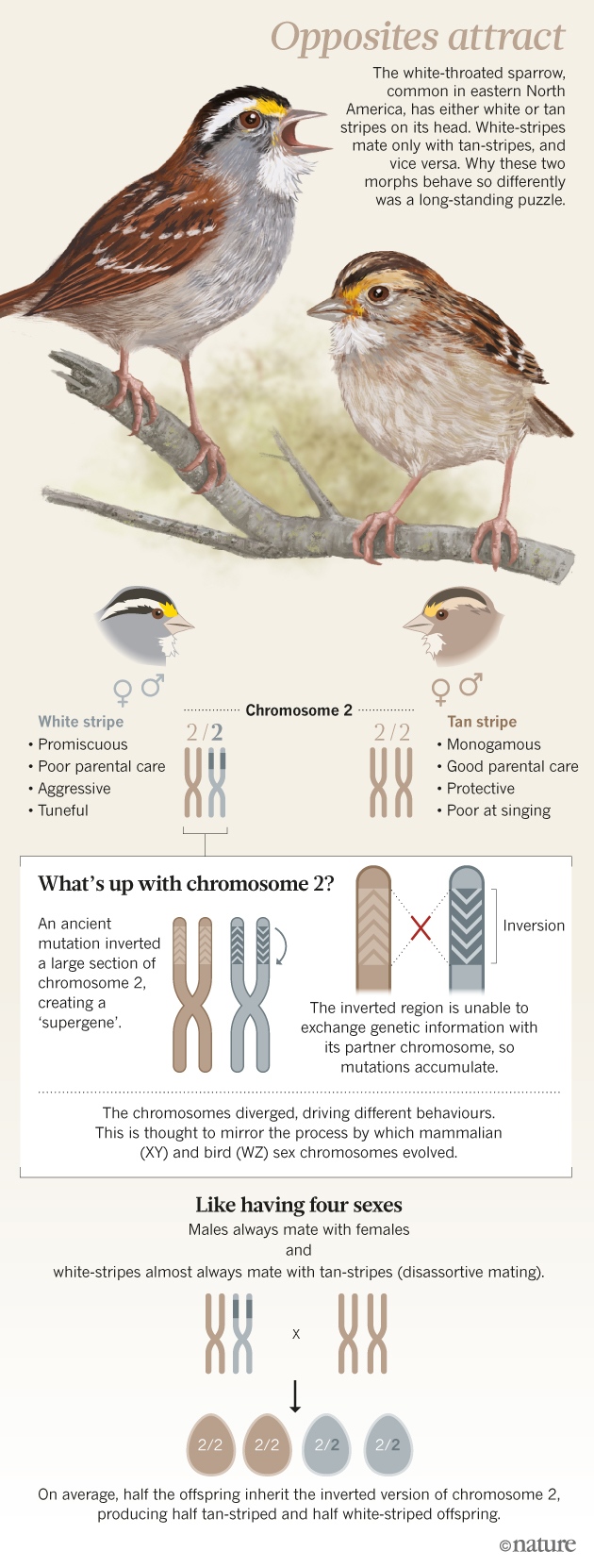

This experiment is imperative to biologists so that we can learn more about how sex chromosomes evolved, and subsequently apply this method to other species. It challenges scientists to think outside the box about what we already know so that we can use our knowledge and apply it on a broader scale. It may also improve research efforts in researching other species that may have been overlooked as potentially having a second pair of sex chromosomes.


Wednesday, November 23, 2016

The Sparrow With 4 Sexes

Has a chance genetic mutation changed the evolutionary course of a species of sparrow?
Husband and wife and dedicated research partners, Rusty Gosner and Elaina Tuttle have spent, nearly, the last 30 years researching and understanding the weird genetics of a species of sparrow, the white-throated sparrow (Zonotrichia albicollis), that has been observed to have 2 different morphs, with both male and female, and very different behaviors between the 2. The first morph is a white-striped sparrow (like in the picture above) that sings exceptionally well, is promiscuous, aggressive, and provides little parental care. The other is a tan striped sparrow that sings poorly, is monogamous, protective, and provides good parental care.

What occurred was and inversion of a section of chromosome 2, which left it unable to pair with it's partner chromosome or homologous chromosome. This inverted region is therefore unable to exchange genetic information and no crossing over occurs, thus mutations form. From these mutations, 4 sexes emerge that can only mate with the other species, so white-striped males can only mate with tan-striped females and tan males can only mate with white females (think of it like opposites attract).

It was thought that these birds were evolving a second set of sex chromosome. To prove this, the duo would have to demonstrate that the genes in the inversion form mutations faster than other mutations on other chromosomes. By sequencing the genomes of 50 birds, the duo did just that and showed how chromosome 2 was evolving like a sex chromosome.

Thursday, February 5, 2015

Chromosome Self-Destruction Saved This Woman's Life

 A woman living in Ohio had an extremely rare genetic immune disease called WHIM syndrome.  She shares this condition with only about 60 people worldwide.  The disease lowered a certain kind of the woman's white blood cells used to fight an infection that she had frequently as a child.  It isn't fatal, but it may lead to scarring, hearing loss, or different forms of cancer from some of the symptoms.  Researched linked WHIM syndrome to the CXCR4 gene that codes for cell surface protein in immune cells.  Having WHIM will cause this gene to work in overdrive and the white blood cells will get stuck instead of being released into the bloodstream.

The woman, who brought her daughters in to see a doctor at the time, found out that her daughters had contracted the condition as well.  However, the woman was perfectly fine: her white blood cells had no trace of the CXCR4 gene mutation.  How could this be?  Doctors were very interested because there is currently no cure for such a condition.  After many tests and medical investigations, scientists found a copy of chromosome 2 in the woman's white blood cells that was significantly shorter than the other.  This missing chunk of chromosome housed, coincidentally enough, the mutated CXCR4 gene.

Chromothripsis is a phenomenon observed recently in leukemia patients and in some cancer patients.  A fault in cell replication causes a chromosome to shatter itself and rearrange in a different order.  Normally, the scrambled cells die after this happens but if they do survive, it could lead to cancer.  However, the chromosome got scrambled in a blood stem cell which led the production of normal white blood cells.  Doctors who have looked into this said it may be worth looking into if people randomly get cured of their diseases.  Scientists may be able to pinpoint genetic mutations that cause serious illnesses like sickle cell anemia, take the blood stem cells out, modify the CXCR4 gene in the blood stem cells, and replace them into the patient.

This is definitely something I've never heard of.  One would think that the destruction of a chromosome would be very detrimental but apparently it can save lives.  Further research must be done on this but so far, from this article alone, this may be one of the most bizarre ways to cure a genetic mutation.  For the sake of people with life threatening genetic mutations, I hope doctors and scientists somehow find a way to manipulate genes enough to effectively get rid of the mutation altogether.

Thursday, November 13, 2014

A New Discovery May Open Doors for Possible Treatments for Alzheimer's Disease

        A group of researchers, led by Andrew J. Saykin, Psy.D and Vijay K. Ramanan, PhD, recently completed the largest genome-wide study of human memory. Andrew J. Saykin, Psy.D is the director of the Indiana Alzheimer Disease Center and the Indiana University Center for Neuroimaging. Vijay K. Ramanan is a Indiana University School of Medicine post-doctoratal researcher and a medical student. Together, Saykin and Ramanan, led a research team have identified a gene that they believe is associated with better memory performance and has not previously been associated with cognition. They found this gene as a result of analyzing genomic data and memory test from more than 14,000 older adults.

Andrew J. Saykin, Psy.D

        A change in the DNA on chromosome 2 was found to be linked to better performance on episodic memory test. Usually, a G nucleotide had replaced the more common A nucleotide in the FASTKD2 gene. This single nucleotide polymorphism was also found to be linked to a larger hippocampus and more dense grey matter. The FASTKD2 gene is found in the inner compartment of mitochondria and is responsible for producing an important protein involved in mitochondrial apoptosis.

The FASTKD2 gene is located on the long (q) arm of chromosome 2 at position 33.3. 

         Since Alzheimer's disease is associated with hippocampal atrophy and the inability to recall recent events, this drug is believed to point the way for drug developments and further studies on memory impairments caused by Alzheimer's disease. "Although the influence of FASTKD2 was modest, there are parallels to research in diabetes, cancer, and hypertension that uncovered genetic variants with similar effects that turned out to be targets for drugs that are now commonly used," Dr. Saykin said.
        This article stood out to me because a couple people close to me had Alzheimer's disease. It's amazing that even though many scientists research the same subject, new discoveries still occur frequently. This FASTKD2 gene should be researched more. Although memory is not controlled by a single gene, this SNP could possibly be the answer to a lot of questions about memory loss. It would be amazing if the FASTKD2 gene led to a drug protecting against memory related issues in Alzheimer's disease.

Main Article: http://www.sciencedaily.com/releases/2014/11/141112115934.htm
Related Article: http://news.medicine.iu.edu/releases/2014/11/saykin-memory-snp.shtml

Monday, September 15, 2014

Diabetes Gene Found in Mice and Men

Laboratory work conducted by Dr. Johan Auwerx and Dr. Ruedi Aebersold confirmed a pathological process indicating the presence of type 2 diabetes in both mice and men. Researchers conducted an in-depth genome and  phenome (phenotypic characteristics) study of a family of mice comprised of 183 members. The initial approach was to investigate the metabolic process of two twin mice who endured different environmental and diet lifestyles. The influence from the environment directly correlates to the expression of certain genes. The expression of these genes determines the risk of developing certain diseases; in this study – type 2 diabetes. To obtain further evidence, a spectroscopy technique was used to identify hundreds of proteins in each individual. Researchers found a particular gene located on Chromosome 2 that was linked to type 2 diabetes.

The image above displays the expression of the gene
researchers discovered in the development of type 2 diabetes.

According to Evan Williams, PhD student and article co-author, “The mice with a high-fat diet are more or less likely to develop diabetes depending on whether this gene is active or not [1].” The diabetic mice also displayed low urinary levels of a metabolite called 2-aminoadipate. The presence of 2-aminoadipate was directly related to the presence of the particular gene, and not related to a rodents body fat. This prompted an investigation in humans. Of nearly 1000 patients, those who were diabetic showed a considerably lower presence of 2-aminoadipate than those who were not. The urinary marker identified by the researches will allow doctors to easily detect type 2 diabetes in new patients. It is fascinating to see the correlation between mice and humans. Since our genomes are so closely related, this allows researchers to identify new techniques to discover other related diseases using a similar approach as Auwerx and Aebersold. 

Article Related - Metabolite 2-Aminoadipate: http://www.hmdb.ca/metabolites/hmdb00510