Showing posts with label rabies virus. Show all posts

Sunday, March 22, 2015

Rabies Resistance

   A new technology to determine the resistance or sensitivity to the rabies virus has been developed. Researchers at Texas A&M AgriLife were able to create a platform so that they could look further into how pathogens interact with human genes which will allow them to find genes that are either more sensitive or less sensitive to the rabies virus. The rabies virus is still a concern in today's world, it is the cause to nearly 55,000 deaths per year worldwide. Further understanding the way that genes are affected by this virus will greatly help the human race when it comes to the Rabies virus.
   
     These researchers used "knockout mice" which are laboratory mice that have inactivated existing genes, these genes are replaced with an artificial piece of DNA. They took thousands of different stem cell lines carrying different mutations and separate them into neurons. With this they were able to see that genes that are known to be involved in rabies when mutated had different sensitivities to the rabies virus.
      The experiment was set up so that about 100 embryonic stem cells were spread out on different plates, separating them into fully functioning neurons. The rabies virus was then added showing up as a florescent green color and monitored for several days. The results were astounding, some plates showed large amount of fluorescent green, while others showed very little. The plates that showed high amounts of green were more sensitive to the rabies virus, the ones showing little green were more resistant. The researchers were able to uncover 63 different host genes that will help with new pathways that can aide in the treatment of rabies. This is a remarkable discovery as it will help with other diseases such as tuberculosis, botulism, Ebola as well as many other disorders. This experiment can be used  to help find resistances or sensitivities to almost any virus or bacteria.

Article: Stem cells help researchers peg rabies resistance
Article 2: Rabies

Tuesday, January 27, 2015

Mice Cured of Rabies after Virus Reached Infectious Stage.


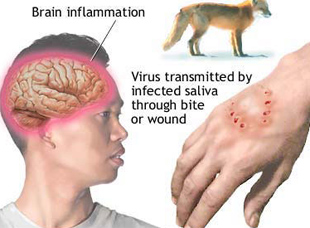
Rabies is a global neurological zoonotic virus that is entirely preventable with appropriate vaccinations. This infection is usually deadly due to the body succumbing to the effects of brain swelling and spinal cord trauma. Transmission is via saliva (bite wounds being most common) and in humans, signs sometimes don't show for up to one year. Most animals show signs and die in 14 days.

Researchers at the University of Georgia have developed a new vaccine against rabies using a slightly different approach compared to the conventional modified live rabies vaccine. A surface protein from the Rabies virus was inserted into a completely different virus called "PIV5", which stands for canine parainfluenza virus 5. Canine parainfluenza is a very common upper respiratory virus transmitted between domesticated dogs and wild canines.  PIV5 delivers the rabies protein to the immune system and enables the body to start creating antibodies against the rabies virus.  At this time, there are no concerns of human transmission of parainfluenza from this vaccine, as PIV5 is not a zoonotic or human virus.  6 days after rabies infection, the mice began displaying signs of rabies having spread to their central nervous system. 50% of the infected mice in this study showing signs of rabies were cured. Researchers are hopeful that this may be a safer vaccine for the future due to it only using surface proteins.


Working in the veterinary field, I have seen more rabies positive wildlife in the past 2 years than I have in the past 10 years, which exposes great risk to our communities.  About 10 days ago, the veterinary hospital I work for submitted a racoon for rabies testing and we were notified soon after that it was a positive specimen. Rabies is a real problem, and not enough people take it seriously.  This is a fantastic revelation for rabies vaccine research and development. It was once thought to be hopeless to cure a person or animal infected with rabies once they showed the neurological deficits of the virus.  Let this be a step in the right direction for advanced rabies treatment and possible cures.  Please vaccinate your pets!  Click here to find the closest free rabies clinic to you!


Here is also an informative video of an actual rabies infected person.
 
Article: Beating the clock: UGA researchers develop new treatment for rabies
Additional Links:CBC - Rabies Structure of PIV5 Rabies Facts & Prevention