Showing posts with label designer genes. Show all posts

Monday, April 6, 2015

Britain set to approve technique to create babies from three people


On January 27, 2015 British lawmakers voted to allow the creation from the DNA of 3 people, a new form of in vitro fertilization, making them the first country to approve the altering of a human egg before placing it in the womb.  This procedure could help to prevent the inheritance of genetic diseases.  It is very common for a mother with defected mitochondria to pass those complications onto her offspring.  Despite the vote being 382 to 128 in favor of the technique, many people argue that is just a way to create “designer babies” and ensure a “perfect child”.  But that is not the case.  This procedure will only be done in mother’s who have faulty mitochondria that do not want to risk transferring any diseases to their children, that is where the third person comes in.  All DNA besides mitochondrial DNA will come from the parents while mitochondrial will come from a donor.  All characteristics of the child will come from the parents, and only to mitochondrial DNA will come from the donor to ensure no defects will be passed on.
            Mitochondrial diseases are devastating and life threatening and there is currently no other treatment towards them.  Receiving DNA from a donor is the only option, making it very appealing to the general public.  The law has yet to be decided as the Church of England would like more time to conduct research to make sure that it will work the way it is intended to so no one is prevented from the use of this scientific advancement.
            In my opinion, this is a brilliant idea.  No parents want to hear that they have passed down a fatal trait to their newborn child, so why should they have to?  Every operation has its problems but based on this article, it seems that the pros definitely outweigh the cons. 

Tuesday, February 10, 2015

3-Parent Child Controversy

The article, When will "3-Parent Babies" come to the U.S.? is explaining how in the United Kingdom the idea of 3-parent babies has been passed in parliament. The child will be genetically made up with material from two females and one male. The main goal for this process is so that the mother can have a child without passing on genetic mutations. Mainly the process is to replace the mitochondria that would be in the mothers’ egg. The genetic mutations that are trying to be avoided cause seizures, premature deaths and even loss of sight.
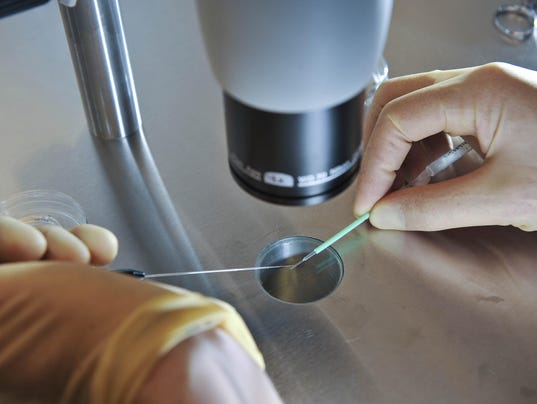
Similar to In Vitro Fertilization(IVF) the process will be done in a petri dish. Genes from the mother, father and female donor will be mixed to make the embryo. The female donor will have a mitochondrial DNA that has no mutations. The nucleus of that egg, the birth mom’s nuclear DNA and the father’s DNA will all be combined to form what will make a child’s genetic makeup. This will then be inserted into the birth mothers’ uterus similar to IVF treatments. The problem is that not enough studies have been done to prove that future issues will not occur. Nobody really knows if genetic mutations will occur in later generations of those children that are created through this process, Public response has showed that people are concerned with the idea of “designer babies."  People think that babies will be created to be smarter, more athletic and have a specific look.

I think this article is interesting in that it is showing how advanced scientific technology has really gotten. Whether or not that is a good thing is the main issue. Personally I think that this is a bad idea. People are going to take it to the level where "designer babies" might actually become a reality. If this happens then society itself will be artificially created. The other issue is that research has not been able to prove the long term affects this 3-parent baby process could have on future generations. What if the mitochondrial mutations come back but even stronger than they were previously, this could cause an even bigger issues in society as a whole. The FDA should further investigate possible harmful affects. 


Wednesday, February 4, 2015

Britain votes on allowing world's first three-parent IVF babies


The never-ending dispute between science and ethics continues with a new proposed law in Britain. This law would allow parents who carry maternally-inherited incurable conditions to participate in a technique, called mitochondrial donation, in which during the fertilization process, the genes will be altered to contain the genetic material of three people. Carried out through IVF (In Vitro Fertilization), doctors could remove mitochondria (the powerhouse of a cell that, if defective, accounts for numerous inherited and potentially fatal diseases), and modify it with genes from a normal female donor. The baby would contain the genetic material from the mother, father, and donor, and could help those who would suffer from mitochondrial disease including brain disorders, liver failure, fatal heart problems, and muscular dystrophy.

Opponents of this law include religious groups as well as other critics, such as lawmaker Rees-Mogg, who said he would vote against it. The fear is that genetically modified embryos, or "designer babies", will become more popular in the future and basically deem the whole process as 'cruel'. My opinion on this is a slightly torn. While the technology is incredible and could potentially help people across the globe not suffer from these diseases, I feel it would be very strange to have a child with three parents, and I'm not sure where it falls on the line between science and ethics. To solve this dilemma, maybe parents could try to find out if their child could be diagnosed with these diseases prior to getting pregnant.

Original Article
Related

Tuesday, February 3, 2015

UK is moving Towards "designer babies"

In a recent New York Times article, the UK is moving toward making babies from the DNA of three different people. Their main reason behind wanting to do this is to try and destroy genetic diseases from future generations. This idea was voted in favor 382-178 in the UK's house of Commons. The fear of critics is what else this will lead to and the idea of designer babies.

The technique they plan on using is a modified version of vitro fertilization. Due to some mothers having a defective mitochondria they want to combine the DNA of the two parents with another women who does not have a defective mitochondria, in the hopes to eliminate and replace the defective mitochondria gene.  

I think this is an interesting article because with further research it could help get rid of some of these complications that are fatal, but on the other hand it is kinda of scaring to think it may lead to a future where you can design your baby. 


Wednesday, April 2, 2014

Big Step Towards "Designer" Genes

A group of scientists, compiled from around the world were able to create the first successful gene synthesis in a eukaryotic organism. Up until this point, genes were only able to be synthesized and successfully reproduced in prokaryotic organisms like bacteria. As far as yeast's genetic milestones go, this is the biggest accomplishment since 1996 when yeast's genome was originally mapped. Within the last 7 years, scientists have put together 273,871 base pairs of DNA, which is still shorter than the typical yeast DNA of 316,667 base pairs. They made over 50,000 changes to the DNA, and the yeast not only lived, but reproduced. Researchers hope that this accomplishment will help them synthesize yeast quickly in order to help manufacture medicines for diseases like malaria. This is a great advancement for the field of synthetic biology.


For me, I tend to agree that this is a really great accomplishment, especially because of the potential of synthesizing other eukaryotic cells. For researchers to successfully write in genes, they are able to correct gene mutations and this could greatly help humans, obviously. While I am not a big supporter of "designer babies," where people pick certain physical traits that they want, I do believe that we should use our knowledge to create healthy babies. The potential for this research is unimaginable, and I look forward to learning of further advancements in the field of synthetic biology.