Showing posts with label TERT gene. Show all posts
Sunday, December 9, 2018
Parrots' keep talking their ways into longer lives
Morgan Wirthlin, a geneticist at the University of Carnegie Mellon, along with her colleagues from other institutes are the first to preform a comparative study on parrot genomes. The study includes over 20 different species of aves while focusing on four species of parrots and dives into their discovery of a section of genes that are linked with the bird's incredible life and cognitive longevity. As you know from this course, the longevity of ones life is correlated to the life of the chromosome's telomeres. As a cell replicates an overhang occurs at the end of the chromosome (telomere) therefore causing the chromosome to shorten by approximately 100bps everytime it replicates. Telomerase is an enzyme that is responsible for the repair of the telomeres so that this reduction in base pairs is fixed. However telomerase is barely active in somatic cells therefore they tend to be reduced which then leads to aging.
Wirthlin mentions that parrots are known to live up to 90 years in captivity which is relative to hundreds of years for a human life span! Through our knowledge of how lifespan is limited one can only infer that parrots have increased levels of telomere repair/protection whether its through telomerase or another enzyme/process. Through the study a pivotal discovery was made. In the 344 genes that were looked at from high longevity birds, 6% have been previously noted to improve longevity of model organisms in a controlled experiment. However the other 94% of those genes have never been connected to improve the lifespan of any other organism from the scientific community's knowledge. TERT (telomerase reverse transcriptase) is part of the whole telomerase compound that protects against cell cenescence, which is the cell ceasing to divide. The study showed that TERT had two positive sites in which this was present in high longevity birds compared to zero in humans. This change in TERT activity could be a plausible explanation in the enhancement of the birds lifespan. One drawback was that TERT could have risks of causing increased cell proliferation and tumor formation therefore doing more harm than good. But the parrots also were found to have genes BUB1B, BUB3, KIF4A, KIF1BP, and CCNE1 which link with controlling cell proliferation and tumor formation. The combination of their telomerase activity and cell-cycle regulation could be revolutionary for our knowledge in preventing or slowing down the rate of cancer in mammalian species. This could also be the first steps in identifying what could slow down the destruction of telomeres or even prevent it all together.
LINKS:
News report from Science Daily
Journal article from Current Biology
Saturday, April 11, 2015
Can Fish Help Us Understand the Mystery of Aging
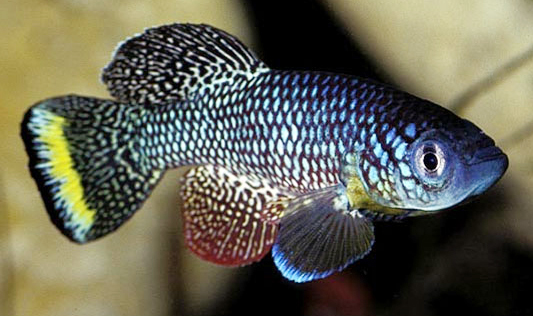
Anne Brunet’s graduate student suggested she use turquoise
killifish and that is how it all started. They found out that the fish loses
muscle mass while aging, stop producing eggs, have a weaken immune system and
even have memory problems. They did an entire genome sequence and located the
genes that are known for aging processes. They used a technique called Crispr,
which could replace DNA with a different one. With that technique they altered
the gene TERT that protects telomeres. They think that as telomeres get shorter
the aging processes increases and had a link to aging. After the TERT
alteration they makes became infertile and females less eggs, atrophied, and
had less blood cells, but never died any sooner than their expected life span. They
plan on continuing the research in order to find out potential anti-aging
treatments for the fish and then hopefully be able to convert it for humans.
This is not normally an article I would attract to, but I
was surprisingly very interesting in this topic. If they could find a treatment
to increase life span it can be very beneficial for the whole human race.
Although they are not there yet, if they keep working, it has a lot of
potential. Another thing that I like about the article was that it mentioned
that the graduate student was the one to mention the turquoise killifish,
although they did say their name, just the recognition that they had suggested it
was nice. The world is very into living longer and looking younger, so this
could potentially be the answer to that, but we will have to wait and see.
Labels:
aging,
anti-aging,
CRISPR,
fish,
Genetics,
TERT gene,
turquoise killifish
Saturday, November 26, 2011
Women of African at Greater Risk for Breast Cancer
Researchers have a identified the location of a genetic risk fact for a special type of breast cancer. This type of breast cancer, known as estrogen receptor-negative breast cancer, is a form of cancer that does not properly express the estrogen receptor and therefore it does not respond well to drug treatments. This type of cancer is especially prevalent in women of African descent. Studies have shown them to be more susceptive to progesterone receptor-negative and human epidermal growth factor-negative breast cancer, as well as estrogen receptor-negative strain. Researchers have linked this phenomenon to the presence of an allele near the TERT gene on chromosome 5, strongly correlating to an increased risk for estrogen receptor-negative breast cancer. This genetic variant then in turn shows a greater link to the other two receptor-negative cancers. This region of the human genome have been previously researched for links to other types of cancer as well, such as ovarian and lung cancer. While studies are still be conducted as to how this allele actually works, researchers believe that once it is completely understood, it will give insight into other types of cancer as well.
http://www.healthcanal.com/cancers/22740-Genetic-Basis-for-Aggressive-Breast-Cancer-Women-African-Ancestry-Identified.html (Article Link)
Subscribe to:
Posts (Atom)