Showing posts with label Polynesia. Show all posts

Wednesday, December 7, 2022

South Americans May Have Traveled to Polynesia 800 years ago


 Researchers suggest genetic analyses show "....DNA swaps between the voyagers and people on a still-undetermined eastern Polynesian island were followed by the spread of the South American ancestry to other eastern  Polynesian islands" (Moreno-Estrada) It is suggested that many Homo groups lived during the Middle Pleistocene and were "...too closely..." related to have been distinct species. The groups would have eventually mated with each other. However it is not known when exactly during that era, the groups mated and there is no definite distinction (genetically nor phenotypically) in Homo sapiens, Denisovans and other ancient Homo populations. Scientist John Hawks from the the University of Wisconsin-Madison, shares new fossil evidence came from the region of Israel.  molar tooth from the lower jar of an individual found near the site called Neshar Ramla (~140 000 and 120 000 years ago) This suggests that a previously unknown Eurasian Homo population lived at the site. 

To continue, "...back-and-forth..." migrations by Homo groups between Africa and Asia started ~400 000 years ago. Rains had turned parts of deserts into green passages covered, which were identified at a Saudi territory that once hosted hunter-gatherers, whose tools were left behind. Stone tools found at the site (~200 000 years ago) resembles like tools found in Africa (from the same H. sapiens)  To conclude, the route of the groups is shown and it is definitely a reason that migration has occurred. However, one should not assume this is could be the only reason. Further research must be conducted. 

Monday, December 13, 2021

DNA offers a new look at how Polynesia was settled


Polynesia, a chain of thousands of islands in the pacific left a genetic trail on the route the voyagers had gone. Using present-day Polynesian DNA, indicates the travelers had started in Samoa in the west, then heading south and then to the east.Traveling east around the 1300s, a small chain of islands were settled upon, one of them being Easter Island. This new analysis, showing the settlement dates ranging from the year 800 to the 1300s aligns with archaeological dating of the years 900 to 1250. However, because of the genetic trail, the new data allows for the visualizing of the pathways the settlers had taken. With the new investigation, researchers had identified DNA exclusive of Polynesian origin from 21 different islands.Using the rare variants displayed in the individuals, researchers can construct the pathways settlers had traveled between each island.

Thursday, November 12, 2020

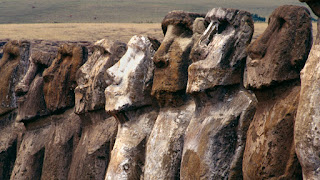
Easter Island Found by South Americans.

Easter Island statues: One mystery solved by researchers | CNN Travel

French Polynesia | Oceania Expeditions

 South Americans Reached Polynesia 800 years ago


Over 800 years ago DNA studies show the indigenous people in South America traveled over 7,000 Km of open sea to reach Polynesia. The South Americans were said to mate with the inhabitants of the island during the initial period of discovery. The ancestry was then spread far east to Easter Island and showed that the ancestors of the people who built the famous statues in Easter island had ancestry from South Americans. To this day the way Easter Island became populated is under debate. One study believes it was possible to drift by a wooden raft from Peru's coast to Polynesia. Most scholars believe at that time it was assumed Asians voyaged to Western Polynesia and then inhabited more towards the east. Ioannidis of Stanford University completed a study of molecular markers in the DNA of 807 individuals from 17 islands in polynesia. They compared the length of the DNA segments shared by both groups to find when Indigenous American DNA was first introduced. The results found several matches around 1150-1380, but the results can't establish which islanders mated with the South Americans before spreading it elsewhere. I believe there is a strong possibility that South Americans did reach Easter island at one point in history and mated with the native Polynesians.