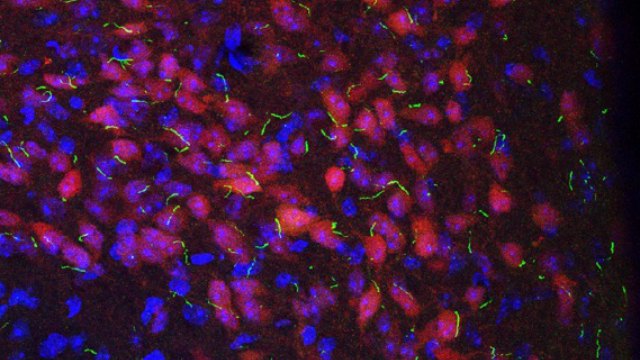
The article Primary Cilia in Neurons Linked to Obesity discusses a link between two gene variants and an increased risk of obesity and diabetes. On January 8 of this year, Nature Genetics reported that the proteins that are localized to cilia of neurons in the hypothalamus(a region of the forebrain that controls hunger and other homeostatic systems) control food intake in mice. Nature Genetics also published two human genetic studies tying variants of a neuronal ciliary gene, adenylyl cyclase 3, to an increase risk of developing obesity and diabetes. This research contributes significant information about the importance of cilia in the brain. The mouse experiment contributed a consensus that cilia in the brain are important for feeding behaviors and energy homeostasis. All 3 of the experiments show that cilia function can have important affects on the general population and not only in the instance of ciliopathies(uncommon diseases caused by mutations to the genes that affect primary cilia). A geneticist at the University of California, Christian Vaisse, states it was recently found that obesity in ciliopathies was linked to the function of primary cilia in neurons. Removal of primary cilia from all the neuron cause the adult mice to become obese.
A mutation to the gene that codes for MC4R(melanocortin 4 receptor) is GPCR(G-protein coupled receptor) which is involved in regulating food intake is one of the lead genetic mutations that cause severe obesity. Vaisse and his colleagues also found that the MC4R has a very large amount of primary cilia in neurons in the hypothalamus except for the two mutation of the gene which prevent accumulation. These studies give us good insight on the importance and roles of primary cilia in the brain. Vaisse and his colleagues plan to continue studying genes that predispose humans to obesity and their cilia. The plan on using this information to eventually to formulate a medication that acts of primary cilia signaling in MC4R neurons and may help people with defects of this pathways. I think this is very useful information in the field and I am interested to see where the research is taken next.
