Showing posts with label Amyotrophic lateral sclerosis. Show all posts

Tuesday, November 13, 2018

ALS and Genetics

Amyotrophic lateral sclerosis (ALS) is a neurodegenerative disease that affects motor neurons, or nerve cells that control muscle movements. This disease depends on genetics and can be a trait that can be passed to the offspring. 

A mutation on C9ORF72 gene can cause a person to have (ALS).This gene provides instructions for making a protein that is located at the tip of the neuron in a region called presynaptic terminal. This area is important for sending the receiving signals between neurons. The mutation in this gene accounts for 25% to 40% of familial ALS cases and 7% of sporadic cases. In addition to the mutation on this gene, many other genes are also thought to be linked to ALS. Mutations in the SOD1 gene account for 12 to 20 percent of familial ALS and 1 to 2 percent of sporadic ALS cases. Mutations in the TARDBP gene are found in about 4 percent of familial ALS cases and about 1 percent of sporadic ALS cases. The FUS gene is mutated in about 5 percent of familial ALS and about 1 percent of sporadic ALS cases. And to a less percent also VCP, ATXN2, NEK1, ANG, TBK1, VAPB, and SQSTM1 genes, among others, that scientist keep studying and discovering.

The inheritance of this gene depends on the gene that was affected. But in most case the trait is inherited, in an autosomal dominant manner. But it can also be inherited in an autosomal recessive manner, it is less common, and it tends to get mistaken for sporadic ALS.

I found the article to be very interesting since there is no cure for this disease, and probably by finding that it is related to certain genes, it can be treated to prevent the disease or if the patient already has it, help relieve the pain and give a longer life expectancy. This finding is a big step on the research and study of ALS. 

References: 

https://ghr.nlm.nih.gov/gene/C9orf72#sourcesforpage       Genetics Home Reference

https://alsnewstoday.com/als-and-genetics/        All News Today

Sunday, December 3, 2017

Research validates five new genes responsible for ALS

An article on Science Daily states the study Dr. Robert Bowser conducted at St. Joseph's Hospital and Medical Center.  The experiment found a link between genes and Amyotrophic Lateral Sclerosis. ALS is a fatal disease that progresses over time affecting the motor neurons and ultimately muscle control. A new technology, IBM Watson for Drug Discovery, was used that provided evidence that RNA metabolism has an effect on the development of ALS. It was found that 11 out of the 30 genes linked to ALS were mutated and caused different forms of ALS. These mutations alter RNA metabolism which affect the motor neurons, leading to a loss in muscle control/movement and paralysis. There are 1,500 RNA binding proteins so it is plausible other genes contribute to ALS. With IBM Watson for Drug Discovery, those genes will be tested for and that information will be able to be obtained faster.
Image result for als
I believe the advancement of technology will change medicine. ALS is a horrible disease, with no known cure. Finding five genes that contribute to the disease will be helpful in understand the disease better and coming up with an effective treatment. As technology improves, more genes will be tested and identified. This is just the beginning and the future of medicine seems to be brighter.

https://www.sciencedaily.com/releases/2017/12/171201104101.htm
https://ghr.nlm.nih.gov/condition/amyotrophic-lateral-sclerosis

Sunday, December 7, 2014

ALS associated genes are the primary suspect that has a direct correlation to Lou Gehrig’s disease


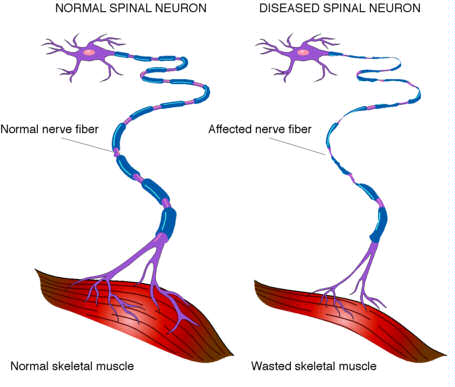
It was thought that genetics’ played a small to no role in causing Amyotrophic lateralsclerosis (ALS), which is commonly referred to Lou Gehrig’s disease. A disease that affects the motor neuron by slowly killing them and slowing down their functions until it comes to a complete stop. This process will stop the signals that come from the brain to the muscle and will lead to the person being paralysis. 
This image is of the nerve cells comparison of a healthy and ALS affected nerve.

The researchers at Cedars-Sinai Medical center are looking into the genes that affect ALS, although this disease can occur to people who do not even have the disease in their bloodline. Even though it not in a person family genetic history, the researches discovered that this certain gene could be responsible for over a third of the people with Lou Gehrig’s disease. Through their studies they stated, “they found that patients with defects in two or more ALS-associated genes saw the onset of the disease approximately 10 years earlier than patients with single-gene mutations.” Meaning that this gene is promising to have a direct correlation with the degenerations of the motor neurons when there is at least two mutations.  Now that they narrow there search to theses genes they can think of the best way to fix the gene, through gene therapy, to help cure or improves the persons health.
I believe that these advancements in the study of the human genes will help find other unknown genes that could also cause Lou Gehrig’s in the near future.  

Wednesday, November 19, 2014

ALS Acceleration Linked to Gene Variant

Amyotrophic lateral sclerosis (ALS) is a neurodegenerative condition that results in destruction to the motor neurons of the human body; and thus, loss of proper motor control and functionality. Death of those with this disease commonly occurs due to respiratory failure upon inability to control the muscles that regulate breathing. There are approximately 12,000 Americans that are affected by this disease.

Researchers at the Penn State College of Medicine determined that there existed an association between excess iron accumulation in the brain and ALS. This was aided primarily by the observation that there was a variant of the HFE gene (H63D HFE), linked to iron overload disease, in 30 percent of the ALS patients within their clinic.

The researchers executed a study with mice, intending to determine the effect of carrying the HFE gene variant on the progression of ALS. Mice with the gene variant were crossbred with standard mice typically used for ALS research. Upon examination of the mice, they found that the progression of the disease occurred at a faster rate in those mice that carried the gene variant. For the crossbred mice, lifespan was reduced by 4 percent. These mice also performed more poorly than the normal mice on testing used to evaluate grip strength of the forelimbs and hindlimbs, indicative of reduced control over motor functions. Increased oxidative stress was also noted for those mice with the gene variant, as well as, increased activation of microglial cells. In a neurodegenerative condition like ALS these microglial cells that conventionally aid bodily repair, can actually result in harmful inflammation. Neurofilaments, which transport nutrients through nerve cells, were also found to be more damaged in mice with the gene variant. 


The identification of a gene variant, H63D HFE, in individuals with an accelerated form of the ALS disease has implications to research oriented in treatment for patients. Treatment that may have previously appeared ineffective may actually prove to be efficacious in new studies that differentiate individuals based on whether they have the normal or accelerated form of the disease. Additionally, researchers may be able to focus on determining treatments that will be more effective in populations of patients with the gene variant specifically.

The determination of a link between the H63D HFE gene variant and an accelerated form of the ALS disease is fascinating. A neurodegenerative disease such as ALS that impairs motor function is very debilitating and unfortunate, especially considering the likely death by respiratory failure. This finding may support research in developing differentiated treatments for those with either the normal or accelerated version of the disease, which may prove to be more efficacious. I also found it very interesting that the disease acceleration was so well modeled in the mice. Hopefully this finding aids future ALS research.


Related Links:

Thursday, October 30, 2014

Identification of a Gene Associated with Familial ALS

Amyotrophic lateral sclerosis (ALS), commonly known as Lou Gherig's disease, is a fatal, "progressive, neurodegenerative disorder affecting the motor neurons in the central nervous system." As the motor neurons die, the brain loses its ability to communicate signals to the body's muscles, ultimately resulting in loss of voluntary muscle movement, paralysis, and eventual respiratory failure. According to the ALS association, the disorder affects 6-8 out of 100,000 people, and 10% of the cases are inherited. There is no cure for the disorder, and the cause of most cases is unknown.

A team of international scientists at the University of Massachusetts Medical School used exome sequencing in order to determine possible genes associated with familial ALS. This technique entails sequencing only the protein-coding genes in a genome. The team performed an exome-wide screen on 363 people with famililar ALS. Each subject also had a relative with the disorder. The team analyzed every coding gene in the genome of the subjects, specifically looking for patterns of rare, damaging mutations that are found more frequently in subjects with ALS.

Through their analysis, the team recognized an elevated frequency of  mutation in the TUBA4A gene in subjects with ALS. The team performed further analyses and was able to determine that the TUBA4A gene is associated with familial ALS. TUBA4A encodes for the protein Tubulin Alpha 4A.
Although the highest levels of the protein occur in the brain, the protein can be found in all human tissue. TUBA4A protein plays a vital role in the nerve cell. The protein "helps build the microtubule network, one of the most important structural components of the nerve cell" by moving the vital building blocks. The team found that mutated TUBA4A protein "is toxic to the neuron by weakening the entire microtubule network.

Landers, PhD, states that "identifying even rare mutations that could cause ALS" is of great importance as these mutations may lead to other common pathways that are changed before motor neuron death in ALS. The study also supports the idea that the cytoskeleton architecture and dynamics are crucial in the progression of ALS.

I was immediately drawn to this article after being bombarded by "Ice Bucket Challenges" all summer. Overall, I think it is really exciting that the TUBA4A was identified to be associated with familial ALS. Any advancements in this disorder are of great value to the scientific community as there is little knowledge regarding the disorder. Hopefully, with all of the donations and increased awareness of ALS, more studies like the one outlined in this article can be performed to gain more knowledge of the genetic roots of the disease.

Article: http://www.medicalnewstoday.com/releases/284333.php
Related Article:
http://ac.els-cdn.com/S0896627310009785/1-s2.0-S0896627310009785-main.pdf?_tid=469435f8-6079-11e4-a282-00000aacb362&acdnat=1414703652_490b044105d452aeb30b16b2123d7470

Wednesday, April 24, 2013

A new biomarker in detecting Lou Gehrig's disease and dementia

Researchers at the Mayo Clinic have discovered an abnormal protein which could prove to be a useful biomarker in the diagnosing of ALS and frontotemporal dementia. Researchers have called the  protein pathology C9RANT and have developed an antibody that can detect the protein which is present in patients having the mutated C9ORF72 gene. The C9ORF72 mutation is the most common genetic cause of dementia and amyotrophic lateral sclerosis. The protein is unique in that it is found throughout the central nervous system in patients with these two diseases, but is not present in patients suffering other diseases. It is hoped that a spinal tap could be used to obtain test results in the future. This marks an important discovery for the neurological community.

ALS, Amyotrophic lateral sclerosis, better known as Lou Gehrig’s disease is the most common of the five motor neuron diseases.  Most people die from ALS due to complete respiratory failure with 4% of the population surviving longer than 10 years after onset. Stephen Hawking is perhaps the most widely known patient suffering from ALS.

Frontotemporal dementia, is the deterioration in the frontal lobe of the brain over time. This disease is second only to Alzheimer’s in prevalence, and  symptoms progress steadily until patients require twenty-four hour care. Patients suffering from the disease last typically 2-10 years. The new biomarker hopefully can provide early warning and therapies could be designed to break up the accumulation of protein before the two diseases take hold.

http://www.medicalnewstoday.com/releases/256309.php