Showing posts with label “genetics”. Show all posts

Saturday, December 9, 2023

Nanoparticles Used to Perform Gene Editing in the Lungs.


Researchers at MIT have found a new way to administer nanoparticles which contain mRNA with CRISPR/Cas 9 components, to the lungs. The main goal of the project was to find a more efficient way to administer drugs. In the past injections and oral forms have been used however researchers find that these pathways might not be the most efficient. As a result, their main target was to create medication that could be inhaled almost like a nebulizer. This concept was first tested on mice with the nanoparticles containing a gene for a fluorescent protein. Scientists then measured what percent of the mice showed fluorescence in the lungs. After three doses, scientists found that almost 60% of the lung epithelial cells had fluorescence. In addition, for lung diseases, the two cells which are most affected are ciliated cells and club cells. They showed a fluorescence of 15%. This method of drug administration is also very effective as the lungs are cleared within 3 days avoiding any inflammation. Scientists are still working on making these particles more stable so they can be aerosolized. The main goal of this project is to correct the genetic mutations caused by cystic fibrosis and other forms of lung disease. 


This study is very insightful because drugs for lung disease are rarely ever inhaled and used in the form of a nebulizer. In many cases, the current drugs can be very inefficient as they often have side effects and don’t target the lungs specifically. However this study gives insight on how future medications might work when it comes to treating lung disease. This project is also very important because it showed that drugs like these can be produced in mass quantities. This is a very important aspect of drug development as if a drug cannot be produced in mass quantities then it can be very hard for the general population to take advantage of it. Overall this study shows a bright future when it comes to the treatment of lung diseases. 


Links: https://news.mit.edu/2023/new-nanoparticles-can-perform-gene-editing-lungs-0330


https://www.nature.com/articles/s41467-020-17029-3


Sunday, December 3, 2023

The Progression of Neurodegenerative Diseases through Identifiable Patterns.


There are many degenerative diseases such as ALS and Alzeihmer’s disease that have a progression of symptoms. In many cases, this rate of progression is different in each individual. Scientists at MIT wanted to find a way to use machine learning and other mathematical tools in order to identify the patterns of these diseases. In addition, scientists wanted to explore if these patterns were shared among individuals. Using machine learning, scientists were able to identify many patterns of progression, many of them being non-linear. Scientists also worked with healthcare professionals using patient data in order to identify and connect patterns of progression. Through this, they were able to identify 4 main patterns of disease progression. In addition, they were also able to interpolate data from less saturated data sets. The most important result is that these patterns are reproducible in other studies and simply do not apply to just one population set. For future studies, scientists aim to use these patterns to further understand these diseases and identify any subtypes. 

This study is very interesting as most researchers examine the disease first and then move onto patterns and treatments. However, this study takes the opposite approach. This research is also very important because for many diseases like ALS, doctors may be able to understand the onset of symptoms, however understanding the progression of the disease is equally, if not more important. Once the pattern of progression is identified, healthcare professionals can understand the disease better and will offer more treatment options if they have knowledge about the disease’s trajectory. All in all, this article was very insightful as it offered a different approach to research and healthcare using new technology such as machine learning.  


Links:  

https://news.mit.edu/2022/neurodegenerative-disease-can-progress-newly-identified-patterns-0927


https://www.frontiersin.org/articles/10.3389/fnins.2019.00135/full


Saturday, November 25, 2023

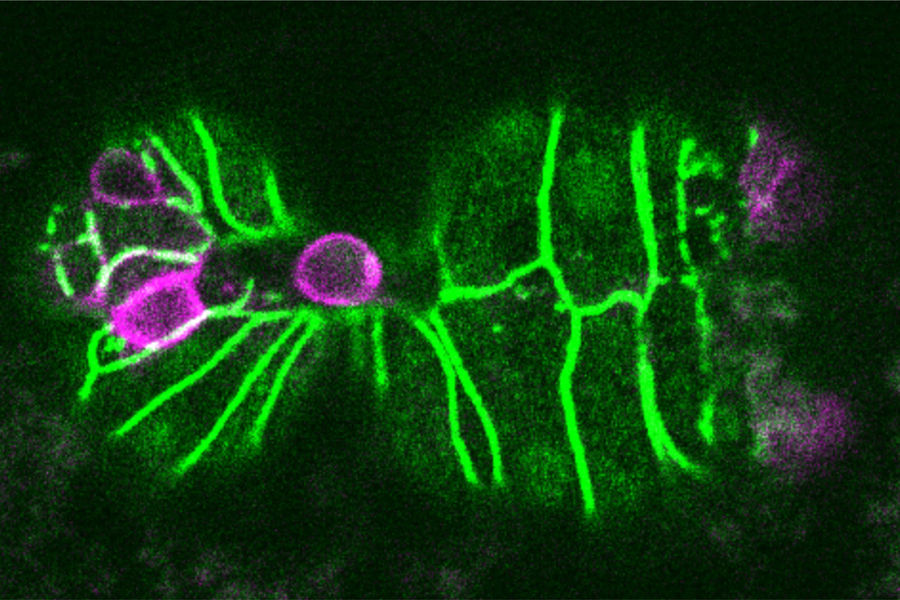
A New Method For Cell Extrusion May Help Against Cancer


    In the cell cycle, there are many cells that are not needed and need to be eliminated. If they aren’t eliminated, then it can cause a lot of trouble. Scientists studied the worm species, C. elegans and found that they participate in a process called cell extrusion. Cell extrusion is basically where cells are expelled from a layer of tissue without affecting other cells around them. Organisms usually have a process called apoptosis which is programmed cell death to control any abnormalities. However the C. elegans, along with other organisms have cell extrusion as a backup. The main question however was how exactly is the backup mechanism triggered. Scientist Vivek Dwivedi studied many genes of the C. elegans and found that these genes get active once the cells get ‘stuck’ in the replication process. Interestingly enough, despite the size of the cells, if they were then able to function properly, they didn’t undergo the process of cell extrusion. Scientists wanted to see if this process could be applied to mammals. They intentionally put kidney cells under DNA replication stress and found that this quadrupled the rate of extrusion. They also found that a cancer suppresor, P53, was also found in iniating extrusion. Scientists ultimately came to a conclusion that extrusion was a much simpler process and may have been the predecessor to apoptosis which evolved at a later time. 

This article is very insightful because cancer is very serious and any new research can be used for treatments against it. This article takes a very integral part of an organism’s body, cell replication, and gives insight on how a certain mechanism can be used to control unwanted cells. Cancer arises due to a failure of apoptosis and uncontrollable cell division. If cell extrusion can be used as a backup when apoptosis fails then this can go a long way in preventing unwanted cell growth. All in all, this study is one of the many starting points in finding ways to combat unwanted cell growth and possibly find a cure for cancer. 


Links:  https://news.mit.edu/2021/cell-extrusion-dna-cancer-0505


           https://www.nature.com/articles/s41586-021-03526-y


Thursday, November 23, 2023

Hardened Arteries Are Also Found in Mummies.


In the journal, “Global Heart”, researchers analyzed mummies all over the world and were shocked to find that they showed signs of atherosclerosis, which is the hardening of arteries. Almost 38% of the mummies showed this affliction. Scientists are not entirely sure what caused this. One possibility is the unhealthy diets of these people who were preserved. In addition, these were probably the elite meaning they did not get as much exercise, leading to greater strain on the heart. Scientists also bring up the fact that the main reason for atherosclerosis was their genetics. One mummy in particular had genetic variations that drastically increased their chance of acquiring heart disease. However scientists do not fully blame genetics for this. They also took into consideration other environmental factors such as inhaling smoke from fires. In addition, stress was also one of the problems that individuals back then faced. Life was not as easy, and the constant stress paired with other factors could’ve been the cause of heart disease. 


This is a very insightful article as people might not know that mummies can actually be very helpful when it comes to genetics and learning about evolution. Many people assume that mummies are just meant to be observed, however analyzing them provides a lot of insight on how life was thousands of years ago. In this case, heart disease is extremely widespread these days. Learning more about how people had it in the past might help researchers and healthcare providers in today’s world, fight the problem. 


Links: https://www.sciencenews.org/article/mummies-reveal-hardened-arteries.


           https://globalheartjournal.com/articles/10.1016/j.gheart.2014.04.002


Monday, November 20, 2023

A Rare Mutation which Helps Protect Against Symptoms of Alzhehimer’s Disease

 An illustration of tau proteins, in orange, with blue and purple proteins floating around.

A Colombian man showed a rare condition, where he was not showing symptoms for Alzheimer’s Disease despite having inherited it. This is the second time scientists have ever seen this mutation with one more Columbian woman carrying it. In many cases, people start showing signs of Alzheimer’s in their forties. However these two individuals with the mutation, are in their seventies, showing no major signs. Scientists believe that this mutation occurs in the PSEN1 gene which is a gene for cutting proteins into peptides. The main cause of the symptoms related to Alzheimer’s disease is Amyloid Plaques and tau tangles. In the case of the women, it was found that there were low levels of tau tangles which are clusters of proteins. However in the man, there were high levels of tau tangles. This showed scientists that in many cases, the protective gene can either be ubiquitous or it can also be only concerned in one area. However the mutation can cause the gene to help reduce tau tangles in some way and this causes the symptoms of Alzheimer’s Disease to be reduced. 


This is very interesting as only two people in the world have exhibited this mutation. This shows that this is something rare however not just a single case that should be dismissed. In addition, it is also a very big coincidence that the only two cases in the world are found in the same country. This is also important because currently there is no cure for Alzheimer’s Disease and this provides insight on new possible treatments related to reducing the effects of tau tangles (clusters of proteins) and ultimately the related symptoms. 


Links: https://www.sciencenews.org/article/rare-mutation-alzheimers-gene

          https://med.stanford.edu/news/all-news/2022/05/gene-mutation-alzheimers.html


Sunday, November 19, 2023

Bird Flu Resistance due to Gene Editing


One of the reasons bird flu spreads is. due to farm animals. Chickens in chicken farms are very susceptible to disease and they are the reason why it spreads. With this being said, scientists have found a way to modify their genes to make them resistant to catching the virus. They made corrections to a gene called ANP32A. This gene gives cells the instructions to make protein that the bird flu likes to rely on, to take over. ANP32A was modified so that way it will stop making the protein that the virus likes to attach to. Even though it did turn out to work, there were still some chickens that got infected, so it is not 100% effective and it requires more studies. The average avian flu is not that dangerous as it only makes birds mildly sick. But there are more strains of this virus, some of which are lethal and make it very dangerous, not just for the birds, but for people as well. Even though there are already alternatives to protect poultry from getting this virus, the cost of continuously treating the birds is a lot, and the virus tends to make changes within itself to counteract the vaccines protection border. This is why genetic editing is something researchers and scientists are working on, as this can offer a more permanent resistance against this virus. An experiment was made with two groups of chicks. One group had chicks that were not genetically modified and one group that was. Researchers got a group of unedited sentinels to go with the unedited chicks and another group of edited sentinels to go with the group of edited chicks. Each group was exposed to the virus. The unmodified chicks that got exposed to the virus contracted it but only one of the modified chicks contracted the virus. Even though the one modified chick got the virus, it didn’t pass down the virus to any other chick in the same incubator. This experiment was tested again, however, there was a change in the dose that the birds were exposed to as well as the separation. Every bird was mixed. The results were that all unmodified chicks and the sentinels got the virus. Half of the modified chicks got the virus but no modified sentinels got the virus. This proves that even though genetically modified chicks contracted the virus, there seemed to be minimal spread of the virus. In order for the birds to be fully resistant to the virus, there needs to be more than just one change to the ANP32A gene and the end result is far from complete.

Scientists modifying genes is not that old. The bird flu is something dangerous which is being dealt with so that this virus becomes resistant in these animals. If scientists are doing this, just imagine what else they might be capable of doing. Modifying genes is complicated but, with these skills, the possibilities of modifying genes to not only animals, but humans, are endless. That is why this article was very interesting to me and captivated my attention because of this incredible study.

Sources:

https://www.sciencenews.org/article/gene-editing-chicken-resistant-bird-flu

https://www.nature.com/articles/s41467-023-41476-3

Monday, November 25, 2019

Without Alzheimer’s Dementia

For decades Alzheimer’s Disease has been a horrifyingly sad disease, that until recently, could not be prevented. The discomfort a diagnosis of this disease presents in the loss of memory an individual suffers, when once they were so vibrant. It’s always been true that with age memory recall becomes more difficult, but the addition of the amyloid-beta deposits create a lonely and ignorant individual that cannot even remember the love of their life. The deposits are overproduced because of a specific mutation known as E280A for early-onset patients. One lucky individual however, has a second mutation, that saved her from having dementia at the early age. The odd thing is, her brain still showed signs of being affected by Alzheimer’s. The mutation is known as the Christchurch mutation. This mutation is found in other early-onset patients, but none of them had two copies of the mutation. It seems with recent discovery a double copy of the Christchurch mutation can inhibit the dementia effects of Alzheimer’s leaving a patient with full cognitive memory for an extended period of time. There is only one case, but one instance is enough to fund research into discovering the physiological effects of  this mutation and if it can be replicated in a new treatment to save the memory of these patients. I found this information relieving because one day I could find myself caring for someone with the disease, and if a treatment is made, I know it will have many positive effects in the advancement of medicine. I truly hope there is a link with the double mutation and this one patient is not simply lucky.


Original Link: https://www.usnews.com/news/health-news/articles/2019-11-04/a-gene-kept-one-woman-from-developing-alzheimers-could-it-help-others
Related Link: https://www.alzforum.org/news/research-news/can-apoe-mutation-halt-alzheimers-disease