Showing posts with label #synthetic biology. Show all posts

Thursday, December 11, 2025

Screwworm Returns, and What is Being Done to Fight it.

 This past summer, an article was published in the New York Times detailing the re arrival of screwworm in the United States. Screwworm, largely eradicated in the 1970s in the United States, has made a reappearance due to breaching a barrier in Panama, sparking concern from both the U.S. and Mexico. The parasite is a flesh eating maggot that feasts on the open wounds of animals. It affects mostly livestock, but can also spread to other animals including deer, rabbits, and even humans.
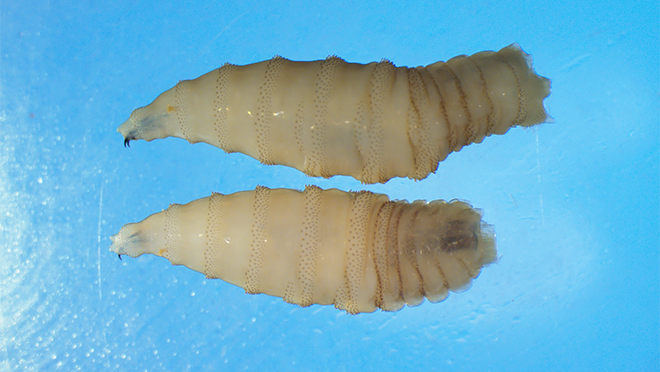
 Two individual larvae on a blue background 

The issue is, this problem had already been solved before. In the 1950s, it was discovered that scientists could create sterile male screwworm flies and release them into areas that contained massive amounts of screwworm. This would severely decrease the population as the females would mate with the sterile males, thus decimating the population. A barrier was created and maintained from 2006 onward, until 2022 where said barrier was somehow broken through, causing screwworm to start to make its way back into Central and North America. This means that these companies that were making the sterile flies will need to heavily ramp up production to drive down the population of these invaders and send them away for good. To me, this article highlights that safety and attention to detail that is needed to work in the field of science. If something like this can happen once, there is nothing stopping it from happening again. We need to ensure that  careful attention is payed to everything, so that something like this, or worse, doesn't happen again.

Neuron zapping help us understand Parkinson's

    Scientists at Johns Hopkins Medicine have taken an important step toward watching neurons communicate in real time. Using a clever “zap-and-freeze” approach, the research team was able to stop brain tissue—first in mice, then in human, at the exact moment one neuron sends a message to the next. Their findings, published in Neuron, give a rare glimpse into the split-second events at the synapse, the junction where most forms of Parkinson’s disease are thought to originate. Because synaptic disruptions drive the majority of Parkinson’s cases, being able to capture this process as it unfolds could bring researchers closer to understanding how communication starts to break down.

                       Freeze-Frame Look at Brain Activity

    To test the method, the team stimulated neurons with a tiny electrical pulse and immediately froze the tissue, preserving every structure for analysis. Remarkably, samples taken from patients undergoing epilepsy surgery showed the same rapid recycling of synaptic vesicles that appeared in mice—including the presence of Dynamin1xA, a protein that enables ultrafast membrane recovery. This parallel between species reinforces the value of mouse models for human brain research. The researchers now hope to use zap-and-freeze on tissue from individuals with Parkinson’s disease, with the goal of pinpointing exactly how these shift in affected neurons and ultimately guiding new ideas.

Thursday, November 21, 2024

Can Genetically Engineered Organisms Help Solve the World’s Water Shortage?


Scientists are now looking to synthetic biology as a potential solution to the global water crisis, and it’s a pretty cool idea. Essentially, researchers are using genetic engineering to create organisms like bacteria and algae that can help clean polluted water, remove salt from seawater, and even improve how we recycle wastewater. One of the biggest breakthroughs is creating genetically modified bacteria that can break down harmful chemicals in contaminated water, making it drinkable. They’re also working on bio-inspired technologies, where engineered organisms mimic nature’s process of desalination to make seawater drinkable without using so much energy.

This technology could be a game changer. Traditional methods of purifying and desalinating water are expensive and require a lot of energy, which isn’t great for the environment. But with genetically engineered organisms, these processes could become cheaper and more sustainable. For example, these modified microbes might be able to remove salt from seawater more efficiently, cutting down on the energy needed for desalination. Another project is focused on using synthetic biology to improve wastewater treatment, making it easier to recycle water for reuse.

However, there are some concerns. First, we don’t fully know what could happen if these genetically modified organisms are released into the environment. There could be risks that we haven’t thought of yet, like them spreading and affecting ecosystems in unintended ways. People are also hesitant about using GMOs, and it might take some time for everyone to feel comfortable with this technology. Plus, we still need to figure out the best rules for safely using these organisms in real-world settings.

But if researchers can work through these challenges, synthetic biology could become an important tool in the fight against the global water shortage, helping to provide clean water to millions of people.