Showing posts with label #parasitic. Show all posts

Thursday, December 11, 2025

Screwworm Returns, and What is Being Done to Fight it.

 This past summer, an article was published in the New York Times detailing the re arrival of screwworm in the United States. Screwworm, largely eradicated in the 1970s in the United States, has made a reappearance due to breaching a barrier in Panama, sparking concern from both the U.S. and Mexico. The parasite is a flesh eating maggot that feasts on the open wounds of animals. It affects mostly livestock, but can also spread to other animals including deer, rabbits, and even humans.
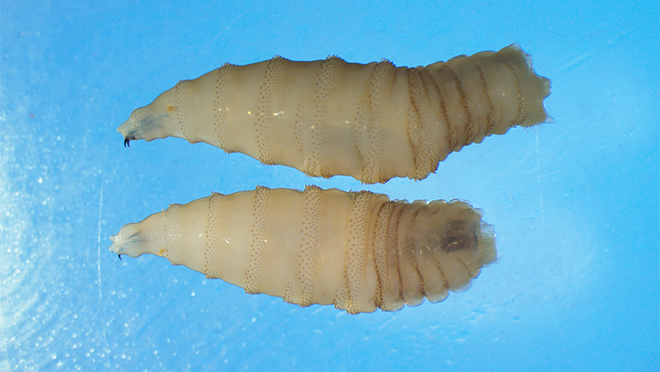
 Two individual larvae on a blue background 

The issue is, this problem had already been solved before. In the 1950s, it was discovered that scientists could create sterile male screwworm flies and release them into areas that contained massive amounts of screwworm. This would severely decrease the population as the females would mate with the sterile males, thus decimating the population. A barrier was created and maintained from 2006 onward, until 2022 where said barrier was somehow broken through, causing screwworm to start to make its way back into Central and North America. This means that these companies that were making the sterile flies will need to heavily ramp up production to drive down the population of these invaders and send them away for good. To me, this article highlights that safety and attention to detail that is needed to work in the field of science. If something like this can happen once, there is nothing stopping it from happening again. We need to ensure that  careful attention is payed to everything, so that something like this, or worse, doesn't happen again.

Thursday, March 9, 2017

Parasitic worm gene used to track down new host

Partnered with bacteria, Steinernema carpocapsae invade and kill insect hosts. While looking for a new host S. carpocapsae use a variety of techniques, such as jumping or standing on its tail while waving its head, to lure in a new host. In the study scientists used a process call RNA interference (RNAi) to look for a link between genes and the behaviors used to find a new host. RNAi reduces the expression of genes so the scientists can examine their function. The scientists used RNAi to reduce a gene that codes for a molecule known as FLP-21. Taking away the FLP-21 hindered the ability of jumping and tail standing implying that regulation of these behaviors is linked to FLP-21.
Scientists have also discovered where in the body FLP-21 can be found. chemical and imaging techniques have shown that FLP-21 is located in the neurons in the worms head. Finding what causes the behaviors of host hunting has allowed scientists to conclude that S. carpocapsae can be an excellent model organism to study parasites in mammals without actually having to use infected mammals.

I thought this was a very interesting article. I think it's great to have an organism we can use to study parasitic infections in mammals without having the infect a mammal.

https://www.sciencedaily.com/releases/2017/03/170302143954.htm

 http://journals.plos.org/plospathogens/article?id=10.1371/journal.ppat.1006185


Saturday, September 19, 2015

Naturally Occurring GMO's?


Some bugs are quite cruel to each other. A great example of this type of bug would be a parasitic wasp. Many species of parasitic wasps will lay their eggs into a living host and have the host be eaten alive by the larvae. To keep the host alive, the wasps will also inject viruses that keep the butterfly from acting erotic/harming themselves which could potentially kill the larvae. Some viruses even cause them to go and die at certain locations which would be advantageous in hiding wasp larvae until maturation.

Now why the heck would this pertain to genetics? Well, these viruses (bracoviruses) being injected by the wasps are actually causing naturally occurring genetically modified butterflies. Since the viral DNA integrates with the host cell DNA, it becomes a permanent part of their genome. When the host is not killed by the larvae, or when the wrong host is injected with the virus, the next generation of butterflies has the possibility of containing this gene, which through domestication, has been seen to be advantageous for butterflies by protecting them from other pathogenic viruses.